The Electron Configuration: Ions definitions Flashcards

The Electron Configuration: Ions definitions
Control buttons has been changed to "navigation" mode.
1/15
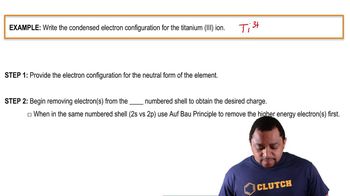
  • Cation
    A positively charged ion formed by losing electrons from orbitals with the highest principal quantum number.
  • Anion
    A negatively charged ion formed by gaining electrons, added to orbitals with available space.
  • Principal Quantum Number
    Indicates the shell number or energy level of an electron, denoted by n.
  • Electron Configuration
    The distribution of electrons in an atom's orbitals, following specific rules for cations and anions.
  • Orbital
    A region in an atom where there is a high probability of finding electrons, designated by s, p, d, or f.
  • Energy Level
    The fixed amount of energy that a system, such as an electron in an atom, can have.
  • Subshell
    A subdivision of electron shells separated by electron orbitals, labeled as s, p, d, or f.
  • Shell Number
    The principal quantum number indicating the main energy level occupied by an electron.
  • Nonmetal
    An element that typically forms anions by gaining electrons, retaining its base name with an '-ide' suffix.
  • Ion
    An atom or molecule with a net electric charge due to the loss or gain of one or more electrons.
  • Electron Removal
    The process of taking electrons from orbitals with the highest energy level in cations.
  • Electron Addition
    The process of adding electrons to orbitals with available space in anions.
  • Highest n Value
    Refers to the orbitals with the highest principal quantum number from which electrons are removed first.
  • Available Space
    Refers to orbitals that can accommodate additional electrons in anions.
  • Base Name
    The original name of a nonmetal element, modified to form an anion by adding '-ide'.