Back

The Electron Configuration: Ions quiz

Control buttons has been changed to "navigation" mode.
1/15
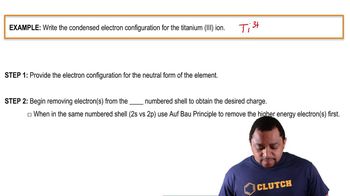
  • What is a cation?

    A cation is a positively charged ion formed when an atom loses one or more electrons.
  • From which orbitals are electrons removed first when forming a cation?

    Electrons are removed first from the orbitals with the highest principal quantum number (n value).
  • How do you determine the principal quantum number (n) from an electron configuration?

    The principal quantum number is the number before the subshell letter (s, p, d, or f) in the electron configuration.
  • If two orbitals have the same n value, which one loses electrons first when forming a cation?

    The orbital listed last (higher energy) loses electrons first; for example, 3p before 3s.
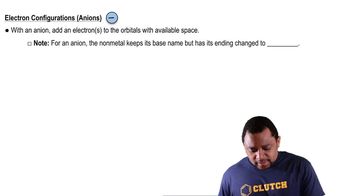
  • What is an anion?

    An anion is a negatively charged ion formed when an atom gains one or more electrons.
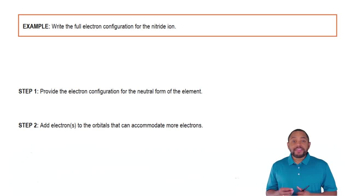
  • Where are electrons added when forming an anion?

    Electrons are added to orbitals with available space, following the order of increasing energy.
  • How is the name of an anion formed from a nonmetal element?

    The base name of the nonmetal is kept, but the ending is changed to '-ide' (e.g., oxide, fluoride, chloride).
  • What does the term 'oxide' indicate about the ion?

    'Oxide' indicates the anion form of oxygen.
  • Why are electrons removed from 3p before 3s when forming a cation?

    Because 3p is higher in energy than 3s, so electrons are removed from 3p first.
  • What is the relationship between the principal quantum number and the shell number?

    The principal quantum number (n) indicates the shell number or energy level of an electron.
  • What happens to the electron configuration when an atom becomes a cation?

    Electrons are removed from the highest energy orbitals, starting with the highest n value.
  • What happens to the electron configuration when an atom becomes an anion?

    Electrons are added to the lowest available energy orbitals with space.
  • How do you identify the highest n value in an electron configuration?

    Look for the largest number before the subshell letter in the configuration.
  • What does the suffix '-ide' in an ion's name signify?

    It signifies that the ion is the anion form of the element.
  • Why is understanding electron removal and addition important for ionic compounds?

    It helps explain how ions form and what their electron configurations are, which is crucial for understanding ionic compounds.