The Electron Configuration definitions Flashcards

The Electron Configuration definitions
Control buttons has been changed to "navigation" mode.
1/15
  • Periodic Law
    States that elements with similar properties recur at regular intervals when organized by increasing atomic weight.
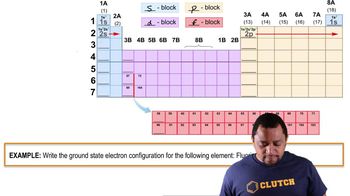
  • Electron Configuration
    Describes the distribution of electrons in an atom's orbitals, crucial for predicting chemical behavior.
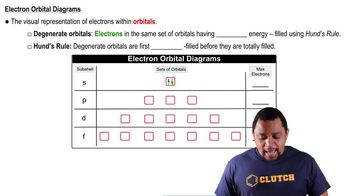
  • Orbital Diagram
    A visual representation of electron arrangements within orbitals, following specific rules like Hund's rule.
  • Hund's Rule
    States that electrons fill degenerate orbitals singly first, with parallel spins, before pairing up.
  • Aufbau Principle
    Electrons fill lower energy orbitals before occupying higher energy ones, starting from 1s.
  • Degenerate Orbitals
    Orbitals within the same subshell that have the same energy level.
  • S Sublevel
    Contains 1 orbital and can hold a maximum of 2 electrons.
  • P Sublevel
    Contains 3 orbitals and can hold a maximum of 6 electrons.
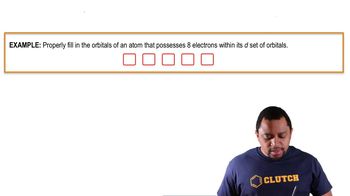
  • D Sublevel
    Contains 5 orbitals and can hold a maximum of 10 electrons.
  • F Sublevel
    Contains 7 orbitals and can hold a maximum of 14 electrons.
  • S Block
    Part of the periodic table where elements have their outermost electrons in the s sublevel.
  • P Block
    Part of the periodic table where elements have their outermost electrons in the p sublevel.
  • D Block
    Part of the periodic table where elements have their outermost electrons in the d sublevel.
  • F Block
    Part of the periodic table where elements have their outermost electrons in the f sublevel.
  • Atomic Structure
    The arrangement of electrons around the nucleus of an atom, influencing its chemical properties.