What is the molar mass of an unknown gas with a density of 2.00 g/L at 1.00 atm and 25.0°C?
First, convert 25.0°C to Kelvin: T = 25.0 + 273.15 = 298.15 K. Use the formula M = (dRT)/P, where d = 2.00 g/L, R = 0.0821 L·atm/(mol·K), T = 298.15 K, and P = 1.00 atm. M = (2.00 × 0.0821 × 298.15) / 1.00 ≈ 48.9 g/mol.
What is the molar mass of a gas in g/mol with a density of 0.890 g/L at 1.00 atm and 75.0°C?
First, convert 75.0°C to Kelvin: T = 75.0 + 273.15 = 348.15 K. Use the formula M = (dRT)/P, where d = 0.890 g/L, R = 0.0821 L·atm/(mol·K), T = 348.15 K, and P = 1.00 atm. M = (0.890 × 0.0821 × 348.15) / 1.00 ≈ 25.4 g/mol.
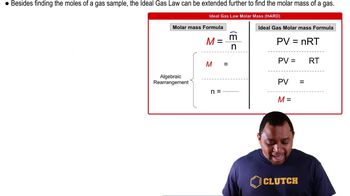
What does the capital M represent in the context of the ideal gas law and molar mass?
Capital M represents the molar mass of the gas, which is the mass per mole of the substance.
How is the amount of gas in moles (n) related to mass and molar mass?
The amount in moles (n) is equal to the mass of the gas divided by its molar mass (n = m/M).
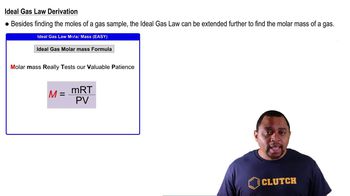
What mnemonic is suggested to help remember the molar mass formula derived from the ideal gas law?
The mnemonic is 'molar mass really tests our valuable patience,' referring to M = mRT/PV.
Why might you skip the derivation of the molar mass formula when studying the ideal gas law?
You might skip the derivation if your professor does not require you to show how the formula is derived.
What is the first algebraic step in deriving the molar mass formula from its definition?
The first step is to multiply both sides of the equation M = m/n by n, resulting in M × n = m.
In the derivation, what substitution is made for n in the ideal gas law equation?
n is substituted with m/M, so PV = (m/M)RT.
What is the final step to isolate molar mass in the derived formula from the ideal gas law?
The final step is to divide both sides by PV, resulting in M = mRT/PV.
How does the derived formula M = mRT/PV streamline the calculation of molar mass?
It allows direct calculation of molar mass from experimental gas data without step-by-step mole calculations.