Skip to main content
General Chemistry
My Course
Learn
Exam Prep
AI Tutor
Study Guides
Textbook Solutions
Flashcards
Explore
Try the app
My Course
Learn
Exam Prep
AI Tutor
Study Guides
Textbook Solutions
Flashcards
Explore
Try the app
Back
The Quadratic Formula quiz
You can tap to flip the card.
What is the standard form of a quadratic equation required to use the quadratic formula?
You can tap to flip the card.
👆
What is the standard form of a quadratic equation required to use the quadratic formula?
The standard form is ax^2 + bx + c, where a, b, and c are coefficients and x is the variable.
Track progress
Control buttons has been changed to "navigation" mode.
1/15
Related flashcards
Related practice
Recommended videos
The Quadratic Formula definitions
The Quadratic Formula
15 Terms
The Quadratic Formula quiz #1
The Quadratic Formula
10 Terms
The Quadratic Formula
5. BONUS: Mathematical Operations and Functions
10 problems
Topic
Logarithmic Functions
5. BONUS: Mathematical Operations and Functions
10 problems
Topic
5. BONUS: Mathematical Operations and Functions
5 topics
15 problems
Chapter
Guided course
07:37
Quadratic Formula Application
5260
views
5
rank
Terms in this set (15)
Hide definitions
What is the standard form of a quadratic equation required to use the quadratic formula?
The standard form is ax^2 + bx + c, where a, b, and c are coefficients and x is the variable.
What is the quadratic formula used to solve for x?
The quadratic formula is x = (-b ± √(b^2 - 4ac)) / (2a).
Why do you often get two possible values for x when using the quadratic formula?
Because of the ± sign in the formula, you calculate both a positive and a negative solution for x.
In chemical equilibrium problems, which value of x is typically used from the quadratic formula solutions?
Usually, the positive value is used, as it represents a physically meaningful concentration.
What must you do to an equation before applying the quadratic formula?
You must rearrange the equation into the standard quadratic form ax^2 + bx + c = 0.
What do the coefficients a, b, and c represent in the quadratic formula?
They are numerical values that multiply x^2, x, and the constant term, respectively.
How does the sign of the coefficients affect the outcome when using the quadratic formula?
The signs of a, b, and c must be correctly included, as they impact the calculation and the final answer.
What is the first step when you have an equation with x in the denominator before using the quadratic formula?
Multiply both sides by x to eliminate the denominator and obtain a quadratic form.
What does the 'plus or minus' (±) in the quadratic formula indicate?
It means you must calculate two possible values for x, one with addition and one with subtraction.
What is the discriminant in the quadratic formula, and how is it calculated?
The discriminant is b^2 - 4ac, found under the square root in the formula.
What happens if the discriminant (b^2 - 4ac) is negative?
If the discriminant is negative, the equation has no real solutions for x.
When solving for x using the quadratic formula, what do you do after substituting the coefficients?
You calculate the value under the square root, then solve for both possible x values using ±.
Why is only one solution from the quadratic formula typically used in chemistry equilibrium problems?
Only one solution is physically meaningful, usually the positive value, as negative concentrations are not possible.
What is an ICE chart and how does it relate to the quadratic formula in chemistry?
An ICE chart helps find equilibrium concentrations, and the quadratic formula is used to solve for x in these charts.
What should you remember about the signs when substituting b and c into the quadratic formula?
Always include the correct signs for b and c, as they affect the calculation and the final answer.
 BackBack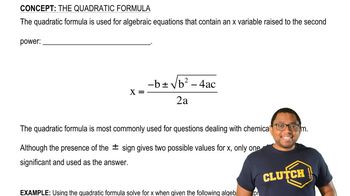
 07:37
07:37