Thermal Equilibrium definitions Flashcards

Thermal Equilibrium definitions
Control buttons has been changed to "navigation" mode.
1/12
  • Thermal Equilibrium
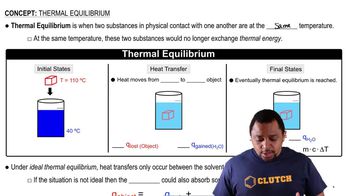
    A state where two substances in contact reach the same temperature, ceasing thermal energy exchange.
  • First Law of Thermodynamics
    A principle stating energy cannot be created or destroyed, only transferred or converted.
  • Heat Transfer
    The movement of thermal energy from a hotter object to a colder one until equilibrium is reached.
  • Calorimeter
    A device used to measure the amount of heat absorbed or released during a chemical or physical process.
  • Specific Heat Capacity
    The amount of heat required to change a substance's temperature by one degree per unit mass.
  • Mass
    A measure of the amount of matter in an object, influencing its heat capacity.
  • Temperature
    A measure of the average kinetic energy of particles in a substance, determining heat flow direction.
  • Negative Q
    Represents heat loss from a hotter object during thermal energy exchange.
  • Positive Q
    Represents heat gain by a colder object during thermal energy exchange.
  • Non-Ideal Conditions
    Scenarios where additional heat is absorbed by the calorimeter, affecting heat transfer calculations.
  • Energy Transfer
    The process of energy moving from one system or object to another, often as heat.
  • Thermal Balance
    The state achieved when all parts of a system reach the same temperature, stopping heat flow.