Thermal Equilibrium quiz #1 Flashcards

Thermal Equilibrium quiz #1
Control buttons has been changed to "navigation" mode.
1/12
  • What happens to water molecules when water is heated?
    When water is heated, its molecules gain kinetic energy, move faster, and the temperature of the water increases.
  • Which energy changes are associated with a liquid freezing?
    When a liquid freezes, it loses thermal energy to its surroundings, causing its molecules to slow down and arrange into a solid structure.
  • Which energy changes are associated with a liquid boiling?
    When a liquid boils, it absorbs thermal energy, which increases the kinetic energy of its molecules, allowing them to escape as vapor.
  • What happens to molecules when the temperature reaches absolute zero?
    At absolute zero, molecular motion theoretically stops, and the molecules have minimum possible energy.
  • Water can be heated above its boiling point without boiling. What is this process called?
    This process is called superheating.
  • Ice is placed in hot water. What happens to the temperature of the ice and the water?
    The ice absorbs heat and its temperature increases, while the water loses heat and its temperature decreases until thermal equilibrium is reached.
  • What occurs at thermal equilibrium?
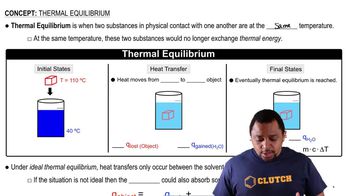
    At thermal equilibrium, two substances in contact reach the same temperature and no longer exchange thermal energy.
  • What does the zeroth law of thermodynamics allow us to define?
    The zeroth law of thermodynamics allows us to define temperature as a measurable property that determines thermal equilibrium between systems.
  • What happens to water molecules when heat is removed?
    When heat is removed from water, its molecules lose kinetic energy and move more slowly, causing the temperature to decrease.
  • Why is it important that the thermometer not touch the sides or bottom of the test tube when measuring temperature?
    It is important because the sides or bottom may be at a different temperature than the liquid, leading to inaccurate readings.
  • Which indicates that thermal energy is no longer being transferred from boiling water to a mug?
    Thermal energy is no longer being transferred when the water and the mug reach the same temperature, indicating thermal equilibrium.
  • Why is it important that the surface of a hot plate is larger than the vessel being heated?
    A larger hot plate surface ensures even heating and better thermal contact, promoting uniform temperature distribution in the vessel.