Using Hess's Law To Determine K definitions Flashcards
Using Hess's Law To Determine K definitions
You can tap to flip the card.
Control buttons has been changed to "navigation" mode.
1/15
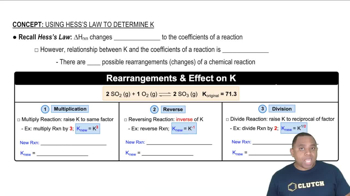
Hess's LawA principle stating that the total enthalpy change of a reaction is the same, regardless of the steps taken.EnthalpyA measure of the total energy of a thermodynamic system, often associated with heat changes in chemical reactions.Delta HSymbol representing the change in enthalpy during a chemical reaction.Equilibrium Constant (K)A value that expresses the ratio of products to reactants at equilibrium for a reversible reaction.Sulfur DioxideA chemical compound with the formula SO2, often involved in reactions forming sulfur trioxide.Sulfur TrioxideA chemical compound with the formula SO3, formed from sulfur dioxide and oxygen.Exponential RelationshipA type of relationship where a change in one quantity results in a proportional change in another quantity's exponent.InverseA mathematical operation that reverses the effect of another operation, such as flipping a fraction.ReciprocalThe inverse of a number; for a fraction, it is obtained by swapping the numerator and denominator.Square RootA value that, when multiplied by itself, gives the original number, often used in calculating changes in K.CoefficientA numerical or constant quantity placed before and multiplying the variable in a chemical equation.Balanced Chemical EquationAn equation where the number of atoms for each element is equal on both sides of the reaction.MoleA unit of measurement for amount of substance, representing Avogadro's number of particles.Reaction DirectionThe orientation of a chemical reaction, indicating which substances are reactants and which are products.Oxygen GasA diatomic molecule with the formula O2, essential for combustion and respiration processes.