Back

Wavelength and Frequency quiz

Control buttons has been changed to "navigation" mode.
1/15
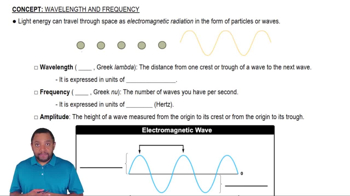
  • What are the two ways light energy can travel through space?

    Light energy can travel as electromagnetic radiation in the form of either particles or waves.
  • What Greek letter is used to represent wavelength?

    Wavelength is represented by the Greek letter lambda (λ).
  • How is wavelength defined in terms of a wave?

    Wavelength is the distance from one crest or trough of a wave to the next crest or trough.
  • What units are used to express wavelength?

    Wavelength is expressed in units of meters (m).
  • What Greek letter is used to symbolize frequency?

    Frequency is symbolized by the Greek letter nu (ν).
  • How is frequency defined for a wave?

    Frequency is the number of waves passing a point per second.
  • What units are used to express frequency?

    Frequency is expressed in hertz (Hz) or seconds inverse (s⁻¹).
  • What is amplitude in the context of a wave?

    Amplitude is the height of a wave measured from the origin to its crest or trough.
  • Where is the origin located in a wave diagram?

    The origin is located at the midpoint of the wave, cutting through the wave in the middle.
  • How do you measure amplitude on a wave diagram?

    Amplitude is measured from the origin up to the crest or down to the trough.
  • What three properties are fundamental to understanding electromagnetic waves?

    Wavelength, frequency, and amplitude are fundamental properties of electromagnetic waves.
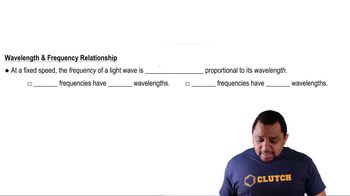
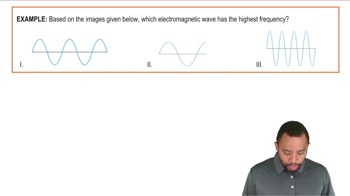
  • What is the relationship between frequency and wavelength at a fixed speed?

    Frequency and wavelength are inversely proportional at a fixed speed.
  • What happens to wavelength as frequency increases?

    As frequency increases, wavelength decreases.
  • What happens to wavelength as frequency decreases?

    As frequency decreases, wavelength increases.
  • Why is the inverse relationship between frequency and wavelength important?

    This relationship is crucial for understanding the behavior of light as electromagnetic radiation.