Weak Titrate-Strong Titrant Curves definitions Flashcards

Weak Titrate-Strong Titrant Curves definitions
Control buttons has been changed to "navigation" mode.
1/15
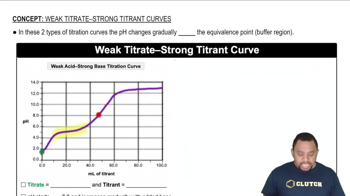
  • Buffer Region
    A section in a titration curve where pH changes gradually due to the presence of a buffer system.
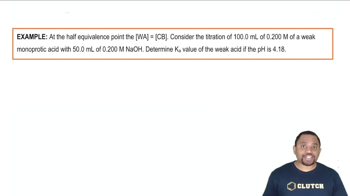
  • Half-Equivalence Point
    The midpoint in the buffer region where the concentration of weak acid equals its conjugate base.
  • Equivalence Point
    The point in a titration curve with the steepest pH change, indicating equal moles of titrant and titrate.
  • Weak Acid
    A substance that partially dissociates in solution, resulting in a pH less than 7 when titrated with a strong base.
  • Strong Base
    A substance that fully dissociates in solution, raising the pH above 7 when titrating a weak acid.
  • Weak Base
    A substance that partially dissociates in solution, resulting in a pH greater than 7 when titrated with a strong acid.
  • Strong Acid
    A substance that fully dissociates in solution, lowering the pH below 7 when titrating a weak base.
  • Titrant
    A solution of known concentration added to another solution to determine its concentration.
  • Titrate
    A solution whose concentration is determined by titration with a titrant.
  • pH Plateau
    The stage in a titration curve where pH levels off after the equivalence point due to excess titrant.
  • Conjugate Base
    The species formed when a weak acid donates a proton during a titration.
  • pH
    A measure of the acidity or basicity of a solution, crucial in determining titration curve characteristics.
  • Steepest Incline
    The part of the titration curve where pH changes most rapidly, indicating the equivalence point.
  • Neutralization
    The reaction between an acid and a base to form water and a salt, key in reaching the equivalence point.
  • Excess Titrant
    The additional titrant present after the equivalence point, causing further pH changes.