Skip to main content
General Chemistry
My Course
Learn
Exam Prep
AI Tutor
Study Guides
Textbook Solutions
Flashcards
Explore
Try the app
My Course
Learn
Exam Prep
AI Tutor
Study Guides
Textbook Solutions
Flashcards
Explore
Try the app
Back
ch-4
You can tap to flip the card.
How is the periodic table organized?
You can tap to flip the card.
👆
How is the periodic table organized?
By increasing
atomic number
, arranged in
groups
(columns) and
periods
(rows).
Track progress
Control buttons has been changed to "navigation" mode.
1/20
Recommended videos
Guided course
01:12
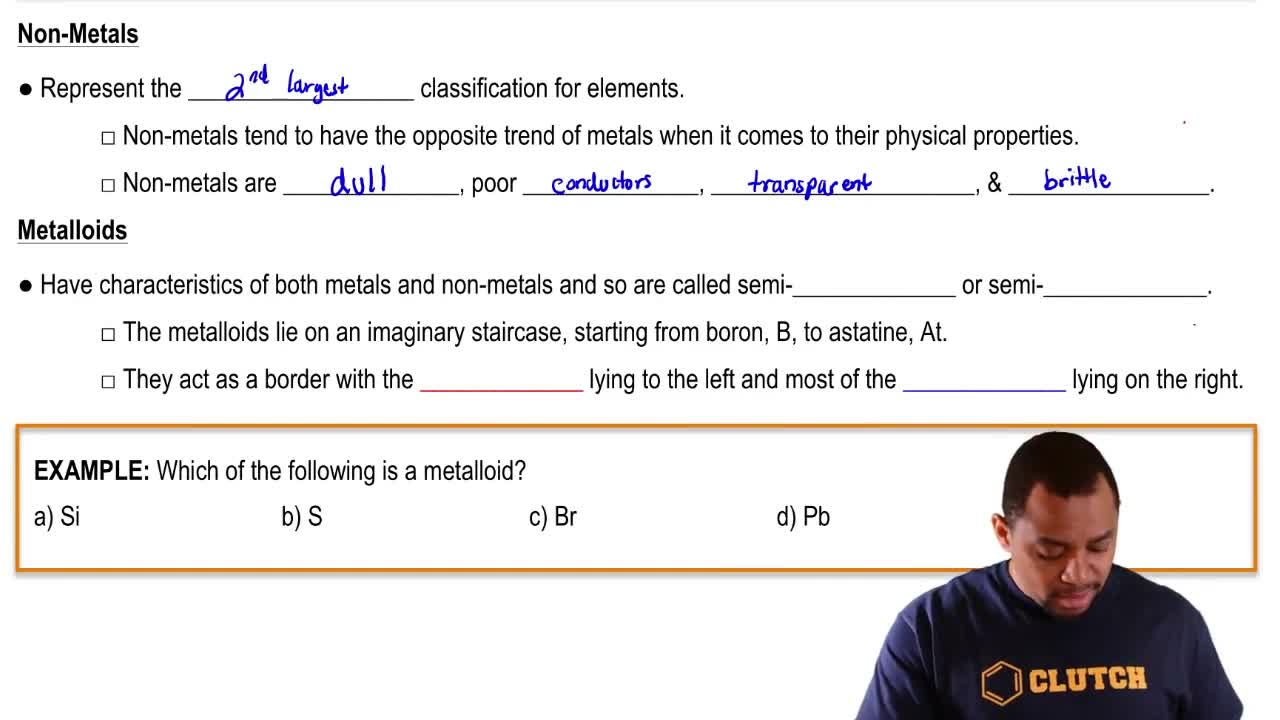
Nonmetal Properties
11286
views
108
rank
Guided course
02:40
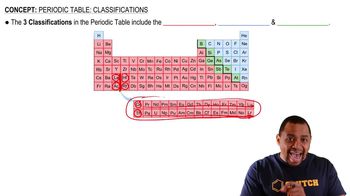
Periodic Table Classifications
15081
views
226
rank
1
comments
Guided course
03:37
Metalloid Properties
10371
views
190
rank
Terms in this set (20)
Hide definitions
How is the periodic table organized?
By increasing
atomic number
, arranged in
groups
(columns) and
periods
(rows).
What defines a group in the periodic table?
A
vertical column
of elements with similar chemical properties and the same number of valence electrons.
What defines a period in the periodic table?
A
horizontal row
of elements where properties change progressively across the row.
What is the trend in reactivity for alkali metals down the group?
Reactivity
increases
down the group due to easier loss of the outer electron.
What is the general trend in metallic character across a period?
Metallic character
decreases
from left to right across a period.
What are the key properties of alkali metals?
Highly reactive, soft metals with one valence electron, found in group 1.
What are halogens and their general properties?
Group 17 elements, highly reactive nonmetals, typically form salts with metals.
What characterizes noble gases?
Group 18 elements, inert gases with full valence shells, very low reactivity.
What are transition metals?
Elements in groups 3-12, characterized by d-electrons, variable oxidation states, and often colored compounds.
How does atomic number relate to element properties?
Atomic number determines the number of protons and electrons, influencing chemical behavior.
What is the trend in atomic radius across a period?
Atomic radius
decreases
from left to right due to increasing nuclear charge pulling electrons closer.
What is the trend in atomic radius down a group?
Atomic radius
increases
down a group because of added electron shells.
How does electronegativity change across a period?
Electronegativity
increases
from left to right across a period.
How does electronegativity change down a group?
Electronegativity
decreases
down a group.
What is metallic character?
The tendency of an element to lose electrons and form positive ions; higher in metals.
Why are noble gases inert?
They have
full valence electron shells
, making them stable and unreactive.
What is the significance of groups in predicting element behavior?
Elements in the same group have similar valence electron configurations, leading to similar chemical properties.
What is the general trend in ionization energy across a period?
Ionization energy
increases
from left to right due to stronger nuclear attraction.
What is the general trend in ionization energy down a group?
Ionization energy
decreases
down a group because outer electrons are farther from the nucleus.
How do transition metals differ from main group elements?
Transition metals have partially filled d orbitals, variable oxidation states, and often form colored ions.
 BackBack
 01:12
01:12