 Back
BackChemical Equilibrium - General Chemistry
 01:18
01:18
Terms in this set (21)
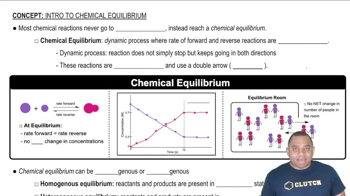
Chemical equilibrium is the state where the forward and reverse reactions occur at the same rate, so concentrations of reactants and products remain constant over time.
Dynamic equilibrium means that reactions continue to occur in both directions simultaneously, but there is no net change in concentrations.
K = \(\frac{[C]^c[D]^d}{[A]^a[B]^b}\), where concentrations are at equilibrium and raised to their stoichiometric coefficients.
The reaction is product-favored at equilibrium, meaning products predominate.
The reaction is reactant-favored at equilibrium, meaning reactants predominate.
The new equilibrium constant is the original constant raised to the power n: K' = Kn.
The equilibrium constant for the reverse reaction is the reciprocal of the forward reaction constant: Krev = 1 / Kfwd.
Multiply the equilibrium constants of the individual reactions to get the overall constant.
Kp = Kc(RT)\(\Delta n\), where \(\Delta n\) is the change in moles of gas (products - reactants).
Pure solids and liquids are assigned an activity of 1 and do not appear in the equilibrium expression.
An ICE table helps track Initial, Change, and Equilibrium concentrations or pressures to calculate equilibrium constants or concentrations.
Q is the ratio of product to reactant concentrations at any point, not necessarily at equilibrium, used to predict reaction direction.
- If Q < K, reaction proceeds forward (forms products).
- If Q = K, system is at equilibrium.
- If Q > K, reaction proceeds backward (forms reactants).
When a system at equilibrium is disturbed, it shifts to counteract the disturbance and restore equilibrium.
Adding reactant shifts the equilibrium to the right, producing more products.
Increasing volume decreases pressure, shifting equilibrium toward the side with more gas molecules.
Decreasing temperature shifts equilibrium to the right (toward products) for exothermic reactions.
Increasing temperature shifts equilibrium to the right (toward products) for endothermic reactions.
The change in reactant concentration is negligible, so initial concentration ≈ equilibrium concentration.
If the change x is less than 5% of the initial concentration, the approximation ignoring x is valid.
Set initial concentrations, express changes with variable x using stoichiometry, write equilibrium expressions, and solve for x using the equilibrium constant.