 Back
BackGeneral Chemistry: Acids and Bases

 02:29
02:29
Terms in this set (35)
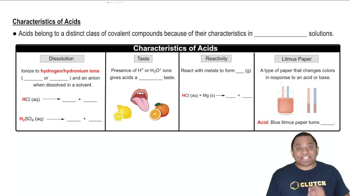
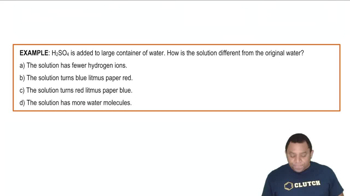
Sour taste, ability to dissolve many metals, neutralize bases, and change blue litmus paper to red.
Examples: Hydrochloric acid (stomach acid), Sulfuric acid (batteries), Nitric acid (fertilizers), Acetic acid (vinegar), Citric acid (citrus fruits), Carbonic acid (carbonated drinks).
Acids with H+ attached to a nonmetal atom, e.g., HCl, HF.
Acids with H+ attached to oxygen, e.g., H2SO4, HNO3.
Contain the COOH group; only the H on COOH is acidic, e.g., acetic acid (HC2H3O2).
Bitter taste, often poisonous, slippery feel, neutralize acids, turn red litmus paper blue.
Examples: NaOH (soap making), KOH (batteries), NH3 (fertilizers), NaHCO3 (baking soda).
Substance that produces \(\mathrm{H^+}\) ions in aqueous solution.
Substance that produces \(\mathrm{OH^-}\) ions in aqueous solution.
Acid: proton donor; Base: proton acceptor; includes proton transfer reactions beyond aqueous solutions.
Can act as either acid or base, e.g., water (H2O).
Two substances related by the transfer of a proton; acid becomes base and base becomes acid in reverse reaction.
Completely ionize in water; examples include HCl, HNO3, H2SO4; strong electrolytes.
Partially ionize in water; less than 1% ionization; common examples are carboxylic acids like acetic acid.
Equilibrium constant for acid ionization; larger Ka means stronger acid.
Water acts as both acid and base, producing \(\mathrm{H_3O^+}\) and \(\mathrm{OH^-}\) ions.
At 25°C, \(K_w = [H_3O^+][OH^-] = 1.00 \times 10^{-14}\).
pH = -log[\(\mathrm{H_3O^+}\)]; pH < 7 acidic, pH = 7 neutral, pH > 7 basic.
pH + pOH = 14 at 25°C; pOH = -log[\(\mathrm{OH^-}\)].
pKa = -log Ka; smaller pKa means stronger acid. pKb = -log Kb; smaller pKb means stronger base.
Completely dissociate in water; examples include NaOH, KOH, Ba(OH)2.
Partially ionize in water; example is NH3; equilibrium exists between base and its ions.
Equilibrium constant for base ionization; larger Kb means stronger base.
Cations of strong bases and anions of strong acids are neutral; cations of weak bases are acidic; anions of weak acids are basic.
Anions are conjugate bases of acids; stronger acid means weaker conjugate base; e.g., F- is basic, Cl- is neutral.
Ka × Kb = Kw; knowing Ka allows calculation of Kb for conjugate base.
Cations that are conjugate acids of weak bases are acidic; small highly charged metal ions also form acidic solutions.
Salt solution pH depends on cation and anion: neutral if both from strong acid/base; acidic if cation acidic; basic if anion basic.
Acids with more than one ionizable proton; have multiple Ka values with Ka1 > Ka2 > ...
Increases with bond polarity and down a group; e.g., HF < HCl < HBr < HI.
Increases with electronegativity of central atom and number of oxygen atoms.
Lewis acid: electron pair acceptor; Lewis base: electron pair donor; broader than Brønsted-Lowry.
Electron-deficient species like H+, BF3, and metal cations with empty orbitals.
Species with lone pairs, often anions or molecules like NH3, CH3O-.
Acid rain forms from nonmetal oxides like SO2, NO2 reacting with water; damages metals, buildings, aquatic life, and soil.