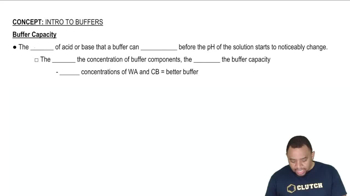
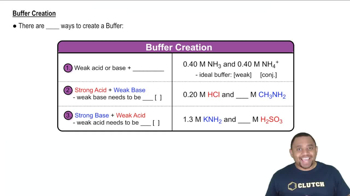
A buffer is a solution that resists pH change when acids or bases are added, typically made of a weak acid and its conjugate base or a weak base and its conjugate acid.
What components make up a typical buffer?
A buffer typically consists of (1) a weak acid and its conjugate base (salt), or (2) a weak base and its conjugate acid (salt).
How do buffers work according to Le Châtelier’s principle?
Buffers neutralize added acid or base by shifting equilibrium: weak acid molecules react with added base, and conjugate base ions react with added acid to maintain pH.
Write the equilibrium reaction for acetic acid buffer system.
CH3COOH(aq) + H2O(l) ⇌ CH3COO-(aq) + H3O+(aq)
What is the Henderson–Hasselbalch equation?
pH = pKa + log(\(\frac{[base]}{[acid]}\)), relates pH, pKa, and the ratio of conjugate base to acid concentrations in a buffer.
What is the effective pH range of a buffer?
The effective pH range of a buffer is approximately pKa ± 1, where the buffer can effectively neutralize added acid or base.
What factors affect buffer effectiveness?
Buffer effectiveness depends on (1) the relative amounts of buffer acid and base (ideally equal), and (2) the absolute concentrations of buffer acid and base.
How do you calculate pH of a buffer using an ICE table?
Set initial concentrations, apply changes (x), and equilibrium expressions to solve for [H3O+], then calculate pH = -log[H3O+].
What happens to pH when strong acid or base is added to a buffer?
Added acid reacts with conjugate base to form more acid; added base reacts with acid to form more conjugate base, causing only small pH changes.
Define titration and equivalence point.
Titration is a technique to determine concentration by adding titrant to analyte; equivalence point is when stoichiometric amount of titrant is added.
What is a titration curve?
A plot of pH versus volume of added titrant showing regions before, at, and after the equivalence point.
Describe the equivalence point pH for strong acid-strong base titrations.
The equivalence point pH is neutral (pH = 7) because the salt formed is neutral.
What is the pH at the half-equivalence point in a weak acid titration?
At half-equivalence point, pH = pKa of the weak acid.
How does the pH at equivalence point differ for weak acid-strong base titrations?
The equivalence point pH is > 7 due to the basic nature of the conjugate base formed.
What is the common ion effect on solubility?
The presence of a common ion decreases the solubility of an ionic compound by shifting equilibrium toward the solid.
How is the solubility product constant (Ksp) defined?
Ksp is the equilibrium constant for the dissolution of a sparingly soluble ionic compound, expressed as the product of ion concentrations raised to their stoichiometric coefficients.
How to calculate molar solubility from Ksp for a salt MX?
For MX ⇌ M+ + X-, Ksp = [M+][X-] = s^2, so molar solubility s = √Ksp.
What is selective precipitation?
Selective precipitation separates ions by adding a reagent that precipitates one ion with the smallest Ksp first, requiring at least a 1000-fold difference in Ksp values.
What is a complex ion and its formation constant (Kf)?
A complex ion contains a central metal cation surrounded by ligands; Kf is the equilibrium constant for its formation.
How does complex ion formation affect solubility?
Formation of complex ions increases solubility of ionic compounds by removing free metal ions from solution.
 Back
Back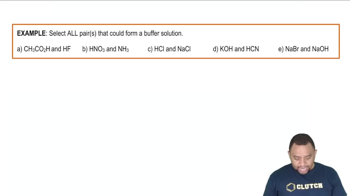
 02:41
02:41