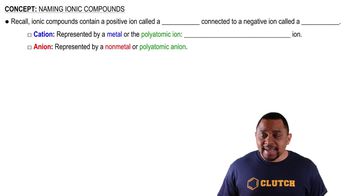
An ionic compound is formed from metal and nonmetal ions held together by ionic bonds, which involve the transfer of electrons.
What is a molecular compound?
A molecular compound consists of nonmetal atoms bonded by covalent bonds, which involve sharing electrons.
How do you predict the charge of main group elements?
Elements in Groups 1, 2, and 13-18 typically form ions with charges equal to group number minus 8 for nonmetals or equal to their group number for metals.
What is the difference between formula mass and molar mass?
Formula mass is the sum of atomic masses in a formula unit (amu), while molar mass is the mass of one mole of that substance (g/mol).
How is percent composition calculated?
Percent composition = (mass of element in compound / total formula mass) × 100%.
What is Avogadro's number and its use?
Avogadro's number is \(6.022\times10^{23}\) entities/mol, used to convert between moles and number of particles.
How do you convert mass to moles?
Divide the mass (in grams) by the molar mass (g/mol): moles = mass / molar mass.
What is an empirical formula?
The empirical formula shows the simplest whole-number ratio of atoms in a compound.
How do you determine an empirical formula from percent composition?
Convert percent to grams, then grams to moles for each element, divide by smallest mole value, and round to whole numbers.
What is a molecular formula?
The molecular formula shows the actual number of atoms of each element in a molecule, which is a whole-number multiple of the empirical formula.
What is molarity and its units?
Molarity (M) = moles of solute / liters of solution; units are mol/L.
What is the dilution equation?
M1V1 = M2V2, where M is molarity and V is volume before and after dilution.
What are strong acids?
Strong acids completely ionize in solution; common examples include HCl, HBr, HI, HNO3, H2SO4, and HClO4.
What is a limiting reactant?
The limiting reactant is the reactant that is completely consumed first, limiting the amount of product formed.
How do you calculate theoretical yield?
Use stoichiometry from the limiting reactant to calculate the maximum amount of product possible.
 Back
 01:52