Skip to main content
General Chemistry
My Course
Learn
Exam Prep
AI Tutor
Study Guides
Textbook Solutions
Flashcards
Explore
Try the app
My Course
Learn
Exam Prep
AI Tutor
Study Guides
Textbook Solutions
Flashcards
Explore
Try the app
Back
General Chemistry Practice Test 2 Key Concepts
You can tap to flip the card.
How to calculate molarity?
You can tap to flip the card.
👆
How to calculate molarity?
Molarity is calculated as
moles of solute divided by liters of solution
. Use \(M = \frac{moles}{L}\).
Track progress
Control buttons has been changed to "navigation" mode.
1/37
Recommended videos
Guided course
01:46
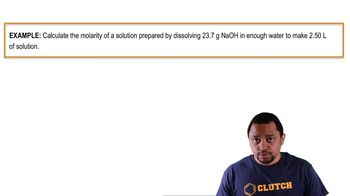
Calculate Molarity Example
12571
views
176
rank
1
comments
Guided course
01:13
Molarity
11471
views
97
rank
1
comments
Guided course
00:53
Molarity Concept
14237
views
116
rank
1
comments
Terms in this set (37)
Hide definitions
How to calculate molarity?
Molarity is calculated as
moles of solute divided by liters of solution
. Use \(M = \frac{moles}{L}\).
What is the formula to find mass needed for a solution of known molarity?
Mass = moles × molar mass. Moles = molarity × volume (in liters).
How to use dilution equation to find volume of stock solution?
Use \(M_1 V_1 = M_2 V_2\), where M and V are molarity and volume before and after dilution.
How to calculate moles of ion in solution?
Moles of ion = molarity × volume × number of ions per formula unit.
Which compounds are generally soluble?
Most ammonium, alkali metal salts, and nitrates are soluble. Exceptions include some lead, barium, and silver salts.
What indicates a precipitation reaction?
Mixing two aqueous solutions that form an insoluble solid (precipitate).
Define an Arrhenius acid.
An Arrhenius acid
produces H+ ions in aqueous solution
.
List common strong acids.
Strong acids include HCl, HNO3, HClO4, HI, and H2SO4.
How to write a complete ionic equation?
Separate all strong electrolytes into ions, showing their physical states, and include precipitates as solids.
What are spectator ions?
Ions that do not participate in the formation of a precipitate and remain unchanged in solution.
What is the net ionic equation for acid-base neutralization?
The net ionic equation is \(\mathrm{H}^+ (aq) + \mathrm{OH}^- (aq) \rightarrow \mathrm{H_2O} (l)\).
How to assign oxidation state to phosphorus in K3PO4?
Phosphorus has an oxidation state of +5 in K3PO4.
What is the oxidizing agent in Zn + Fe2+ → Zn2+ + Fe?
Fe2+ is the oxidizing agent because it gains electrons (is reduced).
Which element is reduced in N2H4 + P + H2O → PH3 + NH2OH?
Phosphorus (P) is reduced.
How to calculate concentration from titration data?
Use molarity and volume of titrant and volume of analyte with stoichiometry to find unknown concentration.
How to convert pressure units from psi to mmHg?
Use conversion factors: 1 atm = 14.7 psi and 1 atm = 760 mmHg.
How to find new pressure when volume changes (Boyle's Law)?
Use \(P_1 V_1 = P_2 V_2\) assuming constant temperature.
Under what conditions do real gases behave ideally?
At low pressure and high temperature, gases behave most like ideal gases.
What is Avogadro's Law?
Volume of a gas is directly proportional to the number of moles at constant temperature and pressure.
How to use combined gas law?
Use \(\frac{P_1 V_1}{T_1} = \frac{P_2 V_2}{T_2}\) to relate pressure, volume, and temperature changes.
How to calculate gas volume using ideal gas law?
Use \(PV = nRT\), where R = 0.0821 L·atm/mol·K.
How to find molar mass from gas data?
Molar mass = mass / moles; moles found from ideal gas law.
How to calculate gas density?
Density = (Pressure × Molar Mass) / (R × Temperature).
What volume does 1 mole of gas occupy at STP?
1 mole of gas occupies 22.4 L at STP.
Which gas has greatest density at STP?
Gas with highest molar mass has greatest density at STP.
What affects rate of effusion?
Lighter gases effuse faster; rate inversely proportional to square root of molar mass.
Define mean free path.
Average distance a molecule travels between collisions.
How to convert Calories to Joules?
1 Calorie = 1000 calories; 1 calorie = 4.18 Joules.
How to calculate change in internal energy (ΔE)?
ΔE = heat (q) + work (w) done on the system.
What does a negative ΔE of the system mean?
System loses energy; surroundings gain the same amount.
How to calculate heat of reaction from enthalpy and mass?
Use stoichiometry and molar mass to find moles, then multiply by ΔHrxn per mole.
How to calculate heat required to raise temperature?
Use \(q = m C_s \Delta T\), where Cs is specific heat capacity.
Characteristics of an endothermic reaction?
Positive ΔH, absorbs heat, feels cold to the touch.
Which processes are endothermic?
Sweat evaporating is endothermic; it absorbs heat.
How to calculate reaction enthalpy from standard enthalpies of formation?
ΔH°rxn = Σ nΔHf(products) – Σ nΔHf(reactants).
How to find ΔH°rxn using Hess's Law?
Combine given reactions and their ΔH values to find ΔH°rxn for target reaction.
How to calculate heat of solution per gram?
Calculate q from temperature change, then divide by mass of solute.
 BackBack
 01:46