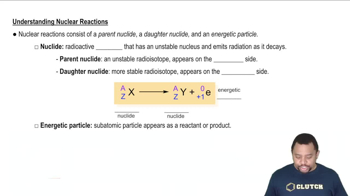
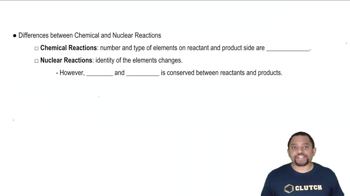
Chemical reactions involve changes in electronic structure (gain, loss, sharing of electrons) with no change in nuclei. Nuclear reactions involve changes in the nucleus, changing the element if proton number changes.
What is radioactivity?
Radioactivity is the release of tiny, high-energy particles or gamma rays from an atom's nucleus.
Types of radioactive emissions
Alpha particles, beta particles, positrons, and gamma rays are common types of radioactive emissions.
Ionizing power vs. penetrating power of radiation
Ionizing power is the ability to ionize atoms; alpha radiation has the highest ionizing power. Penetrating power is the ability to pass through matter; gamma rays have the highest penetrating power.
What is transmutation in nuclear chemistry?
Transmutation is the process where atoms of one element change into atoms of a different element during radioactive decay.
Parent nuclide vs. daughter nuclide
The parent nuclide is the original nucleus undergoing decay; the daughter nuclide is the new nucleus formed after decay.
Conservation in nuclear equations
In nuclear equations, the sum of atomic numbers and the sum of mass numbers must be equal on both sides.
Alpha decay characteristics
Alpha decay emits an alpha particle (2 protons, 2 neutrons), decreasing atomic number by 2 and mass number by 4.
Beta decay characteristics
Beta decay emits an electron, increasing atomic number by 1 while mass number remains unchanged.
Gamma emission characteristics
Gamma rays are high-energy photons with no change in atomic or mass number; they have the least ionizing but highest penetrating power.
Positron emission characteristics
Positron emission releases a positron (+1 charge), decreasing atomic number by 1 with no change in mass number.
Electron capture process
Electron capture pulls an inner orbital electron into the nucleus, converting a proton to a neutron, decreasing atomic number by 1 without changing mass number.
Half-life and radioactive decay rate
Radioactive decay follows first-order kinetics with \(t_{1/2} = \frac{0.693}{k}\). Shorter half-life means faster decay.
Definition of nuclear fission
Nuclear fission is the splitting of a large unstable nucleus into two smaller nuclei, releasing a large amount of energy.
Definition of nuclear fusion
Nuclear fusion is the joining of small nuclei to form a larger nucleus, releasing more energy per gram than fission.
Applications of radioactivity in medicine
Radioactive nuclides are used as radiotracers in PET scans and gamma rays in cancer radiotherapy.
What is a radiotracer?
A radiotracer is a radioactive nuclide attached to a compound to track its movement in the body.
How does alpha radiation interact with matter?
Alpha particles have high ionizing power but low penetrating power; they can be stopped by paper or air.
How does beta radiation interact with matter?
Beta particles have moderate ionizing power and greater penetrating power than alpha particles.
How does gamma radiation interact with matter?
Gamma rays have low ionizing power but very high penetrating power, requiring dense materials like lead for shielding.
 Back
Back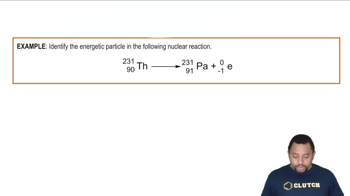
 00:45
00:45