A solution is a homogeneous mixture made of two or more components that form a uniform composition.
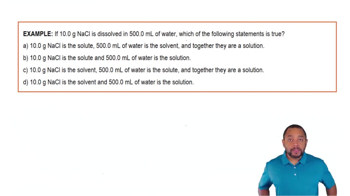
Define solute and solvent in a solution.
Solute is the component dissolved in the solvent. Solvent is the component present in the largest amount that dissolves the solute.
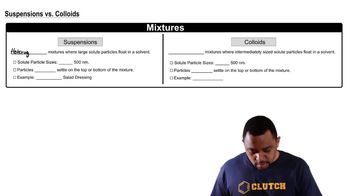
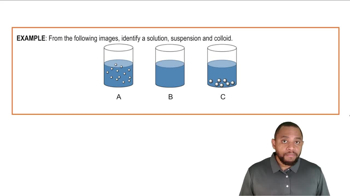
What distinguishes suspensions, colloids, and solutions by particle size?
Suspensions have particles > 1000 nm that settle out. Colloids have particles between 1 nm and 500 nm that do not settle. Solutions have particles < 1 nm and are homogeneous.
What are electrolytes?
Electrolytes are compounds that conduct electricity by dissociating into ions when dissolved or melted.
What defines a strong electrolyte?
Strong electrolytes completely dissociate into ions in solution. They include strong acids, strong bases, and soluble ionic compounds.
List common strong acids.
Strong acids include HCl, HBr, HI, HClO3, HClO4, HNO3, H2SO4, and periodic acid (HIO4).
What defines a strong base?
Strong bases are hydroxides of Group 1A and heavier Group 2A metals, such as NaOH, KOH, Ca(OH)2, and Ba(OH)2.
What are weak electrolytes?
Weak electrolytes partially dissociate into ions and include weak acids and weak bases.
What are non-electrolytes?
Non-electrolytes are molecular/covalent compounds that do not dissociate into ions, such as water, sugars, and alcohols.
What is solubility?
Solubility is the ability of a solute to dissolve in a solvent. Soluble compounds dissolve; insoluble compounds do not.
What is the GANA CASH mnemonic for soluble ionic compounds?
GANA CASH stands for Group 1A, NH4+, NO3–, Acetates, ClO3–/ClO4–, and SO42– as generally soluble ions, with some exceptions.
What is the COPS mnemonic for insoluble ionic compounds?
COPS stands for CO32–, OH–, PO43–, and S2– as generally insoluble ions, with exceptions that form soluble compounds.
What is a molecular equation?
A molecular equation shows reactants and products as intact molecules, not dissociated ions.
What is a precipitation reaction?
A precipitation reaction occurs when at least one product is an insoluble ionic compound (a precipitate).
What is a gas evolution reaction?
A gas evolution reaction produces a gas such as H2S, CO2, or SO2, often via decomposition of a median product.
What is a complete ionic equation?
A complete ionic equation shows all soluble ionic compounds dissociated into their ions.
What is a net ionic equation?
A net ionic equation shows only the ions and molecules directly involved in the chemical reaction, excluding spectator ions.
How is oxidation number defined?
Oxidation number is the hypothetical charge an atom would have if electrons were assigned to the more electronegative element.
What is the oxidation number of an atom in its natural state?
The oxidation number of an atom in its natural (elemental) state is zero.
What is the LEO the lion goes GER mnemonic?
LEO means 'Lose Electrons = Oxidation'; GER means 'Gain Electrons = Reduction'.
What is a redox reaction?
A redox reaction involves the transfer of electrons; oxidation is loss of electrons, reduction is gain of electrons.
What is the activity series?
The activity series ranks elements by their ability to displace others in single displacement reactions; higher elements displace lower ones.
How is molarity defined?
Molarity (M) is the number of moles of solute per liter of solution.
What is osmolarity?
Osmolarity is the total concentration of all ions in solution, calculated as the number of ions times the molarity of the compound.
What is dilution and its formula?
Dilution is adding solvent to decrease concentration. The formula is \(M_1V_1 = M_2V_2\).
What is solution stoichiometry?
Solution stoichiometry uses molarity and volume to calculate amounts of reactants or products in solution reactions.
 Back
 01:16