Back

General Chemistry: Solutions and Aqueous Reactions

Control buttons has been changed to "navigation" mode.
1/26
  • What is a solution?

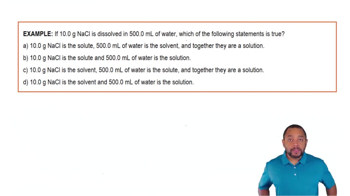
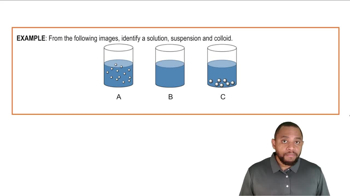
    A solution is a homogeneous mixture composed of a solvent (majority component) and one or more solutes (minority components).
  • What defines an aqueous solution?

    An aqueous solution is a solution where water is the solvent.
  • What does concentration describe in a solution?

    Concentration describes the amount of solute dissolved in a given quantity of solvent or solution.
  • What is molarity and its formula?

    Molarity (M) is moles of solute per liter of solution: \(M = \frac{\text{moles solute}}{\text{liters solution}}\).
  • How do you prepare 3.0 L of a 2.0 M solution?

    Multiply volume by molarity: 3.0 L × 2.0 M = 6.0 moles of solute needed.
  • What is the dilution equation?

    The dilution equation is \(M_1 V_1 = M_2 V_2\), where M and V are molarity and volume before and after dilution.
  • What happens during dilution of a solution?

    The amount of solute remains constant; only the volume changes by adding more solvent.
  • What determines solubility of a solute in a solvent?

    Solubility depends on the strength of interactions between solute and solvent particles.
  • What occurs when an ionic compound dissolves in water?

    Ions separate and become surrounded by water molecules in a process called hydration, allowing them to move freely.
  • Define electrolytes and nonelectrolytes.

    Electrolytes dissolve to form ions and conduct electricity; nonelectrolytes dissolve as molecules and do not conduct electricity.
  • What is the difference between strong and weak electrolytes?

    Strong electrolytes completely dissociate into ions, 100% ionization; weak electrolytes partially dissociate.

  • Give examples of strong electrolytes.

    Ionic compounds like HCl, HBr, HI, HNO3, HClO4, H2SO4

  • What are solubility rules used for?

    Solubility rules predict whether an ionic compound will dissolve in water based on ion combinations.
  • What happens in a precipitation reaction?

    Mixing two aqueous ionic solutions can form an insoluble product called a precipitate if one product is insoluble.
  • How do you predict if a precipitate will form?

    Identify ions, exchange them to form products, then use solubility rules to check if any product is insoluble.
  • What is a molecular equation?

    Shows complete, neutral formulas for all compounds in a reaction.
  • What is a complete ionic equation?

    Shows all strong electrolytes as separated ions.
  • What is a net ionic equation?

    Shows only the species that change during the reaction; spectator ions are omitted.
  • What is the net ionic equation for a strong acid-strong base neutralization?

    \(\mathrm{H^+ (aq) + OH^- (aq) \rightarrow H_2O (l)}\)
  • Define acids and bases (Arrhenius definition).

    Acids produce H+ ions in solution; bases produce OH- ions.
  • What are gas-evolution reactions?

    Reactions that produce a gas, often observed as bubbling.
  • What defines a redox reaction?

    A reaction involving transfer of electrons; oxidation is loss, reduction is gain of electrons.
  • What is an oxidizing agent?

    A substance that causes oxidation and is itself reduced.
  • What is a reducing agent?

    A substance that causes reduction and is itself oxidized.
  • What are key rules for assigning oxidation states?

    Free elements = 0; monatomic ions = charge; sum in compounds = 0; sum in polyatomic ions = ion charge.
  • What is the activity series of metals?

    A ranking of metals by their tendency to lose electrons; higher metals are more reactive and easily oxidized.