Skip to main content
General Chemistry
My Course
Learn
Exam Prep
AI Tutor
Study Guides
Textbook Solutions
Flashcards
Explore
Try the app
My Course
Learn
Exam Prep
AI Tutor
Study Guides
Textbook Solutions
Flashcards
Explore
Try the app
Back
General Chemistry: Solutions and Aqueous Reactions
You can tap to flip the card.
What is a solution?
You can tap to flip the card.
👆
What is a solution?
A
homogeneous mixture
where the composition is uniform throughout.
Track progress
Control buttons has been changed to "navigation" mode.
1/26
Recommended videos
Guided course
01:16
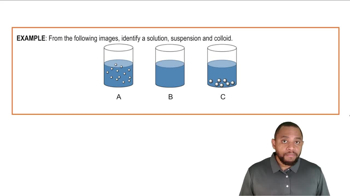
Identify Mixtures Example
10541
views
245
rank
4
comments
Guided course
02:38
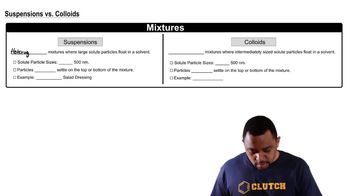
Suspensions and Colloids
12357
views
125
rank
2
comments
Guided course
1:17
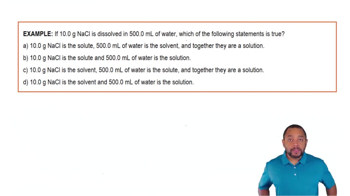
Solution Components Example
12874
views
188
rank
3
comments
Terms in this set (26)
Hide definitions
What is a solution?
A
homogeneous mixture
where the composition is uniform throughout.
Define solvent and solute.
The
solvent
is the majority component in a solution; the
solute
is the minority component.
What happens when an ionic compound dissolves in water?
The compound
dissociates
into individual ions, which are surrounded and stabilized by water molecules.
What is an electrolyte?
A substance that
dissociates into ions
in water, producing a solution that conducts electricity.
Difference between strong and weak electrolytes?
A
strong electrolyte
dissociates completely; a
weak electrolyte
dissociates partially in water.
What is a nonelectrolyte?
A substance that dissolves in water but
does not dissociate into ions
, so the solution does not conduct electricity.
What does solubility mean?
Soluble
compounds dissolve well in a solvent;
insoluble
compounds do not dissolve appreciably.
How is molarity defined?
Molarity (M)
= moles of solute divided by liters of solution.
How to calculate moles from molarity and volume?
Moles =
molarity × volume (in liters)
.
What is the dilution equation?
\(M_1V_1 = M_2V_2\), relating initial and final molarity and volume.
What is a precipitation reaction?
A reaction where two aqueous ionic solutions form an
insoluble solid (precipitate)
.
How to predict precipitation reactions?
Identify ions, exchange partners, write formulas, check solubility rules, and write products with states.
What are spectator ions?
Ions that do not participate in the reaction and appear unchanged on both sides of the ionic equation.
Difference between molecular, complete ionic, and net ionic equations?
Molecular shows compounds intact; complete ionic shows all ions; net ionic removes spectator ions.
Arrhenius definition of acids and bases?
Acids produce
H+
ions; bases produce
OH-
ions in aqueous solution.
Bronsted-Lowry definition of acids and bases?
Acids are
proton donors
; bases are
proton acceptors
.
What is a strong acid or base?
A substance that
completely ionizes
in water, acting as a strong electrolyte.
What is a weak acid or base?
A substance that
partially ionizes
in water, acting as a weak electrolyte.
What is a polyprotic acid?
An acid that can donate
more than one proton (H+)
per molecule.
What is a neutralization reaction?
An acid and base react to form
water and a salt
.
What are gas-forming reactions?
Reactions where acids react with sulfides, sulfites, or carbonates to produce gases like H2S, SO2, or CO2.
Define oxidation and reduction.
Oxidation is
loss of electrons
; reduction is
gain of electrons
.
What is the mnemonic for oxidation and reduction?
LEO the lion says GER
: Loss of Electrons is Oxidation, Gain of Electrons is Reduction.
How to assign oxidation numbers?
Use rules: elements = 0, monatomic ions = charge, O = -2 (except peroxides), H = +1 (except hydrides), halogens usually -1.
What is the sum of oxidation numbers in compounds and polyatomic ions?
Sum is zero for neutral compounds; equals the ion charge for polyatomic ions.
What is the oxidizing agent and reducing agent?
Oxidizing agent causes oxidation (is reduced); reducing agent causes reduction (is oxidized).
 BackBack
 01:16