Skip to main content
General Chemistry
My Course
Learn
Exam Prep
AI Tutor
Study Guides
Textbook Solutions
Flashcards
Explore
Try the app
My Course
Learn
Exam Prep
AI Tutor
Study Guides
Textbook Solutions
Flashcards
Explore
Try the app
Back
Intermolecular Forces in General Chemistry
You can tap to flip the card.
What are intermolecular forces?
You can tap to flip the card.
👆
What are intermolecular forces?
Intermolecular forces are the forces of attraction or repulsion between molecules, affecting physical properties like boiling and melting points.
Track progress
Control buttons has been changed to "navigation" mode.
1/20
Recommended videos
Guided course
01:59
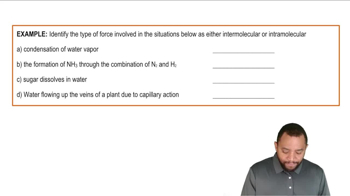
Intermolecular vs Intramolecular Forces
11519
views
271
rank
1
comments
Guided course
2:04
Intermolecular vs Intramolecular Example
6636
views
133
rank
1
comments
Guided course
01:59
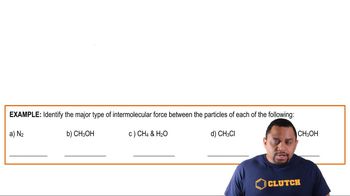
Intermolecular Forces Example
6849
views
67
rank
8
comments
Terms in this set (20)
Hide definitions
What are intermolecular forces?
Intermolecular forces are the forces of attraction or repulsion between molecules, affecting physical properties like boiling and melting points.
Name the four main types of intermolecular forces.
London dispersion forces
,
dipole-dipole interactions
,
hydrogen bonding
, and
ion-dipole forces
.
What causes London dispersion forces?
Temporary fluctuations in electron distribution create instantaneous dipoles, inducing attraction between nonpolar molecules.
Which molecules experience London dispersion forces?
All molecules experience London dispersion forces, but they are the only intermolecular force in nonpolar molecules.
What are dipole-dipole interactions?
Attractions between the positive end of one polar molecule and the negative end of another polar molecule.
How does molecular polarity affect dipole-dipole forces?
Stronger molecular polarity leads to stronger dipole-dipole interactions.
What is hydrogen bonding?
A strong dipole-dipole interaction occurring when hydrogen is bonded to N, O, or F and attracted to a lone pair on another N, O, or F.
Why is hydrogen bonding stronger than regular dipole-dipole interactions?
Because of the high electronegativity of N, O, or F and the small size of hydrogen, which allows close approach of molecules.
What are ion-dipole forces?
Attractions between an ion and the partial charges on a polar molecule.
Where are ion-dipole forces commonly found?
In solutions where ionic compounds dissolve in polar solvents like water.
How do intermolecular forces affect boiling points?
Stronger intermolecular forces require more energy to separate molecules, resulting in higher boiling points.
Compare the strength order of intermolecular forces.
Ion-dipole > hydrogen bonding > dipole-dipole > London dispersion forces.
What role do intermolecular forces play in solubility?
Like dissolves like: substances with similar intermolecular forces tend to be soluble in each other.
How do molecular size and shape affect London dispersion forces?
Larger and more surface-area molecules have stronger London dispersion forces due to increased polarizability.
What is polarizability?
The ease with which the electron cloud of a molecule can be distorted to form instantaneous dipoles.
Why do noble gases have low boiling points?
They are nonpolar atoms with only weak London dispersion forces between them.
How does hydrogen bonding affect water's properties?
Hydrogen bonding causes water's high boiling point, surface tension, and solid form being less dense than liquid.
What is the difference between intramolecular and intermolecular forces?
Intramolecular forces hold atoms together within a molecule; intermolecular forces act between molecules.
How do intermolecular forces influence vapor pressure?
Stronger intermolecular forces lower vapor pressure because fewer molecules escape into the gas phase.
What is the effect of temperature on intermolecular forces?
Increasing temperature provides energy to overcome intermolecular forces, leading to phase changes like evaporation.
 BackBack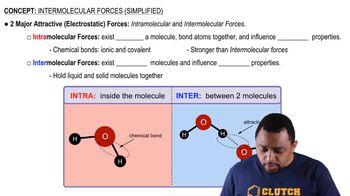
 01:59
01:59