An ionic bond is a chemical bond formed by the transfer of electrons from a metal to a nonmetal, resulting in oppositely charged ions that attract each other.
How do ionic bonds form?
Ionic bonds form when one atom loses electrons to become a cation and another atom gains electrons to become an anion, creating electrostatic attraction.
What types of elements typically form ionic bonds?
Ionic bonds usually form between metals (which lose electrons) and nonmetals (which gain electrons).
Describe the electron transfer in ionic bonding.
In ionic bonding, electrons are transferred from the metal atom to the nonmetal atom, resulting in charged ions.
What is a metallic bond?
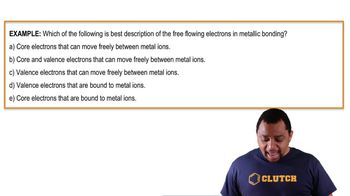
A metallic bond is the attraction between metal atoms and the delocalized sea of electrons that move freely around them.
How do metallic bonds differ from ionic bonds?
Metallic bonds involve a sea of delocalized electrons shared among metal atoms, while ionic bonds involve electron transfer and attraction between ions.
What properties result from metallic bonding?
Metallic bonding gives metals properties like conductivity, malleability, ductility, and luster.
Why are ionic compounds generally solid at room temperature?
Ionic compounds have strong electrostatic forces between ions, requiring high energy to break, so they are usually solid.
What is the role of electrostatic forces in ionic bonds?
Electrostatic forces are the attractive forces between positively and negatively charged ions that hold ionic compounds together.
Explain the concept of a 'sea of electrons' in metallic bonding.
The 'sea of electrons' refers to the delocalized electrons that move freely around metal cations, allowing conductivity and bonding.
How does electron configuration change in ionic bonding?
Atoms achieve a stable electron configuration (often a full octet) by losing or gaining electrons in ionic bonding.
What is the typical charge on metal ions in ionic compounds?
Metal ions typically have a positive charge (cations) because they lose electrons.
What is the typical charge on nonmetal ions in ionic compounds?
Nonmetal ions typically have a negative charge (anions) because they gain electrons.
Why do metals conduct electricity in the solid state?
Metals conduct electricity because their delocalized electrons can move freely through the metal lattice.
What is the difference between ionic and covalent bonds?
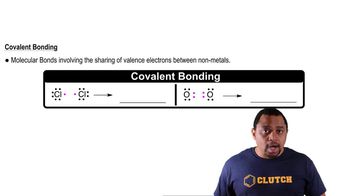
Ionic bonds involve electron transfer and attraction between ions, while covalent bonds involve electron sharing between atoms.
How does the strength of ionic bonds compare to metallic bonds?
Ionic bonds are generally stronger due to electrostatic attraction, while metallic bonds vary but allow flexibility.
What happens to the melting point of ionic compounds?
Ionic compounds have high melting points because strong ionic bonds require much energy to break.
Can ionic compounds conduct electricity?
Ionic compounds conduct electricity only when molten or dissolved because ions are free to move.
What is the lattice structure in ionic compounds?
Ionic compounds form a crystal lattice where ions are arranged in a repeating 3D pattern to maximize attraction.
Why are metals malleable and ductile?
Metals are malleable and ductile because the sea of electrons allows metal atoms to slide past each other without breaking bonds.
 Back
 01:04