Skip to main content
General Chemistry
My Course
Learn
Exam Prep
AI Tutor
Study Guides
Textbook Solutions
Flashcards
Explore
Try the app
My Course
Learn
Exam Prep
AI Tutor
Study Guides
Textbook Solutions
Flashcards
Explore
Try the app
Back
Periodic Properties of the Elements - General Chemistry
You can tap to flip the card.
Who independently developed the early periodic table based on element properties?
You can tap to flip the card.
👆
Who independently developed the early periodic table based on element properties?
Dmitri Mendeleev
and
Lothar Meyer
independently concluded how elements should be grouped.
Track progress
Control buttons has been changed to "navigation" mode.
1/29
Recommended videos
Guided course
01:12
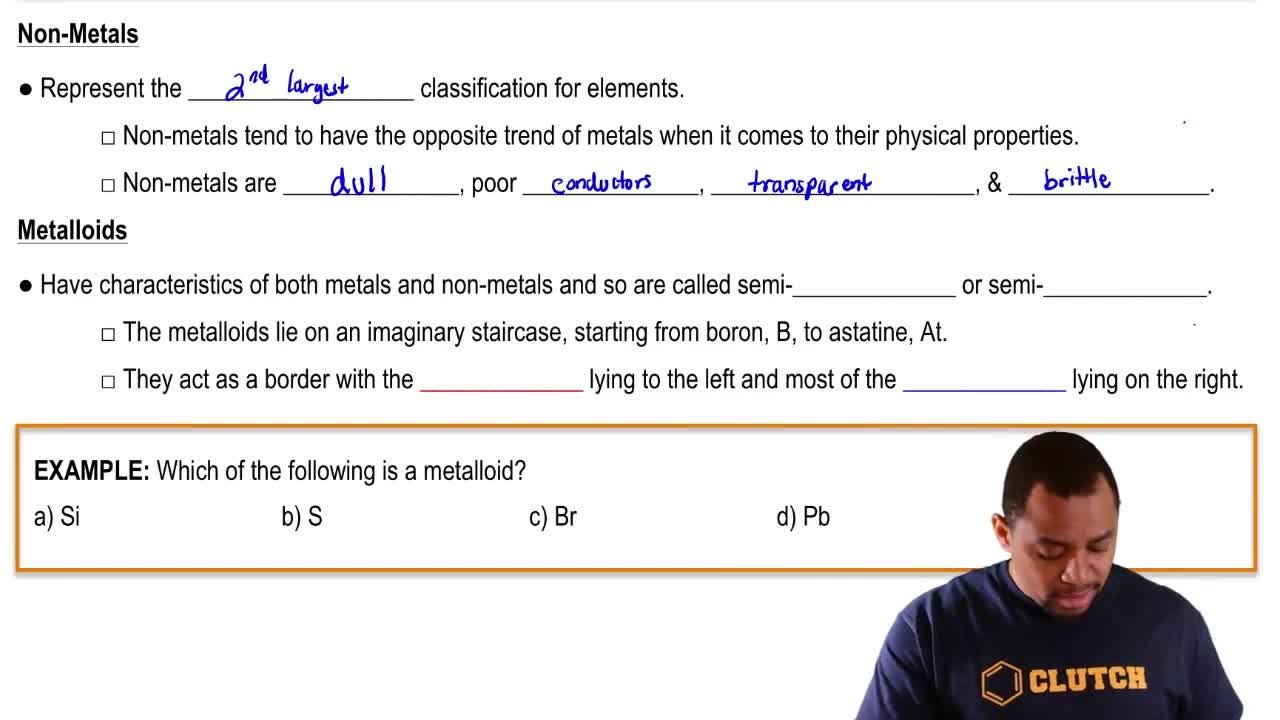
Nonmetal Properties
11319
views
108
rank
Guided course
02:40
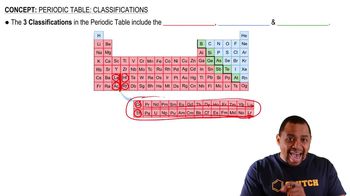
Periodic Table Classifications
15138
views
226
rank
1
comments
Guided course
03:37
Metalloid Properties
10399
views
192
rank
Terms in this set (29)
Hide definitions
Who independently developed the early periodic table based on element properties?
Dmitri Mendeleev
and
Lothar Meyer
independently concluded how elements should be grouped.
What fundamental property did Mendeleev use to organize the periodic table?
Mendeleev used
atomic masses
and chemical properties to organize the table.
What is the modern basis for the periodic property of elements?
The
atomic number
, or number of protons, is the basis for periodic properties.
Define periodicity in the context of the periodic table.
Periodicity is the
repetitive pattern
of element properties based on atomic number.
What is effective nuclear charge (\(Z_{eff}\))?
It is the net positive charge experienced by valence electrons:
Z_{eff} = Z - S
, where Z is atomic number and S is screening by inner electrons.
How does effective nuclear charge change across a period and down a group?
Increases across a period
and
increases slightly down a group
.
What is the bonding atomic radius?
Half the distance between nuclei of two bonded atoms.
How does atomic radius change across a period and down a group?
Atomic radius
decreases across a period
and
increases down a group
.
Why are cations smaller than their parent atoms?
Cations lose outer electrons, reducing electron-electron repulsions and size.
Why are anions larger than their parent atoms?
Anions gain electrons, increasing electron-electron repulsions and size.
What trend is observed in ionic size within an isoelectronic series?
Ionic size
decreases with increasing nuclear charge
for ions with the same number of electrons.
Define ionization energy.
Minimum energy required to remove an electron from a gaseous atom or ion.
How does first ionization energy generally change across a period and down a group?
First ionization energy
increases across a period
and
decreases down a group
.
What causes irregularities in ionization energy trends?
Irregularities occur when electrons enter a new sublevel or pair in an orbital, affecting electron repulsions.
From which electrons are cations formed?
Electrons are lost from the
highest energy level (largest n value)
.
What is electron affinity?
Energy change when an electron is added to a gaseous atom; usually exothermic (negative).
How does electron affinity trend across a period and down a group?
Electron affinity generally
increases across a period
and changes little down a group.
What are the general properties of metals?
Metals have
shiny luster
, conduct heat and electricity, are malleable and ductile, and form cations easily.
How do metal oxides generally behave chemically?
Metal oxides tend to be
basic
and react with acids.
What are the general properties of nonmetals?
Nonmetals can be solid, liquid, or gas; solids are dull and brittle; they have large negative electron affinities and form anions.
How do nonmetal oxides generally behave chemically?
Nonmetal oxides are mostly
acidic
.
What characterizes metalloids?
Metalloids have properties intermediate between metals and nonmetals and can be semiconductors.
What are the key properties of alkali metals?
Soft, metallic solids with low densities, low melting points, and low ionization energies; react exothermically with water.
How do alkali metals differ in their reaction with oxygen?
Li forms oxides, Na forms peroxides, and K, Rb, Cs form superoxides.
What are the key properties of alkaline earth metals?
Higher densities and melting points than alkali metals; form +2 cations; reactivity increases down the group.
What is unique about oxygen allotropes?
Oxygen exists as dioxygen (O2) and ozone (O3).
What are the general properties of halogens?
Typical nonmetals with highly negative electron affinities; exist as anions and form metal halides.
What are the general properties of noble gases?
Monatomic gases with very high ionization energies and positive electron affinities; mostly unreactive.
How does hydrogen behave chemically?
Hydrogen forms covalent acids like HCl and hydride anions (H−) when reacting with metals.
 BackBack
 01:12