 Back
BackAcid-Base Equilibria and Buffer Solutions
Study Guide - Smart Notes
 Tailored notes based on your materials, expanded with key definitions, examples, and context.
Acid-Base Equilibria
Introduction to Acid-Base Equilibria
Acid-base equilibria describe the balance between acids and bases in solution, particularly focusing on how weak acids and bases partially ionize and establish equilibrium. This topic is essential for understanding buffer solutions, titrations, and physiological pH regulation.
Buffer Solutions
Definition and Importance of Buffers
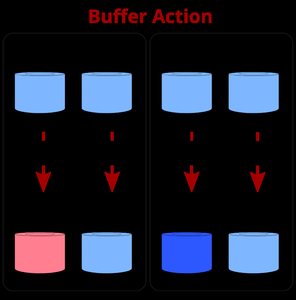
Buffer Solution: A buffer is a solution that resists changes in pH when small amounts of acid or base are added.
Composition: Buffers typically consist of a weak acid and its conjugate base, or a weak base and its conjugate acid.
Function: Buffers maintain a nearly constant pH, which is crucial in many chemical and biological systems.
Types of Buffer Solutions
Acidic Buffer: Made from a weak acid and its salt (conjugate base), e.g., ethanoic acid and sodium ethanoate. These have pH < 7.
Basic Buffer: Made from a weak base and its salt (conjugate acid), e.g., ammonia and ammonium chloride. These have pH > 7.
How Buffers Work: The Ethanoic Acid/Sodium Ethanoate System
Consider a buffer made from ethanoic acid (CH3COOH) and sodium ethanoate (CH3COONa):
Ethanoic acid partially ionizes in water:

Sodium ethanoate fully ionizes in water:

The buffer contains a large reserve of both CH3COOH and CH3COO-.
Buffer Action When Acid (H+) is Added
Added H+ ions react with CH3COO- to form CH3COOH, shifting equilibrium to the left.
The concentration of CH3COO- and CH3COOH remains nearly constant due to the large reserves.
Result: The pH remains relatively unchanged.

Buffer Action When Base (OH-) is Added
OH- reacts with H+ to form water, reducing [H+].
Equilibrium shifts right: more CH3COOH ionizes to replace H+.
Concentrations of CH3COOH and CH3COO- remain nearly constant.
Result: The pH remains relatively unchanged.
Buffer Capacity
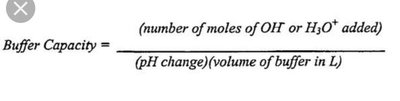
Buffer capacity is a measure of how much acid or base a buffer can absorb without a significant change in pH. It depends on the concentrations of the acid and its conjugate base.
Buffer Capacity Formula |
|---|
Biological Buffers: The Bicarbonate Buffer System in Blood
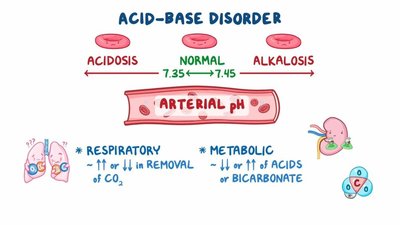
In humans, the bicarbonate buffer system maintains blood pH between 7.35 and 7.45. CO2 produced by cells dissolves in blood, forming H+ and HCO3- ions:
If [H+] increases (acidosis), equilibrium shifts left, reducing [H+].
If [H+] decreases (alkalosis), equilibrium shifts right, increasing [H+].
Buffer Solutions in Food Chemistry
Buffer capacity in food affects spoilage; higher protein content increases buffer capacity.
Food with high buffer capacity resists pH changes, slowing spoilage by microorganisms.
Calculating the pH of Buffer Solutions
Henderson-Hasselbalch Equation
The pH of a buffer solution can be calculated using the Henderson-Hasselbalch equation:
pKa: The negative logarithm of the acid dissociation constant (Ka).
[salt]: Concentration of the conjugate base.
[acid]: Concentration of the weak acid.
Example Calculation
Calculate the pH of a buffer containing 0.305 mol dm-3 ethanoic acid and 0.520 mol dm-3 sodium ethanoate. Ka = 1.74 × 10⁻⁵ mol dm-3 at 298 K.

Buffer Preparation and Titration
Buffers can be prepared by mixing a weak acid with its salt or by partial neutralization with a strong base.
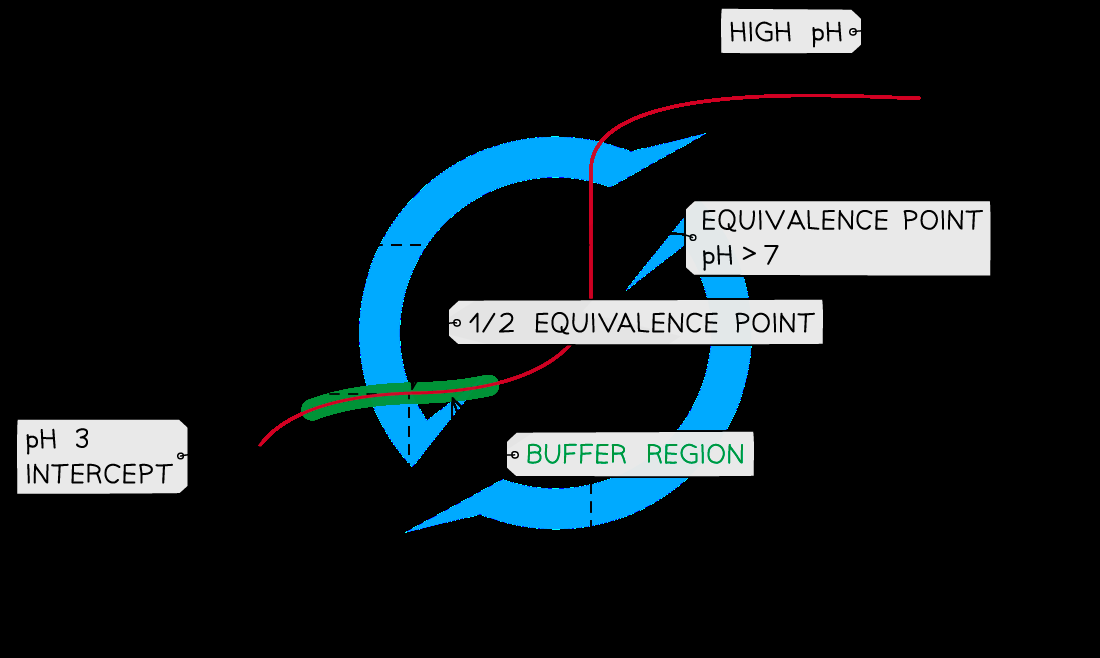
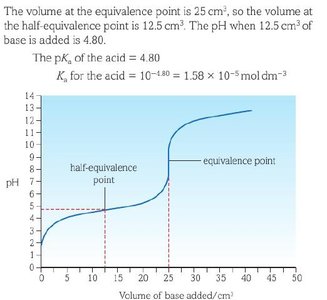
During titration, the half-equivalence point is when [acid] = [conjugate base], so pH = pKa.
Key Equations
At half-equivalence: , so
General buffer:
Practice Problems
Question |
|---|
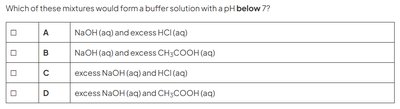
Which of these mixtures would form a buffer solution with a pH below 7? A. NaOH (aq) and excess HCl (aq) B. NaOH (aq) and excess CH3COOH (aq) C. excess NaOH (aq) and HCl (aq) D. excess NaOH (aq) and CH3COOH (aq) |
Question |
|---|
Calculate the pH of a buffer solution containing 0.305 mol dm-3 of ethanoic acid and 0.520 mol dm-3 sodium ethanoate. The Ka of ethanoic acid = 1.74 × 10⁻⁵ mol dm-3 at 298 K. |
Question |
|---|
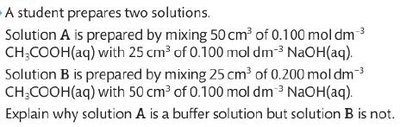
A student prepares two solutions. Solution A is prepared by mixing 50 cm3 of 0.100 mol dm-3 CH3COOH(aq) with 25 cm3 of 0.100 mol dm-3 NaOH(aq). Solution B is prepared by mixing 25 cm3 of 0.200 mol dm-3 CH3COOH(aq) with 50 cm3 of 0.100 mol dm-3 NaOH(aq). Explain why solution A is a buffer solution but solution B is not. |
Question |
|---|
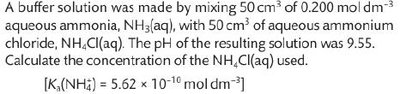
A buffer solution was made by mixing 50 cm3 of 0.200 mol dm-3 aqueous ammonia, NH3(aq), with 50 cm3 of aqueous ammonium chloride, NH4Cl(aq). The pH of the resulting solution was 9.55. Calculate the concentration of the NH4Cl(aq) used. [Kb(NH3) = 5.62 × 10⁻¹⁰ mol dm-3] |
Summary Table: Buffer Solution Properties
Type of Buffer | Components | pH Range | Example |
|---|---|---|---|
Acidic Buffer | Weak acid + salt of weak acid | < 7 | CH3COOH + CH3COONa |
Basic Buffer | Weak base + salt of weak base | > 7 | NH3 + NH4Cl |
Key Takeaways
Buffers are essential for maintaining pH stability in chemical and biological systems.
The Henderson-Hasselbalch equation is used to calculate buffer pH.
Biological buffers, such as the bicarbonate system, are vital for life.
Buffer capacity determines how much acid or base a buffer can neutralize before significant pH change occurs.
