 Back
BackAcid-Base Equilibria, Buffers, and Salt Solutions Study Guidance
Study Guide - Smart Notes
 Tailored notes based on your materials, expanded with key definitions, examples, and context.
Q5. Determine the pH of a 0.22 M NaF solution at 25°C. The Ka of HF is 3.5 × 10⁻⁵. (Notice this is a salt)
Background
Topic: Salt Solutions and Hydrolysis
This question tests your understanding of how salts derived from weak acids (like NaF from HF) affect the pH of a solution. You need to know how to calculate the pH when a salt undergoes hydrolysis in water.
Key Terms and Formulas
Hydrolysis: Reaction of an ion with water to produce H+ or OH-.
Ka: Acid dissociation constant for HF.
Kb: Base dissociation constant for F- (conjugate base of HF).
Relationship: $K_w = K_a \times K_b$ where $K_w = 1.0 \times 10^{-14}$ at 25°C.
pH calculation: $\text{pOH} = -\log[OH^-]$, $\text{pH} = 14 - \text{pOH}$
Step-by-Step Guidance
Identify the salt: NaF is the salt of a weak acid (HF) and a strong base (NaOH). F- will hydrolyze in water.
Write the hydrolysis equation: $F^- + H_2O \rightleftharpoons HF + OH^-$
Calculate $K_b$ for F- using $K_w$ and $K_a$: $K_b = \frac{K_w}{K_a}$
Set up the equilibrium expression for $[OH^-]$ using the initial concentration of F- (0.22 M).
Try solving on your own before revealing the answer!
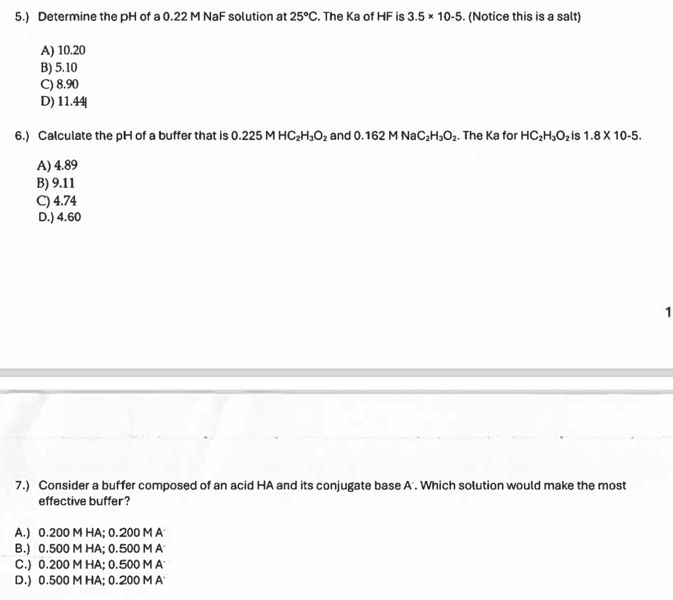
Q6. Calculate the pH of a buffer that is 0.225 M HC2H3O2 and 0.162 M NaC2H3O2. The Ka for HC2H3O2 is 1.8 × 10⁻⁵.
Background
Topic: Buffer Solutions and Henderson-Hasselbalch Equation
This question tests your ability to calculate the pH of a buffer solution using the concentrations of a weak acid and its conjugate base.
Key Terms and Formulas
Buffer: Solution containing a weak acid and its conjugate base.
Henderson-Hasselbalch Equation: $\text{pH} = \text{p}K_a + \log\left(\frac{[\text{A}^-]}{[\text{HA}]}\right)$
$\text{p}K_a = -\log K_a$
Step-by-Step Guidance
Calculate $\text{p}K_a$ from the given $K_a$ value.
Identify $[\text{HA}]$ (acid) and $[\text{A}^-]$ (conjugate base) concentrations.
Plug the values into the Henderson-Hasselbalch equation.
Set up the logarithmic expression for the ratio of base to acid.
Try solving on your own before revealing the answer!
Q7. Consider a buffer composed of an acid HA and its conjugate base A-. Which solution would make the most effective buffer?
Background
Topic: Buffer Capacity and Effectiveness
This question tests your understanding of what makes a buffer most effective. The effectiveness depends on the concentrations and the ratio of acid to base.
Key Terms and Formulas
Buffer Capacity: The amount of acid/base the buffer can neutralize.
Effective Buffer: Most effective when $[\text{HA}] \approx [\text{A}^-]$ and both concentrations are high.
Step-by-Step Guidance
Compare the ratios of acid to base in each option.
Consider the absolute concentrations: higher concentrations increase buffer capacity.
Identify which option has both a 1:1 ratio and the highest concentrations.
Try solving on your own before revealing the answer!
Final Answers
Q5: 10.20 Q6: 4.89 Q7: B) 0.500 M HA; 0.500 M A'
For Q5, the salt hydrolyzes to produce OH-, making the solution basic. For Q6, the buffer pH is calculated using the Henderson-Hasselbalch equation. For Q7, the most effective buffer has equal and high concentrations of acid and base.
