 Back
BackAcid-Base Equilibria, Buffers, and Solubility Equilibria
Study Guide - Smart Notes
 Tailored notes based on your materials, expanded with key definitions, examples, and context.
Acid-Base Equilibria & Buffer Solutions
Introduction to Buffers
Buffer solutions are essential in chemistry and biology because they resist changes in pH when small amounts of strong acid or base are added. Buffers are crucial for maintaining stable pH in living systems, laboratory research, and medical applications.
Definition: A buffer is a solution that contains a weak acid and its conjugate base, or a weak base and its conjugate acid.
Examples: Human blood (buffered at pH ~7.4), ocean water (pH ~8.1-8.3).
Composition:
Weak acid + salt of its conjugate base (e.g., HF + NaF)
Weak base + salt of its conjugate acid (e.g., NH3 + NH4Cl)
Common Ion Effect
The common ion effect occurs when a solution contains two substances that share a common ion, which suppresses the ionization of a weak acid or base. This effect is important in buffer solutions.
Example: Adding NaF to an HF solution increases the concentration of F-, shifting the equilibrium and increasing the pH.
Le Chatelier’s Principle: The addition of a common ion shifts the equilibrium to reduce the effect of the added ion.
Calculating pH of Buffer Solutions
To calculate the pH of a buffer, identify the major species in solution and use either an ICE table or the Henderson-Hasselbalch equation.
Major Species: For a buffer of HF and NaF, the major species are HF, Na+, F-, and H2O.
Henderson-Hasselbalch Equation: A shortcut for buffer solutions where :
Example: For [HF] = 1.0 M and [NaF] = 0.5 M, .
Effect of Adding Strong Acid or Base to a Buffer
When a strong acid or base is added to a buffer, the buffer reacts to minimize the pH change. The reaction goes to completion, and stoichiometry is used to determine the new concentrations before recalculating pH with the Henderson-Hasselbalch equation.
Example: Adding 2.0 mL of 1.0 M NaOH to 40 mL of buffer ([HF] = 1.0 M, [NaF] = 0.5 M) results in a small pH change (from 2.84 to 2.9), demonstrating buffer action.
Summary: Buffers Resist pH Change
Unbuffered solution: Large pH change upon addition of strong base.
Buffered solution: Minimal pH change under the same conditions.
Titrations and Buffer Capacity
Titration of Weak Acid with Strong Base
Titration involves the gradual addition of a strong base to a weak acid, monitoring pH changes throughout the process. The titration curve provides information about buffer regions, equivalence points, and pH changes.
Net Ionic Equation:
Key Points:
Before adding NaOH: Only weak acid present; use ICE table to calculate pH.
After adding some NaOH: Both acid and conjugate base present; use Henderson-Hasselbalch equation.
At half-equivalence point: .
At equivalence point: All acid converted to conjugate base; pH > 7 due to hydrolysis of the conjugate base.
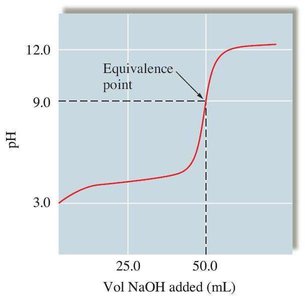
Buffer Region: The region where both weak acid (HA) and its conjugate base (A-) are present, and pH changes minimally.
Equivalence Point: The point where moles of added base equal moles of acid initially present; pH rises sharply.
Polyprotic Acid Titrations
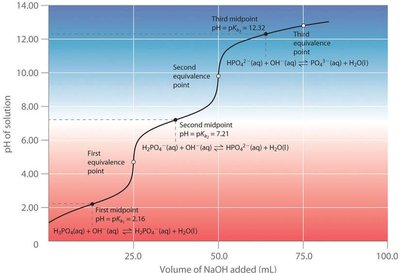
Polyprotic acids can donate more than one proton, resulting in multiple equivalence points and buffer regions during titration. Each deprotonation step has its own pKa and equivalence point.
Example: Titration of H3PO4 with NaOH shows three equivalence points and three buffer regions.
At each midpoint: for the corresponding deprotonation step.
Solubility and Complex Ion Equilibria
Solubility Product (Ksp)
The solubility product constant, Ksp, describes the equilibrium between a solid ionic compound and its ions in solution. It is used to calculate the solubility of sparingly soluble salts.
General Equation: For
Ksp Expression:
Example: for CaCO3
Table: Solubility Products at 25°C
Ionic Solid | Ksp |
|---|---|
AgCl | 1.6 × 10⁻¹⁰ |
CaCO3 | 8.7 × 10⁻⁹ |
Mg(OH)2 | 8.9 × 10⁻¹² |
Ca3(PO4)2 | 1.3 × 10⁻³² |
Common Ion Effect in Solubility
The presence of a common ion decreases the solubility of a sparingly soluble salt due to the shift in equilibrium.
Example: Solubility of Ag2SO4 in water is 0.014 mol/L, but in 0.1 M AgNO3 it decreases to 0.0012 mol/L.
pH and Solubility
The solubility of some salts depends on pH, especially if the anion is a weak base. For example, the solubility of Mg(OH)2 increases as pH decreases (more acidic), because OH- is consumed.
Example: For CaCO3, CO32- can react with water to form HCO3- and OH-, affecting solubility.
Precipitation and Qualitative Analysis
Precipitation Condition
Precipitation occurs when the product of ion concentrations (Q) exceeds the solubility product (Ksp).
If Q < Ksp: No precipitate forms.
If Q > Ksp: Precipitate forms until equilibrium is restored.
Selective Precipitation
Selective precipitation is used to separate ions in solution by adding a reagent that precipitates one ion before another, based on differences in Ksp values.
Example: In a mixture of Cu+ and Pb2+, adding I- will precipitate CuI before PbI2 due to the lower Ksp of CuI.
Practice and Review
Identifying buffer solutions and major species in solution
Applying the common ion effect in buffer and solubility problems
Calculating pH of buffer solutions and during titrations
Understanding titration curves, equivalence points, and buffer regions
Calculating solubility and predicting precipitation using Ksp and Q
Applying selective precipitation for qualitative analysis
