 Back
Acid-Base Equilibria: Concepts, Calculations, and Properties
Study Guide - Smart Notes
 Tailored notes based on your materials, expanded with key definitions, examples, and context.
Acid-Base Equilibria
Introduction to Acid-Base Equilibria
Acid-base equilibria are fundamental to understanding chemical reactivity in aqueous solutions. This topic covers the definitions of acids and bases, their equilibrium reactions, and the calculations associated with their properties.
Definitions of Acids and Bases
Arrhenius Definition: An acid increases the concentration of H+ ions in water, while a base increases the concentration of OH- ions.
Brønsted-Lowry Definition: An acid donates a proton (H+), and a base accepts a proton.
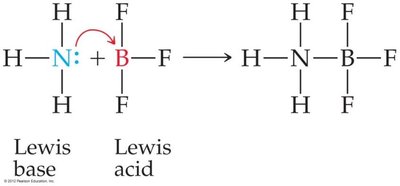
Lewis Definition: An acid is an electron pair acceptor, and a base is an electron pair donor.
Example: Ammonia (NH3) acts as a Brønsted-Lowry base by accepting a proton from water, forming NH4+ and OH-.
Autoionization of Water
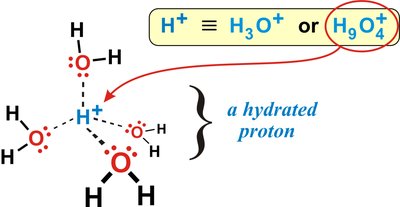
Water can self-ionize, producing hydronium (H3O+) and hydroxide (OH-) ions. This equilibrium is characterized by the ion product constant, Kw.
Equation:
Ion Product Constant: at 25°C
In pure water,
pH and pOH Calculations
The pH scale quantifies the acidity or basicity of a solution based on the concentration of hydronium ions. pOH is similarly defined for hydroxide ions.
pH Equation:
pOH Equation:
Relationship: (at 25°C)
Example: If , then , and pH = 10.
Conjugate Acid-Base Pairs
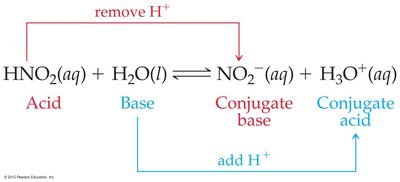
Acids and bases form conjugate pairs during equilibrium reactions. The conjugate base is formed when an acid loses a proton, and the conjugate acid is formed when a base gains a proton.
Example: HF (acid) dissociates to form F- (conjugate base).
Strong acids have very weak conjugate bases; weak acids have stronger conjugate bases.
Acid and Base Strength
The strength of an acid or base is determined by its degree of dissociation in water. Strong acids and bases dissociate completely, while weak acids and bases only partially dissociate.
Ka (Acid Dissociation Constant):
pKa:
Kb (Base Dissociation Constant):
pKb:
Example: Acetic acid (CH3COOH) has , indicating it is a weak acid.
ICE Tables for Equilibrium Calculations
ICE (Initial, Change, Equilibrium) tables are used to solve equilibrium problems for weak acids and bases. The change in concentration is represented by 'x', and equilibrium concentrations are calculated to determine pH or percent ionization.
Example: For acetic acid, set up the table and solve for x using .
Percent Ionization
Percent ionization measures the fraction of acid or base molecules that dissociate in solution.
Formula:
Higher percent ionization indicates a stronger acid.
Polyprotic Acids
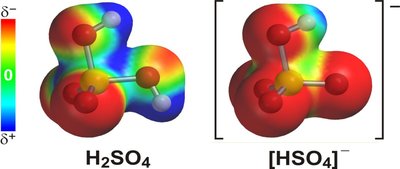
Polyprotic acids can donate more than one proton. Each dissociation step has its own value, and the first dissociation is usually the strongest.
Example: Sulfuric acid (H2SO4) has .
For most calculations, only the first dissociation is considered if .
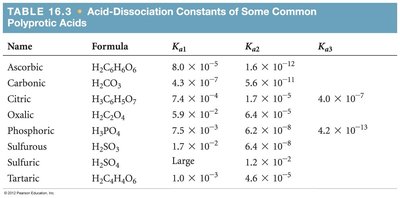
Name | Formula | Ka1 | Ka2 | Ka3 |
|---|---|---|---|---|
Ascorbic | H2C6H6O6 | 8.0 × 10⁻⁵ | 1.6 × 10⁻¹² | |
Carbonic | H2CO3 | 4.3 × 10⁻⁷ | 5.6 × 10⁻¹¹ | |
Citric | H3C6H5O7 | 7.4 × 10⁻⁴ | 1.7 × 10⁻⁵ | 4.0 × 10⁻⁷ |
Oxalic | H2C2O4 | 5.9 × 10⁻² | 6.4 × 10⁻⁵ | |
Phosphoric | H3PO4 | 7.5 × 10⁻³ | 6.2 × 10⁻⁸ | 4.2 × 10⁻¹³ |
Sulfurous | H2SO3 | 1.7 × 10⁻² | 6.4 × 10⁻⁷ | |
Sulfuric | H2SO4 | Large | ||
Tartaric | H2C4H4O6 | 1.0 × 10⁻³ | 4.6 × 10⁻⁵ |

Effect of Structure on Acid/Base Behavior
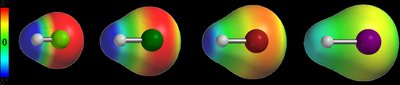
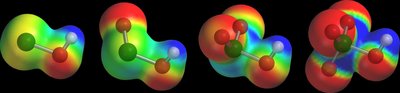
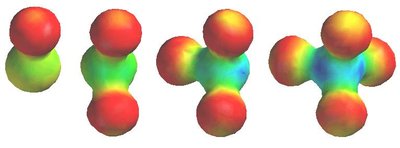
The strength of acids and bases is influenced by molecular structure, including bond polarity, bond strength, and the stability of the conjugate base.
For hydrohalic acids, HF is weaker than HCl, HBr, and HI due to the strong H–F bond and the high charge density of F-.
For oxyacids, more oxygen atoms and a more electronegative central atom increase acid strength.
Lewis Acids and Bases
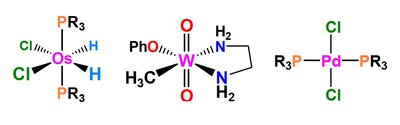
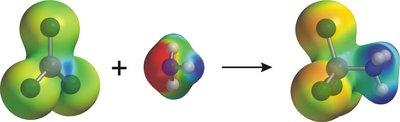
Lewis acids and bases expand the definition to include electron pair transfer. Many metal ions and compounds like BF3 act as Lewis acids, accepting electron pairs from Lewis bases.
Example: NH3 donates an electron pair to BF3, forming NH3–BF3.
Relationship Between Ka and Kb
Ka and Kb for conjugate acid-base pairs are related through the ion product constant of water, Kw.
Equation:
pKw:

Acid-Base Properties of Salt Solutions
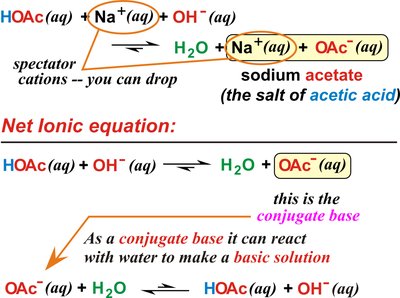
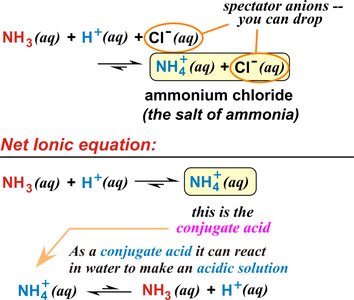
Salts formed from acids and bases can be acidic, basic, or neutral depending on the nature of their constituent ions.
Salts of strong acids and strong bases are neutral (e.g., NaCl).
Salts of weak acids and strong bases are basic (e.g., NaCH3COO).
Salts of strong acids and weak bases are acidic (e.g., NH4Cl).
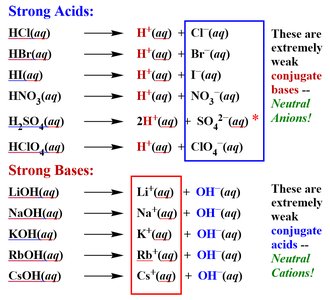
Summary Table: Strong Acids and Bases
Strong Acids | Conjugate Base |
|---|---|
HCl | Cl- |
HBr | Br- |
HI | I- |
HNO3 | NO3- |
H2SO4 | SO42- |
HClO4 | ClO4- |
Strong Bases | Conjugate Acid |
|---|---|
LiOH | Li+ |
NaOH | Na+ |
KOH | K+ |
RbOH | Rb+ |
CsOH | Cs+ |
Key Concepts and Calculations
Definitions of Brønsted-Lowry acids and bases
Identification of strong acids and bases
Writing dissociation reactions and equilibrium expressions (Ka, Kb)
Ranking acidity and basicity based on periodic trends and molecular structure
Polyprotic acids and their dissociation steps
Determining if a salt is acidic, basic, or neutral
Identifying Lewis acids and bases
Calculating pH, pOH, pKa, pKb, percent ionization, and equilibrium concentrations
