 Back
BackAcid-Base Reactions and Solution Chemistry: Study Notes
Study Guide - Smart Notes
 Tailored notes based on your materials, expanded with key definitions, examples, and context.
Solution Chemistry
Acid-Base Reactions
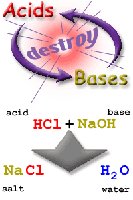
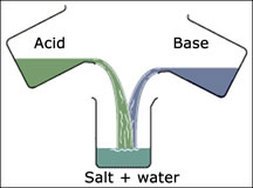
Acid-base reactions are a fundamental aspect of solution chemistry, involving the interaction between acids and bases to produce water and a salt. These reactions are essential for understanding chemical equilibrium, titrations, and the behavior of electrolytes in aqueous solutions.
Types of Acids and Bases
Arrhenius, Brønsted-Lowry, and Lewis Definitions
Acids and bases can be classified according to three main theories:
Arrhenius (Classical): Acids produce H+ ions in aqueous solution; bases produce OH- ions. The products are water and an ionic salt.
Brønsted-Lowry: Acids are proton donors; bases are proton acceptors. The products are the conjugate base of the acid and the conjugate acid of the base.
Lewis: Acids are electron pair acceptors; bases are electron pair donors. The product is a coordinate covalent compound.
For this chapter, focus is mainly on Arrhenius acid/base reactions.
Net Ionic Equation (NIE) for Acid-Base Reactions
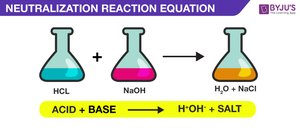
The net ionic equation for a typical Arrhenius acid-base reaction is:
Hydroxide ions are strong bases and will completely react with even weak acids in aqueous solution.
Gas Formation in Neutralization Reactions
Sometimes, neutralization reactions produce a gas in addition to water and a salt. This occurs when weak bases such as carbonates and bicarbonates react with acids, resulting in water, a salt, and a gas (often CO2).
Electrolytes
Classification of Electrolytes
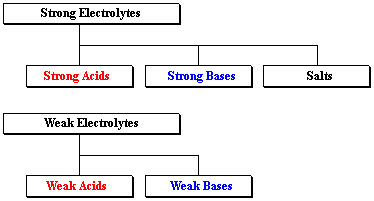
Acids and bases are electrolytes, meaning they conduct electricity in solution. Their strength determines their classification:
Strong acids and bases: Strong electrolytes (completely dissociate in water)
Weak acids and bases: Weak electrolytes (partially dissociate in water)
Stoichiometry in Acid-Base Reactions
Identifying Species and Reaction Determination
Before a reaction occurs, list the species present in the combined solution. For example, NaCl in aqueous solution is actually Na+ (aq) and Cl- (aq). In acidic solutions, the species are H+ (aq), the anion from the acid, and water. In basic solutions, the species are the cation from the base, OH- (aq), and water. Water is not a reactant and can be ignored in the reaction equation.
Stoichiometric Calculations
To solve acid-base stoichiometry problems:
Write the balanced net ionic equation (NIE).
Calculate moles of reactants using solution volumes and molarities.
Determine the limiting reactant if necessary.
Calculate moles of required reactant or product and convert to required units.

Neutralization and Titration
Neutralization
A neutralization reaction occurs when just enough base is added to react completely with the acid in a solution. The acid is then neutralized. The most common laboratory technique for this is volumetric analysis, also known as titration.
Titration Vocabulary
Titrant: Solution of known concentration, usually placed in the buret.
Analyte: Solution of unknown concentration, placed in the reaction vessel.
Equivalence point: The point where the amount of titrant added results in perfect neutralization. The pH at this point may not be exactly 7.
Indicator: Substance added to detect the equivalence point by color change.
Endpoint: The point at which the indicator changes color.
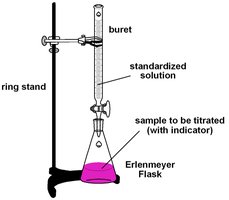
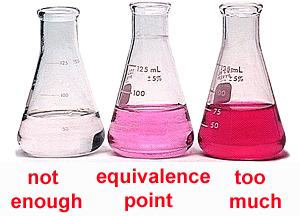
Requirements for Successful Titration
The exact reaction between titrant and analyte must be known.
The reaction must proceed quickly.
The equivalence point must be determined accurately, using an appropriate indicator or pH probe.
The volume of titrant needed to reach the equivalence point must be measured precisely.
For acid/base titrations, the titrant should be a strong acid or strong base.
Practice Problems
Electrolyte Classification
Substance | Type | Electrolyte Classification |
|---|---|---|
H2SO4 | Strong acid | Strong electrolyte |
CH3CH2OH | Alcohol (not acid/base) | Nonelectrolyte |
NH3 | Weak base | Weak electrolyte |
KClO4 | Ionic compound | Strong electrolyte |
Cu(NO3)2 | Ionic compound | Strong electrolyte |
Stoichiometry Practice
Neutralization: What volume of 0.0521 M Ba(OH)2 is required to neutralize 14.20 mL of 0.141 M H3PO4? Answer: 57.6 mL Ba(OH)2
Potassium Ion Concentration: Which will have the highest concentration of potassium ion: 0.20 M KCl, 0.15M K2CrO4, or 0.080 M K3PO4? Answer: 0.15 M K2CrO4 has the highest K+ concentration
Precipitation: What mass of NaOH is needed to precipitate Cd2+ ions from 35.0 mL of 0.500 M Cd(NO3)2? Answer: 1.40 g NaOH
Neutralization Calculations:
a) How many mL of 0.120 M HCl are needed to completely neutralize 50.0 mL of 0.101 M Ba(OH)2? Answer: 84.2 mL HCl solution
b) How many mL of 0.125 M H2SO4 are needed to neutralize 0.200 g NaOH? Answer: 20.0 mL H2SO4 solution
Stoichiometry Review: A 0.205-g sample of a mixture of Na2SO4 and K2SO4 is dissolved in water. Excess BaCl2 is added, forming 0.298 g BaSO4. What mass of SO42- ion is in the sample? Answer: 0.123 g SO42-. What is the mass percent of SO42- ion in the sample? Answer: 60.0 % SO42- in the sample.
Summary Table: Electrolyte Classification
Electrolyte Type | Examples |
|---|---|
Strong Electrolytes | Strong acids, strong bases, salts |
Weak Electrolytes | Weak acids, weak bases |
Nonelectrolytes | Molecular compounds (e.g., alcohols) |
