 Back
BackAcid-Base Titration and pH: Concepts, Calculations, and Applications
Study Guide - Smart Notes
 Tailored notes based on your materials, expanded with key definitions, examples, and context.
Acid-Base Titration and pH
Section 1: Aqueous Solutions and the Concept of pH
The behavior of acids and bases in aqueous solutions is fundamental to understanding chemical equilibria and titration. The self-ionization of water and the resulting hydronium and hydroxide ions establish the basis for the pH scale and acid-base calculations.
Self-Ionization of Water: Two water molecules interact to produce a hydronium ion (H3O+) and a hydroxide ion (OH−) by proton transfer.
Ionization Constant of Water (Kw): The equilibrium constant for water ionization is given by: At 25°C,
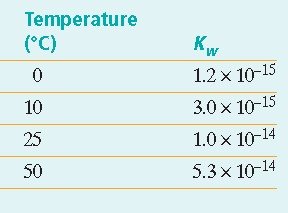
Temperature Dependence: The value of increases with temperature, indicating greater ionization at higher temperatures.
Neutral, Acidic, and Basic Solutions:
Neutral: M
Acidic:
Basic:
Strong Acids and Bases: These are considered completely ionized in aqueous solution. For example, a 0.010 M NaOH solution has M, and can be calculated using .
![Table of [H3O+], [OH-], and Kw for various solutions](https://static.studychannel.pearsonprd.tech/study_guide_files/general-chemistry/sub_images/10b8d15d_image_3.png)
Calculating Ion Concentrations: If either or is known, the other can be found using .
Section 2: The pH Scale
The pH scale quantifies the acidity or basicity of a solution based on the concentration of hydronium ions. It is a logarithmic scale, making it easier to express a wide range of concentrations.
Definition of pH:
Definition of pOH:
Relationship: at 25°C
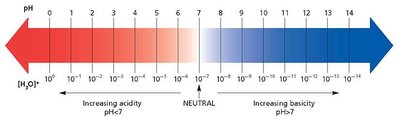
Significant Figures: The number of decimal places in pH equals the number of significant figures in .
Calculating pH and [H3O+]:
To find pH:
To find :
![Instructions for calculating pH and [H3O+]](https://static.studychannel.pearsonprd.tech/study_guide_files/general-chemistry/sub_images/10b8d15d_image_8.png)
Examples:
For M, pH = 7.0 (neutral)
For M, M, pH = 11.00 (basic)
![Table of solution, [H3O+], and pH values](https://static.studychannel.pearsonprd.tech/study_guide_files/general-chemistry/sub_images/10b8d15d_image_4.png)
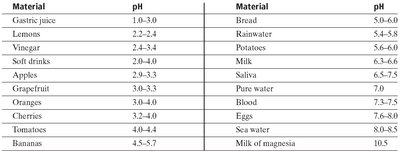
pH of Common Materials: Everyday substances have characteristic pH values, which can be referenced for context.
Summary Table: The relationship between , , and pH for various solutions is summarized below.
![Table of [H3O+], [OH-], and pH for various solutions](https://static.studychannel.pearsonprd.tech/study_guide_files/general-chemistry/sub_images/10b8d15d_image_9.png)
Section 3: Acid and Base Strength
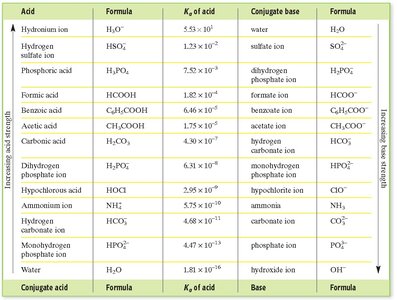
Acids and bases vary in strength, which is reflected in their degree of ionization in water. The acid dissociation constant () quantifies acid strength, while the base dissociation constant () does so for bases.
Strong Acids/Bases: Completely ionize in solution (e.g., HCl, NaOH).
Weak Acids/Bases: Partially ionize; equilibrium exists between ionized and unionized forms.
Conjugate Acid-Base Pairs: Each acid has a conjugate base, and vice versa.
Section 4: Indicators and pH Meters
Indicators and pH meters are tools for determining the pH of a solution. Indicators are weak acids or bases that change color depending on the pH, while pH meters provide precise measurements based on voltage changes.
Transition Interval: The pH range over which an indicator changes color.
Indicator Selection: Choose an indicator whose transition interval matches the expected pH at the equivalence point of a titration.
pH Meter: Measures pH by detecting voltage differences between electrodes in solution.
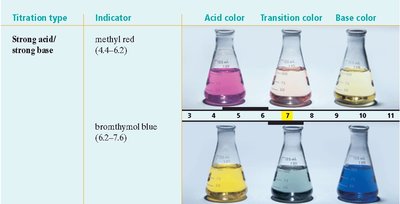
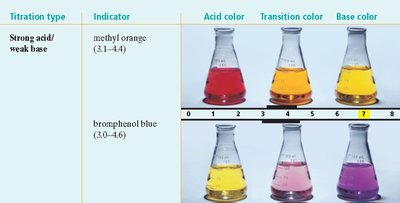
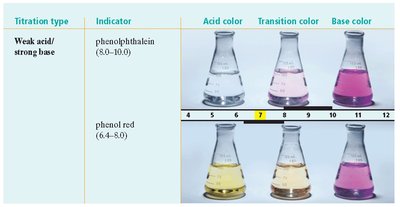
Section 5: Titration and Equivalence Point
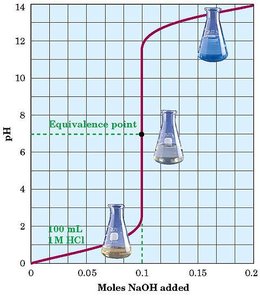
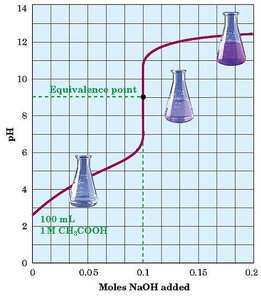
Titration is a quantitative technique used to determine the concentration of an unknown acid or base by reacting it with a standard solution. The equivalence point is when stoichiometrically equivalent amounts of acid and base have reacted.
Neutralization Reaction:
Equivalence Point: The point at which the amount of acid equals the amount of base in a titration.
End Point: The point at which the indicator changes color, ideally matching the equivalence point.
Indicator Choice:
Strong acid/strong base: Indicator with transition near pH 7
Strong acid/weak base: Indicator with transition below pH 7
Weak acid/strong base: Indicator with transition above pH 7
Section 6: Calculating Molarity in Titration
The molarity of an unknown solution can be determined by titration using a standard solution of known concentration. The calculation involves stoichiometry and the balanced neutralization equation.
Standard Solution: A solution of known concentration used in titration.
Primary Standard: A highly pure compound used to prepare the standard solution.
Calculation Steps:
Write the balanced equation for the neutralization reaction.
Calculate the moles of standard solution used.
Determine the moles of unknown solution reacted (using stoichiometry).
Calculate the molarity of the unknown solution.
Summary Table: Solution Types and pH
Solution | General Condition | At 25°C |
|---|---|---|
Neutral | , pH = pOH | M, pH = 7.0 |
Acidic | , pH < pOH | M, M, pH < 7.0 |
Basic | , pH > pOH | M, M, pH > 7.0 |
*Additional info: The above summary table is inferred from the provided content and standard chemistry knowledge for clarity.*
