 Back
BackAcid-Base Titration and pH: Concepts, Calculations, and Applications
Study Guide - Smart Notes
 Tailored notes based on your materials, expanded with key definitions, examples, and context.
Acid-Base Titration and pH
Hydronium Ions, Hydroxide Ions, and the Ionization of Water
The self-ionization of water is a fundamental process in aqueous solutions, where two water molecules interact to produce a hydronium ion (H3O+) and a hydroxide ion (OH−) by proton transfer. This equilibrium is described by the ionization constant of water, Kw.
Self-ionization equation:
Ionization constant of water:
At 25°C,
Neutral solution: M
Acidic solution:
Basic solution:
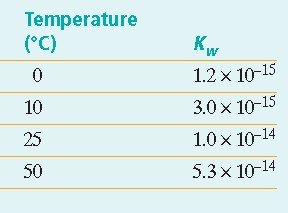
Additional info: The value of Kw increases with temperature, indicating that water ionizes more at higher temperatures.
Strong and Weak Acids and Bases
Strong acids and bases are considered to be completely ionized in aqueous solutions, while weak acids and bases only partially ionize. The strength of an acid or base is quantified by its ionization constant (Ka for acids, Kb for bases).
Strong acid example: HCl, HNO3
Weak acid example: CH3COOH (acetic acid)
Strong base example: NaOH, KOH
Weak base example: NH3 (ammonia)
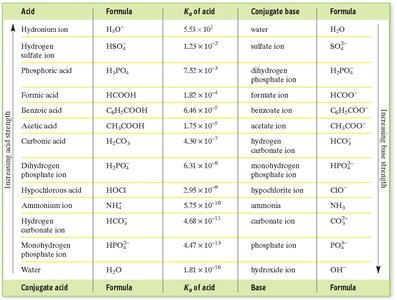
Additional info: The table above lists acids, their formulas, ionization constants, and their conjugate bases, illustrating the relationship between acid and base strength.
Calculating [H3O+] and [OH−] in Solutions
The concentrations of hydronium and hydroxide ions in various solutions can be calculated using Kw. For strong acids and bases, the concentration of the acid or base equals the concentration of the ion produced.
For a strong acid: concentration of acid
For a strong base: concentration of base
To find the other ion: or
![Table of [H3O+], [OH-], and Kw for various solutions](https://static.studychannel.pearsonprd.tech/study_guide_files/general-chemistry/sub_images/c03ad2d1_image_3.png)
The pH Scale
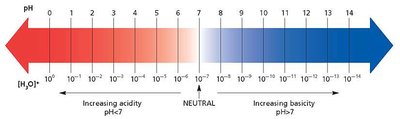
The pH scale is a logarithmic scale used to express the acidity or basicity of a solution. It is defined as the negative logarithm of the hydronium ion concentration.
pH definition:
pOH definition:
Relationship: at 25°C
Neutral solution: pH = 7.0
Acidic solution: pH < 7.0
Basic solution: pH > 7.0
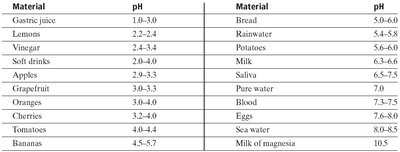
pH of Common Materials
Everyday substances have characteristic pH values, which can be used to classify them as acidic, neutral, or basic.
Relationship Between [H3O+], [OH−], and pH
The relationship between hydronium ion concentration, hydroxide ion concentration, and pH is summarized in the following tables. These relationships are essential for understanding acid-base chemistry and for solving quantitative problems.
![Table of solution types and their [H3O+], [OH-], and pH](https://static.studychannel.pearsonprd.tech/study_guide_files/general-chemistry/sub_images/c03ad2d1_image_7.png)
![Instructions for calculating pH and [H3O+]](https://static.studychannel.pearsonprd.tech/study_guide_files/general-chemistry/sub_images/c03ad2d1_image_8.png)
![Table of [H3O+], [OH-], and pH for various solutions](https://static.studychannel.pearsonprd.tech/study_guide_files/general-chemistry/sub_images/c03ad2d1_image_9.png)
![Table of [H3O+], [OH-], and pH for various solutions](https://static.studychannel.pearsonprd.tech/study_guide_files/general-chemistry/sub_images/c03ad2d1_image_10.png)
Calculating pH and [H3O+]
To calculate pH from [H3O+], use the formula . To find [H3O+] from pH, use .
Example: If M, then
Example: If , then M
pH Indicators and pH Meters
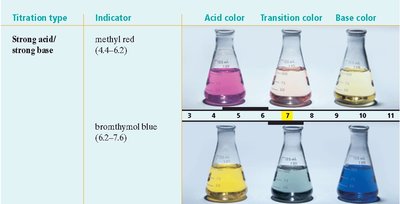
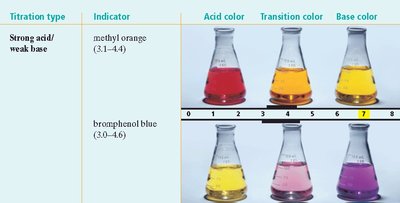
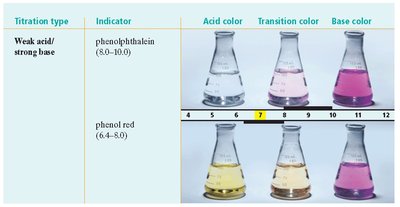
Acid-base indicators are substances that change color depending on the pH of the solution. Each indicator has a specific transition interval. pH meters provide a precise measurement of pH by detecting voltage changes related to [H3O+].
Titration and Equivalence Point
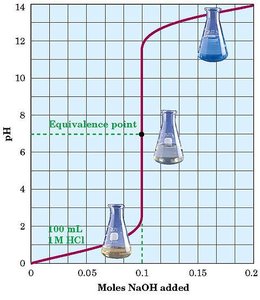
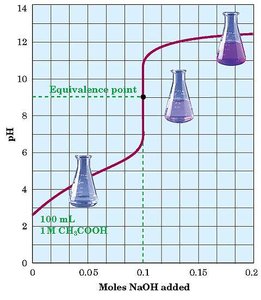
Titration is a laboratory technique used to determine the concentration of an unknown acid or base by reacting it with a standard solution. The equivalence point is reached when the amounts of acid and base are stoichiometrically equivalent. The end point is indicated by a color change of the indicator.
Neutralization reaction:
Equivalence point: Chemically equivalent amounts of acid and base have reacted.
End point: The indicator changes color, signaling the completion of the reaction.
Molarity and Titration Calculations
The molarity of an unknown solution can be determined by titration using the following steps:
Write the balanced equation for the neutralization reaction.
Calculate the moles of the standard solution used.
Determine the moles of the unknown solution based on stoichiometry.
Calculate the molarity of the unknown solution using .
Example: If 20.0 mL of 5.0 × 10⁻³ M NaOH is required to neutralize 10.0 mL of HCl, the molarity of HCl can be calculated using stoichiometry and the titration formula.
