 Back
BackAcid-Base Titrations: Calculations, Curves, and Concepts
Study Guide - Smart Notes
 Tailored notes based on your materials, expanded with key definitions, examples, and context.
Acid-Base Titrations
Introduction to Titration
Titration is a quantitative analytical technique used to determine the concentration of an unknown acid or base solution by reacting it with a solution of known concentration. The process involves the gradual addition of a titrant to the analyte until the reaction reaches the equivalence point, where stoichiometrically equivalent amounts of acid and base have reacted.
Analyte: The solution of unknown concentration (acid or base).
Titrant: The solution of known concentration added from a buret.
Equivalence Point (Ve): The point at which the amount of titrant added is stoichiometrically equivalent to the amount of analyte present.
Indicator: A substance used to visually signal the end point of the titration, often by a color change (not always used if pH is measured directly).
Titration of Weak Acids and Weak Bases
Weak Acid with Strong Base
When titrating a weak acid (e.g., acetic acid, HC2H3O2) with a strong base (e.g., NaOH), the reaction proceeds in two main stages: a stoichiometric reaction followed by an equilibrium adjustment. The pH changes gradually at first, then rises sharply near the equivalence point, and finally levels off as excess base is added.
Key Reaction:
Ka (Acid Dissociation Constant): Indicates the strength of the weak acid. For acetic acid, .
Equivalence Point: The pH at equivalence is greater than 7 due to the formation of a weak conjugate base.
Example Calculation: Calculate the pH after mixing 100.0 mL of 0.102 M acetic acid with 50.0 mL of 0.10 M NaOH.
Calculate moles of acid and base.
Determine the limiting reactant and the amount remaining after reaction.
Set up an equilibrium expression for the remaining weak acid/base and solve for pH.
Weak Base with Strong Acid
When titrating a weak base (e.g., ammonia, NH3) with a strong acid (e.g., HCl), the pH decreases gradually, then drops sharply at the equivalence point, and finally levels off as excess acid is added. The equivalence point pH is less than 7 due to the formation of a weak conjugate acid.
Key Reaction:
Kb (Base Dissociation Constant): For ammonia, .
Equivalence Point: The pH at equivalence is less than 7.
Steps in Acid-Base Titration Calculations
Step 1: Determine Progress of Titration
Identify whether the titration is before, at, or after the equivalence point by comparing the moles of titrant added to the moles of analyte present.
Step 2: Stoichiometry Calculation
Assume the reaction between the strong acid/base and the weak base/acid goes to completion. Calculate the amounts of all species present after the reaction.
Step 3: Equilibrium Calculation
For the remaining weak acid or base, set up an equilibrium expression using the appropriate Ka or Kb value and solve for the pH of the solution.
pH Titration Curves
Understanding the Curve
A pH titration curve plots the pH of the solution as a function of the volume of titrant added. The shape of the curve provides information about the acid/base strength and the equivalence point.
Axes: pH (y-axis) vs. Volume of titrant delivered (x-axis).
Buffer Region: The region before the equivalence point where the solution resists changes in pH.
Equivalence Point: The steepest part of the curve, where the amount of acid equals the amount of base.
After Equivalence: The pH levels off as excess titrant is added.
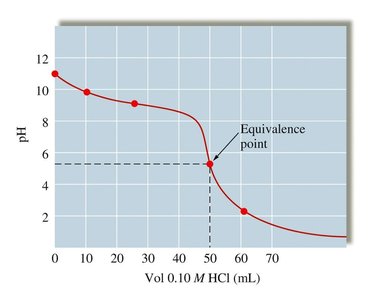
Figure: Example titration curve for 100.0 mL of 0.050 M NH3 with 0.10 M HCl. The equivalence point is marked, and the pH drops sharply at this point, indicating the completion of the reaction between the weak base and strong acid.
Sample Data Table: Titration of Acetic Acid with NaOH
The following table summarizes the pH changes during the titration of 100.0 mL of 0.102 M acetic acid with 0.10 M NaOH:
Volume NaOH (mL) | pH |
|---|---|
0 | 2.87 |
10.0 | 3.79 |
20.0 | 4.14 |
30.0 | 4.38 |
40.0 | 4.57 |
50.0 | 4.74 |
60.0 | 4.92 |
70.0 | 5.11 |
80.0 | 5.35 |
90.0 | 5.70 |
100.0 | 8.72 |
102.0 | 12.28 |
150.0 | 12.52 |
200.0 | 12.52 |
Additional info: The sharp increase in pH near 100 mL indicates the equivalence point for this titration.
Applications of Titration
Determining Unknown Concentrations
Titration is commonly used to determine the molarity of an unknown acid or base solution. By measuring the volume of titrant required to reach the equivalence point, the concentration of the analyte can be calculated using the stoichiometry of the reaction.
Example: To determine the molarity of 200.0 mL of dilute HNO2, titrate with 0.100 M NaOH and use the volume at equivalence to calculate the unknown concentration.
Visualizing Titration Curves
Strong Acid with Strong Base
When titrating a strong acid with a strong base, the pH starts low, rises gradually, and then increases sharply at the equivalence point, which occurs at pH 7.
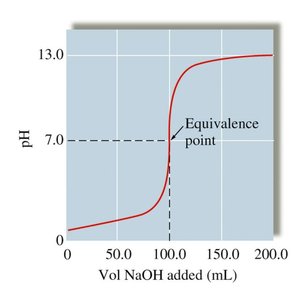
Figure: Titration curve for a strong acid (e.g., HCl) with a strong base (e.g., NaOH). The equivalence point is at pH 7.
Weak Acid with Strong Base
When titrating a weak acid with a strong base, the equivalence point occurs at a pH greater than 7 due to the formation of a weak conjugate base.
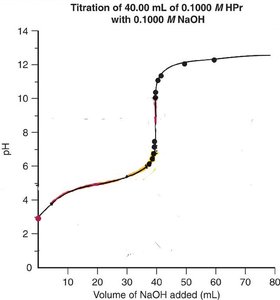
Figure: Titration curve for 40.00 mL of 0.1000 M HPr with 0.1000 M NaOH. The equivalence point is above pH 7, characteristic of weak acid-strong base titrations.
Lab Techniques: Measuring pH During Titration
During a titration, the pH is measured after each addition of titrant, often using a pH meter for accuracy. The titrant is delivered from a buret, and the analyte is stirred to ensure thorough mixing.
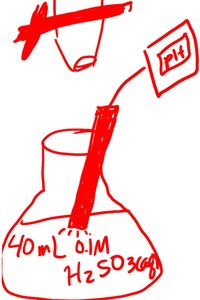
Figure: Typical laboratory setup for titration, showing the analyte in a flask, a pH probe, and titrant being added from a buret.
Summary Table: Types of Acid-Base Titrations
Type of Titration | Equivalence Point pH | Curve Shape |
|---|---|---|
Strong Acid + Strong Base | 7 | Sharp rise at equivalence |
Weak Acid + Strong Base | >7 | Buffer region, then sharp rise |
Weak Base + Strong Acid | <7 | Buffer region, then sharp drop |
Additional info: The equivalence point pH depends on the strengths of the acid and base involved.
