 Back
BackAcid-Base Titrations II: Weak Acid–Strong Base Titrations
Study Guide - Smart Notes
 Tailored notes based on your materials, expanded with key definitions, examples, and context.
Acid-Base Titrations
Overview of Titration Types
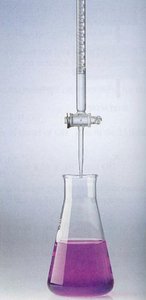
Titration is a laboratory technique used to determine the concentration of an unknown solution (analyte) by reacting it with a solution of known concentration (titrant). In acid-base titrations, the analyte and titrant are acids and bases of varying strengths. The main types include:
Strong Acid–Strong Base
Weak Acid–Strong Base
Weak Base–Strong Acid
Each type produces a characteristic titration curve, which plots pH versus the volume of titrant added.
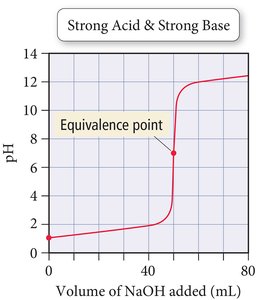
Strong Acid–Strong Base Titration Curve
Key Features of the Curve
The titration curve for a strong acid with a strong base shows a rapid pH change near the equivalence point. The equivalence point is where the amount of acid equals the amount of base added, resulting in a neutral solution (pH ≈ 7 for strong acid/strong base titrations).
Initial: Solution contains only strong acid; pH is low.
Before Equivalence: Acid is in excess; pH increases gradually.
At Equivalence: Moles of acid = moles of base; pH rises sharply to near 7.
After Equivalence: Base is in excess; pH is high.
Example Reaction:
Titration of a Weak Acid with a Strong Base
General Features
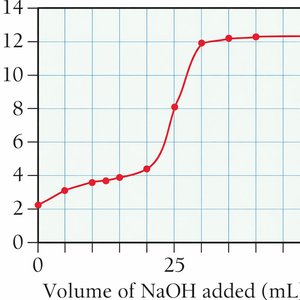
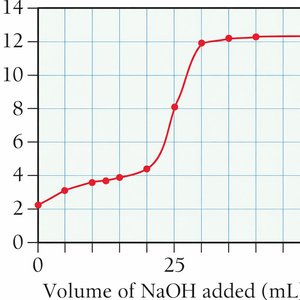
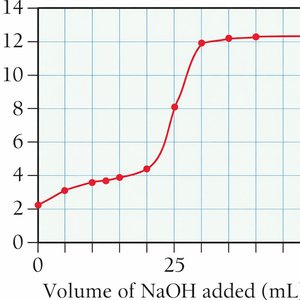
When titrating a weak acid with a strong base, the titration curve differs from that of a strong acid. The pH at the equivalence point is greater than 7 due to the formation of a weak conjugate base.
Initial: Only weak acid present; calculate pH using the acid dissociation constant ().
Before Equivalence: Buffer region; both weak acid and its conjugate base are present.
At Equivalence: All weak acid converted to conjugate base; pH determined by the base hydrolysis.
After Equivalence: Excess strong base; pH determined by the concentration of excess OH–.
Stepwise Calculation of pH During Titration
1. Initial Point (Before Any Base Added)
All analyte is weak acid (), no base added.
pH is calculated using the of the acid and an ICE table.
Example Equation:
2. Before Equivalence Point (Buffer Region)
Acid moles > base moles; both and are present.
Buffer solution is formed; use the Henderson-Hasselbalch equation:
3. Equivalence Point
Acid moles = base moles; all converted to .
Solution contains only the conjugate base (); pH is calculated using for $A^-$.
4. After Equivalence Point
Base moles > acid moles; excess strong base determines pH.
Calculate excess and use:
5. Half-Equivalence Point
Half of the weak acid has been neutralized; .
At this point, .
Example Calculations
Equivalence Point Calculation
Given: 25.00 mL of 0.135 M formic acid () titrated with 0.250 M NaOH. Find the volume of NaOH needed to reach equivalence.
Calculate moles of acid:
At equivalence, moles of added = moles of acid.
Volume NaOH needed:
pH at Equivalence Point
All acid converted to (conjugate base).
Calculate and use to find .
Convert to pOH, then to pH.
pH at Half-Equivalence Point
At half-equivalence, .
pH = pKa (for formic acid, ).
Determining the Ka of an Unknown Weak Acid
Experimental Procedure
Titrate a known volume of the unknown weak acid with a standard strong base.
Monitor the pH throughout the titration and record the titration curve.
Locate the equivalence point and determine the volume of base added.
Find the half-equivalence point on the curve.
At the half-equivalence point, pH = pKa; thus, the measured pH gives the pKa of the unknown acid.
Summary Table: Titration Curve Regions and Calculations
Region | Dominant Species | Calculation Method |
|---|---|---|
Initial | Weak acid () | ICE table, |
Before Equivalence (Buffer) | and | Henderson-Hasselbalch equation |
Half-Equivalence | ||
Equivalence | Conjugate base () | ICE table, |
After Equivalence | Excess | Calculate , then pOH and pH |
Key Equations
Henderson-Hasselbalch Equation:
Relationship between and :
pOH and pH: ,
