 Back
BackAcid–Base Equilibria: Classification, Strength, and Calculations
Study Guide - Smart Notes
 Tailored notes based on your materials, expanded with key definitions, examples, and context.
Acid–Base Equilibria
Classifications of Acids and Bases
Acids and bases are fundamental concepts in chemistry, and their definitions vary depending on the theoretical framework. Understanding these definitions is crucial for predicting chemical behavior in aqueous solutions.
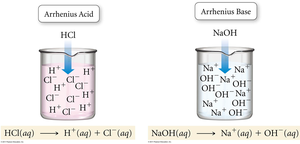
Arrhenius Definition: An acid produces H+ ions in solution, while a base produces OH- ions.
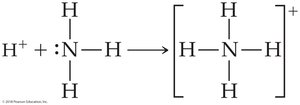
Brønsted–Lowry Definition: An acid is a proton (H+) donor; a base is a proton acceptor.
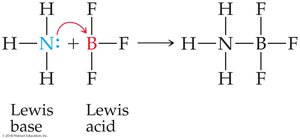
Lewis Definition: An acid is an electron pair acceptor; a base is an electron pair donor.
Example: Arrhenius acid and base dissociation in water.
Example: Brønsted–Lowry acid-base reaction: NH3 acting as a base by accepting a proton.
Example: Lewis acid-base reaction: NH3 (Lewis base) donates an electron pair to BF3 (Lewis acid).
Amphiprotic Substances
Some substances, such as water, can act as both an acid and a base. This dual behavior is called amphiprotic. For example, water can donate a proton to ammonia or accept a proton from an acid.
Example: NH3 (aq) + H2O (l) → NH4+ (aq) + OH- (aq)
Conjugate Acid-Base Pairs
Acids and bases that differ by one proton (H+) are called conjugate acid–base pairs. Every acid–base reaction yields a conjugate acid and a conjugate base.
Example: CH3COOH (acetic acid) and CH3COO- (acetate ion) form a conjugate pair.
Relative Strengths of Acids and Bases
The strength of an acid or base is determined by its ability to donate or accept protons. There is an inverse relationship: the stronger the acid, the weaker its conjugate base, and vice versa.
Strong acids: Completely dissociate in water.
Weak acids: Partially dissociate in water.
Acid–Base Equilibrium
Acid–base reactions reach equilibrium, favoring the transfer of a proton from the stronger acid to the stronger base, forming the weaker acid and base.
Example: CH3COOH (aq) + H2O (l) → H3O+ (aq) + CH3COO- (aq)
Autoionization of Water and the pH Scale
Autoionization of Water
Water can autoionize, meaning one water molecule donates a proton to another. The equilibrium constant for this process is called the ion product constant for water, Kw.
Equation: (at 25 ºC)
Aqueous Solutions: Acidic, Basic, or Neutral
The relative concentrations of H3O+ and OH- determine whether a solution is acidic, basic, or neutral.
Acidic: [H3O+] > [OH-]
Basic: [OH-] > [H3O+]
Neutral: [H3O+] = [OH-]
The pH Scale
The pH scale is a logarithmic method for reporting hydrogen ion concentration. Neutral pH is 7.00; acidic pH is below 7.00; basic pH is above 7.00.
Equation:
pOH:
Relationship: (at 25 ºC)
Measuring pH
pH can be measured accurately with a pH meter or quickly with indicators. Indicators change color depending on the acidity or basicity of the solution.
Strong and Weak Acids and Bases
Strong Acids and Bases
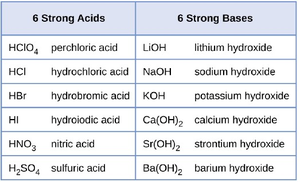
Strong acids and bases completely ionize in solution and are strong electrolytes. The most common strong acids and bases are listed below.
Example: HCl (aq) + H2O (l) → H3O+ (aq) + Cl- (aq)
Example: NaOH (aq) → Na+ (aq) + OH- (aq)
Weak Acids
Weak acids only partially ionize in water, resulting in an equilibrium mixture of all species. The acid-dissociation constant, Ka, quantifies the strength of a weak acid.
Equation:
Expression:
Example: Structure of weak acids, with the ionizable proton shown in red.
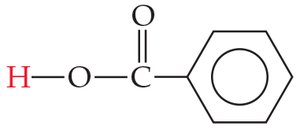
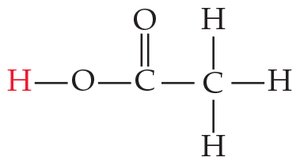
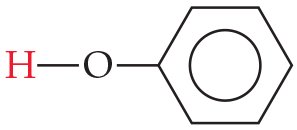
Comparing Strong and Weak Acids
Strong acids dissociate completely, while weak acids only partially dissociate. This affects reaction rates and conductivity.
Example: CH3COOH (aq) + H2O (l) ⇔ H3O+ (aq) + CH3COO- (aq)
Calculating Ka and Percent Ionization
Ka can be calculated from pH and concentration data. Percent ionization measures the fraction of acid molecules that ionize.
Equation:
Calculating pH Using Ka
To calculate pH for a weak acid, set up an equilibrium table, write the Ka expression, and solve for the equilibrium concentration of H3O+.
Polyprotic Acids
Polyprotic acids have more than one ionizable proton. Each ionization step has its own Ka value, and the first ionization usually dominates the pH calculation.
Weak Bases and Their Equilibria
Weak Bases
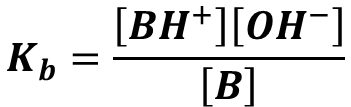
Weak bases partially ionize in water. The base-dissociation constant, Kb, quantifies their strength.
Equation:
Expression:
Types of Weak Bases
Anions of weak acids (conjugate bases)
Neutral substances with nonbonding electron pairs (often containing nitrogen, e.g., ammonia and amines)
Calculating pH Using Kb
Similar to weak acids, use an equilibrium table and the Kb expression to solve for OH- concentration and then calculate pOH and pH.
Relationship Between Ka and Kb
Ka and Kb Relationship
For a conjugate acid–base pair, Ka and Kb are related by the ion-product constant for water:
Equation:
If you know Ka or Kb, you can calculate the other.
Acid–Base Properties of Salt Solutions
Salt Solutions
Salts are ionic compounds formed from the neutralization of acids and bases. Their solutions can be acidic, basic, or neutral depending on the properties of the ions.
Neutral salts: Both ions do not react with water (e.g., NaCl).
Basic salts: Anion reacts with water to produce OH- (e.g., NaF).
Acidic salts: Cation reacts with water to produce H3O+ (e.g., NH4Cl).
Hydrated Cations
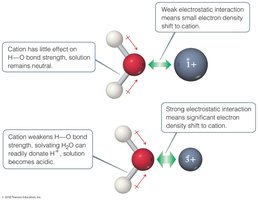
Transition and post-transition metal cations can form hydrated ions, which may be acidic due to strong electrostatic interactions with water.

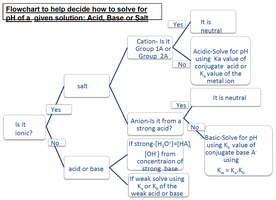
Flowchart for Solving pH of a Solution
A flowchart can help determine whether to use Ka, Kb, or salt hydrolysis to solve for pH.
Acid–Base Behavior and Chemical Structure
Factors Affecting Acid Strength
The ability of an acid to donate a proton depends on:
Bond polarity: H–A bond must be polarized.
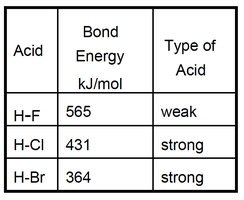
Bond strength: Weaker H–A bonds make stronger acids.
Stability of A-: More stable conjugate bases make stronger acids.
Binary Acids
Binary acids consist of hydrogen and one other element. Within a group, bond strength is most important; within a period, bond polarity dominates.
Oxyacids
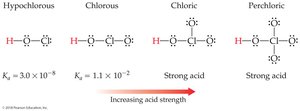
Oxyacids contain hydrogen, oxygen, and a nonmetal. Acid strength increases with the electronegativity of the nonmetal and the number of oxygen atoms.
Carboxylic Acids
Carboxylic acids are organic acids with the –COOH group. Their acidity is enhanced by electron-withdrawing effects and resonance stabilization of the conjugate base.
Summary of Key Concepts and Skills
Acid and base definitions (Arrhenius, Brønsted–Lowry, Lewis)
Strong and weak acids/bases
Conjugate acid and base pairs
Calculations: (at 25 ºC),
