 Back
BackLesson 8.7: Acid–Base Titration: Principles, Calculations, and Indicators
Study Guide - Smart Notes
 Tailored notes based on your materials, expanded with key definitions, examples, and context.
Acid–Base Titration
Introduction to Acid–Base Titration
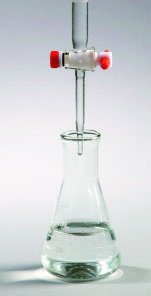
Acid–base titration is a quantitative analytical technique used to determine the concentration of an acid or base in solution. This process involves the gradual addition of a titrant (a solution of known concentration) from a burette to a sample solution until the reaction reaches the equivalence point, where stoichiometrically equivalent amounts of acid and base have reacted.
Titrant: The solution of known concentration added from the burette.
Sample: The solution being analyzed, placed in a receiving flask (often an Erlenmeyer flask).
Equivalence Point: The stage at which the amount of titrant added is stoichiometrically equivalent to the amount of substance in the sample.
Endpoint: The point at which the indicator changes color, signaling the completion of the titration.
Indicator: A weak acid or base that changes color at a specific pH, used to visually signal the endpoint.
Accurate titration requires precise measurement of volumes and concentrations. The titrant is often standardized using a primary standard—a highly pure compound with a known amount.
Principles and Calculations in Acid–Base Titration
The stoichiometry of the acid–base reaction is fundamental to titration calculations. The general reaction for a strong acid and strong base is:
Before the equivalence point: The concentration of the excess reactant (acid or base) determines the pH.
At the equivalence point: For strong acid–strong base titrations, the solution is neutral () because only water and the salt are present.
After the equivalence point: The concentration of the excess titrant determines the pH.
For weak acid–strong base titrations, the calculation involves both stoichiometry and equilibrium (ICE tables) because the weak acid does not fully dissociate. At the equivalence point, the solution contains the conjugate base, which hydrolyzes to produce a basic pH ().
Sample Calculation: Determining the Volume of Titrant Required
To find the volume of titrant needed to reach the equivalence point:
Where is concentration and is volume. Rearranging for the unknown volume gives:
pH Curves in Titration
A pH curve (titration curve) is a graph of pH versus the volume of titrant added. It provides information about the equivalence point, initial pH, and the appropriate indicator to use. For strong acid–strong base titrations, the pH changes sharply near the equivalence point. For weak acid–strong base titrations, the equivalence point occurs at due to the basic nature of the conjugate base.
Acid–Base Indicators
Indicators are weak acids or bases that change color at specific pH ranges. The choice of indicator depends on the expected pH at the equivalence point. The endpoint should closely match the equivalence point for accurate titration results.
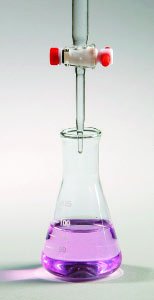
Phenolphthalein: Colorless in acid, pink in base; suitable for titrations with equivalence points near pH 8–10.
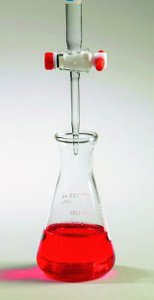
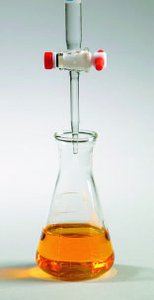
Methyl orange: Red in acid, yellow in base; suitable for titrations with equivalence points near pH 3–4.
Summary Table: Key Terms in Acid–Base Titration
Term | Definition |
|---|---|
Titration | Addition of precise volumes of titrant to a sample to determine concentration |
Sample | Solution being analyzed |
Titrant | Solution of known concentration added from the burette |
Burette | Calibrated tube for delivering variable known volumes of liquid |
Standard Solution | Solution with accurately known concentration |
Primary Standard | Highly pure, stable chemical for standardizing titrants |
Equivalence Point | Point where stoichiometric amounts of acid and base have reacted |
Endpoint | Point where the indicator changes color |
Practice Problems
Calculate the volume of 0.10 mol/L HCl required to titrate 25.0 mL of 0.50 mol/L NaOH to the equivalence point.
For a titration of 25.00 mL of 0.350 mol/L HCl with 0.500 mol/L NaOH, determine the pH after 10.00 mL of NaOH is added.
Explain why the equivalence point pH differs between strong acid–strong base and weak acid–strong base titrations.
Key Takeaways
Strong acid–strong base titrations have an equivalence point at pH 7; weak acid–strong base titrations have pH > 7 at equivalence due to conjugate base hydrolysis.
Indicators must be chosen based on the expected pH at the equivalence point for accurate titration results.
pH curves provide valuable information for analyzing titration progress and selecting appropriate indicators.
