 Back
BackAcidic, Basic, and Neutral Salts; Buffer Solution Identification
Study Guide - Smart Notes
 Tailored notes based on your materials, expanded with key definitions, examples, and context.
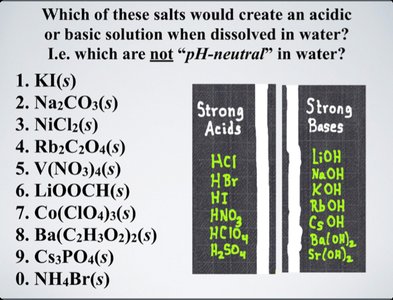
Q1. Which of these salts would create an acidic or basic solution when dissolved in water? (i.e., which are NOT pH-neutral?)
Background
Topic: Acid-Base Properties of Salts
This question tests your understanding of how salts affect the pH of aqueous solutions. You need to determine whether each salt, when dissolved in water, will produce a solution that is acidic, basic, or neutral. This depends on the acid-base properties of the ions that make up the salt.
Key Terms and Concepts:
Salt Hydrolysis: The reaction of the ions from salts with water to produce H+ or OH-.
pH-Neutral Salt: A salt formed from a strong acid and a strong base (e.g., NaCl, KNO3).
Acidic Salt: A salt where the cation is from a weak base or the anion is from a strong acid.
Basic Salt: A salt where the anion is from a weak acid or the cation is from a strong base.
Step-by-Step Guidance
For each salt, identify the acid and base from which it is derived. Use the reference list of strong acids and strong bases provided in the image.
Determine if the parent acid and base are strong or weak. If both are strong, the salt is neutral. If one is weak, the salt will hydrolyze to affect pH.
For salts with a cation from a weak base (e.g., NH4+), the solution will be acidic. For salts with an anion from a weak acid (e.g., CH3COO-), the solution will be basic.
Mark which salts are NOT pH-neutral based on your analysis.
Try solving on your own before revealing the answer!
Final Answer:
The salts that are NOT pH-neutral are those derived from a strong acid and weak base (acidic), or a weak acid and strong base (basic). For example, NH4Br (acidic), Na2CO3 (basic), etc. Use the strong acid/base list to check each one.
Neutral salts are formed from strong acid + strong base (e.g., KI, NiCl2).
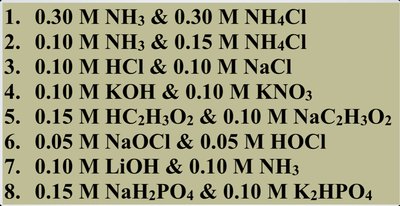
Q2. Identify which of the following pairs are buffer solutions.
Background
Topic: Buffer Solutions
This question tests your ability to recognize buffer solutions. A buffer consists of a weak acid and its conjugate base, or a weak base and its conjugate acid, in comparable concentrations.
Key Terms and Concepts:
Buffer Solution: A solution that resists changes in pH when small amounts of acid or base are added. Made from a weak acid + its salt (conjugate base) or a weak base + its salt (conjugate acid).
Conjugate Acid-Base Pair: Two substances that differ by one proton (H+).
Step-by-Step Guidance
For each pair, identify if one component is a weak acid (or base) and the other is its conjugate base (or acid).
Check if both components are present in significant (comparable) concentrations.
Exclude pairs where one component is a strong acid or strong base, as these do not form buffers.
Mark which pairs meet the buffer criteria.
Try solving on your own before revealing the answer!
Final Answer:
Buffer solutions are those pairs where you have a weak acid and its conjugate base, or a weak base and its conjugate acid, in similar concentrations. For example, NH3 & NH4Cl, HC2H3O2 & NaC2H3O2, etc.
Pairs with strong acids or bases (e.g., HCl & NaCl, KOH & KNO3) are not buffers.
