 Back
BackAcidity in Water: Types, Environmental Significance, and pH Ranges
Study Guide - Smart Notes
 Tailored notes based on your materials, expanded with key definitions, examples, and context.
Acidity
Types of Acidity
Acidity in water refers to the capacity of water to neutralize bases, and is an important parameter in environmental chemistry and water quality analysis. The types of acidity commonly encountered in water and wastewater analysis are mineral acidity and carbon dioxide acidity, each defined by their behavior in titration and their effect on pH.
Mineral Acidity: Caused by strong acids such as hydrochloric, sulfuric, and nitric acids. It is measured using methyl orange as an indicator, which changes color at a pH of about 4.5.
Carbon Dioxide Acidity: Caused by dissolved carbon dioxide, which forms carbonic acid in water. This acidity is measured using phenolphthalein as an indicator, which changes color at a pH of about 8.3.
Total Acidity: The sum of mineral acidity and carbon dioxide acidity, representing the overall acid-neutralizing capacity of the water.
Indicators: Methyl orange and phenolphthalein are used to determine the endpoints for mineral and carbon dioxide acidity, respectively.
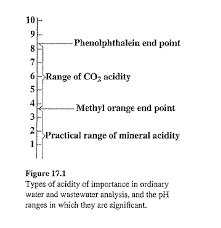
Figure 17.1: Types of acidity of importance in ordinary water and wastewater analysis, and the pH ranges in which they are significant.
Environmental Significance of Mineral Acidity and Carbon Dioxide
Understanding acidity in water is crucial for environmental and public health reasons. The presence of mineral acids and carbon dioxide affects water quality, aquatic life, and infrastructure.
Carbon Dioxide: While carbon dioxide is present in carbonated drinks at concentrations higher than those found in natural waters, it is not a major public health concern. However, it contributes to the acidity of water and can affect aquatic ecosystems.
Mineral Acidity: Water with significant mineral acidity is not suitable for human consumption due to its corrosive nature. Acidic waters can damage pipes and infrastructure, leading to increased maintenance costs.
Corrosive Characteristics: Acidic water is corrosive, which can lead to the leaching of metals from pipes and increased expenses for corrosion control.
Aquatic Life: High acidity (low pH) in water can be lethal to aquatic organisms, as many species are sensitive to pH changes and may die at low pH levels.
Summary Table: Acidity and Alkalinity on the pH Scale
The following table summarizes the relationship between acidity, alkalinity, and indicator endpoints on the pH scale:
pH Range | Indicator | Type of Acidity/Alkalinity |
|---|---|---|
0 - 4.5 | Methyl orange | Mineral acidity |
4.5 - 8.3 | None | Carbon dioxide acidity |
8.3 - 10.3 | Phenolphthalein | Caustic alkalinity |
10.3 - 14 | None | Total alkalinity |
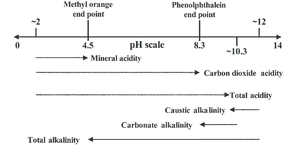
Figure: pH scale showing the endpoints for methyl orange and phenolphthalein, and the ranges for mineral acidity, carbon dioxide acidity, caustic alkalinity, carbonate alkalinity, and total alkalinity.
Key Formulas and Concepts
Acidity Calculation: Acidity is often determined by titration with a standard base, using indicators to identify endpoints. The amount of base required to reach the endpoint is used to calculate acidity.
pH: The pH of a solution is a measure of its hydrogen ion concentration, given by:
Acid-Base Neutralization: The reaction between acids and bases in water can be represented as:
Example: Acidity in Natural Waters
Natural waters may contain both mineral acids and dissolved carbon dioxide. The acidity is measured by titrating the sample with a base and using methyl orange and phenolphthalein to determine the endpoints. Water with a pH below 4.5 (mineral acidity) is considered highly acidic and unsuitable for consumption.
Additional info: The notes have been expanded to include definitions, environmental context, and a summary table for clarity and completeness.
