 Back
Acids and Bases: Definitions, Reactions, and Calculations
Study Guide - Smart Notes
 Tailored notes based on your materials, expanded with key definitions, examples, and context.
Acids and Bases
Introduction to Acids and Bases
Acids and bases are fundamental concepts in chemistry, crucial for understanding chemical reactions, solution properties, and biological processes. The earliest definition was provided by Arrhenius, which describes acids and bases based on their behavior in water.
Arrhenius Acid: Contains a hydrogen atom and dissolves in water to form a hydrogen ion, H+.
Arrhenius Base: Contains hydroxide and dissolves in water to form OH−.
Example:
HCl(g) → H+(aq) + Cl−(aq)
NaOH(s) → Na+(aq) + OH−(aq)
However, the Arrhenius definition is limited, as H+ does not exist freely in water but forms the hydronium ion, H3O+.
Brønsted–Lowry Definitions
The Brønsted–Lowry definition expands the concept:
Brønsted–Lowry Acid: Proton (H+) donor.
Brønsted–Lowry Base: Proton (H+) acceptor.
Example:
HCl(g) + H2O(l) → H3O+(aq) + Cl−(aq)
HCl donates a proton to water, making it a Brønsted–Lowry acid, while water accepts the proton, acting as a Brønsted–Lowry base.
Brønsted–Lowry Acids and Bases
Brønsted–Lowry acids must contain a hydrogen atom, while bases must have a lone pair of electrons to accept a proton.
Common Acids: HCl, HBr, H2SO4, HNO3, acetic acid (CH3COOH)
Common Bases: NaOH, KOH, Mg(OH)2, Ca(OH)2, H2O, NH3
Proton Transfer and Conjugate Pairs
When an acid reacts with a base, a proton is transferred. The product formed by loss of a proton from an acid is its conjugate base, and the product formed by gain of a proton by a base is its conjugate acid.
Example: HBr + H2O → Br− + H3O+
HBr and Br− are a conjugate acid–base pair; H2O and H3O+ are another.
When a species gains a proton, it gains a +1 charge; when it loses a proton, it gains a −1 charge.
An amphoteric compound (e.g., water) can act as either an acid or a base.
Acid and Base Strength
Strong and Weak Acids and Bases
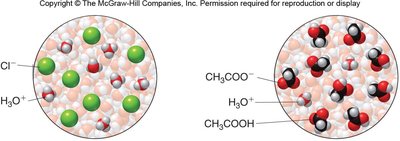
Acids and bases are classified as strong or weak based on their degree of dissociation in water.
Strong Acid: 100% dissociates into ions (e.g., HCl, HBr, HNO3, H2SO4).
Weak Acid: Only partially dissociates (e.g., CH3COOH, H3PO4, HF).
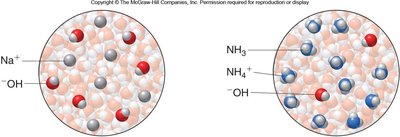
Strong Base: 100% dissociates (e.g., NaOH, KOH).
Weak Base: Only partially dissociates (e.g., NH3).
Strong acids form weak conjugate bases, and strong bases form weak conjugate acids.
Example: HCl (strong acid) → Cl− (weak conjugate base); OH− (strong base) → H2O (weak conjugate acid).
Dissociation of Water and the Ion-Product Constant
Self-Ionization of Water
Water can act as both an acid and a base, leading to self-ionization:
2 H2O(l) → H3O+(aq) + OH−(aq)
The concentrations of H3O+ and OH− in pure water are equal, and their product is the ion-product constant for water, Kw:
At 25°C: M
To calculate one ion concentration when the other is known:
Example: If M, then M$.
The pH Scale
Calculating pH and [H3O+]
The pH scale quantifies the acidity or basicity of a solution:
Acidic: pH < 7 ( M)
Basic: pH > 7 ( M)
Neutral: pH = 7 ( M)
To calculate pH from :
Example: M →
To calculate from pH:
Example: pH = 8.50 → M
The number of significant figures in determines the digits after the decimal in pH.
Common Acid–Base Reactions
Neutralization Reactions
Neutralization occurs when an acid reacts with a base to produce water and a salt:
General equation: HA(aq) + MOH(aq) → H2O(l) + MA(aq)
Steps to write a balanced equation:
Identify acid and base; draw H2O as a product.
Determine the salt from remaining ions.
Balance the equation.
Example: Mg(OH)2 + 2 HCl → 2 H2O + MgCl2
Net ionic equation for strong acid and strong base:
H+(aq) + OH−(aq) → H2O(l)
Reactions with Bicarbonate and Carbonate Bases
Bicarbonate (HCO3−) and carbonate (CO32−) bases react with acids to form carbonic acid, which decomposes into water and carbon dioxide.
H+(aq) + HCO3−(aq) → H2CO3(aq) → H2O(l) + CO2(g)
2 H+(aq) + CO32−(aq) → H2CO3(aq) → H2O(l) + CO2(g)
Titration
Determining Concentration by Titration
Titration is a method to determine the concentration of an acid or base by reacting it with a solution of known concentration. The endpoint is reached when the acid is completely neutralized.
# moles of acid = # moles of base at endpoint
Steps to calculate unknown molarity:
Calculate moles of base used:
Use balanced equation to find moles of acid.
Calculate molarity of acid:
Example: If 22.5 mL of 0.100 M NaOH titrates 25.0 mL of HCl:
Step 1: mol NaOH
Step 2: mol HCl (1:1 ratio)
Step 3: M
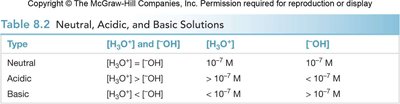
Summary Table: Neutral, Acidic, and Basic Solutions
The following table summarizes the relationship between hydronium and hydroxide ion concentrations in different types of solutions:
Type | [H3O+] and [OH−] | [H3O+] | [OH−] |
|---|---|---|---|
Neutral | [H3O+] = [OH−] | 10−7 M | 10−7 M |
Acidic | [H3O+] > [OH−] | > 10−7 M | < 10−7 M |
Basic | [H3O+] < [OH−] | < 10−7 M | > 10−7 M |
