 Back
Acids and Bases: Definitions, Strength, Equilibria, and Applications
Study Guide - Smart Notes
 Tailored notes based on your materials, expanded with key definitions, examples, and context.
Acids and Bases: Fundamental Definitions
Arrhenius Definition
The Arrhenius definition classifies acids and bases based on their behavior in water. An acid is a substance that produces H+ ions when dissolved in water, while a base produces OH- ions.
Strong Acids and Bases: Dissociate completely in water, meaning all acid or base molecules react to form ions.
Weak Acids and Bases: Dissociate only partially; most molecules remain intact.
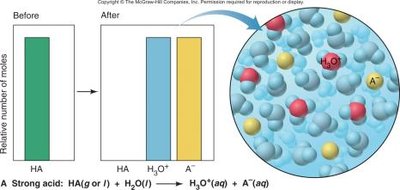
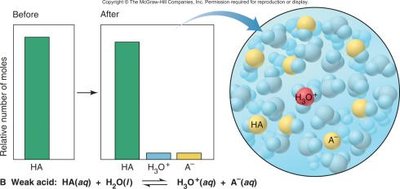
Example: Hydrochloric acid (HCl) is a strong acid; acetic acid (CH3COOH) is a weak acid.
Brønsted-Lowry Definition
The Brønsted-Lowry definition expands the concept: an acid is a proton (H+) donor, and a base is a proton acceptor. This definition applies to reactions in aqueous and non-aqueous solutions.
Conjugate Acid-Base Pair: When an acid donates a proton, it forms its conjugate base; when a base accepts a proton, it forms its conjugate acid.
Example: HCl(aq) + H2O → H3O+(aq) + Cl-(aq)
Lewis Definition
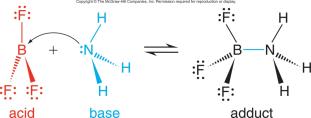
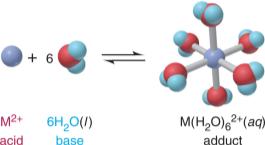
The Lewis definition further broadens acid-base chemistry: a Lewis acid accepts an electron pair, while a Lewis base donates an electron pair. This includes many reactions not covered by the other definitions.
Any Brønsted-Lowry base is also a Lewis base.
Electron-deficient species (such as BF3) and metal cations can act as Lewis acids.
Acid and Base Strength
Strong vs. Weak Acids and Bases
Acid and base strength depends on the extent of dissociation in water.
Strong Acids: Hydrohalic acids (HCl, HBr, HI), and oxoacids where the number of O atoms exceeds ionizable protons by two or more (e.g., HNO3, H2SO4).
Weak Acids: HF, acids where H is not bonded to O or a halogen (e.g., HCN), oxoacids with fewer O atoms, and carboxylic acids (RCOOH).
Strong Bases: Water-soluble compounds with O2- or OH- ions, especially group 1A and 2A metal hydroxides.
Weak Bases: Amines (NR3), ammonia (NH3), and anions of weak acids.
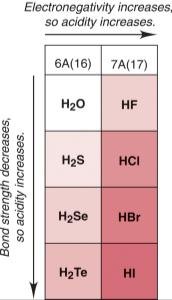
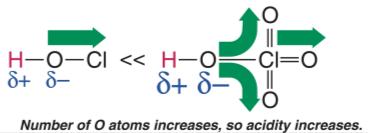
Factors Affecting Acid Strength
Electronegativity: Acidity increases with higher electronegativity of the atom bonded to H.
Bond Strength: Weaker H–X bonds dissociate more easily, increasing acidity.
Oxoacids: More O atoms increase acidity by stabilizing the negative charge on the conjugate base.
Self-Ionization of Water and pH
Autoionization of Water
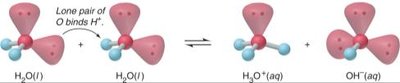
Water molecules can react with each other to form hydronium (H3O+) and hydroxide (OH-) ions in a process called autoionization.
Equation:
Equilibrium constant: at 25°C
pH, pOH, and pKw
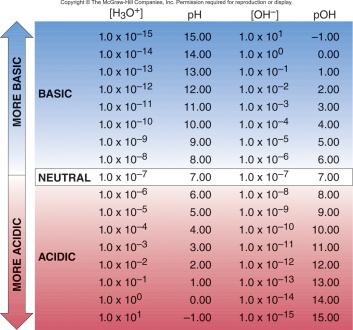
The pH scale quantifies acidity and basicity:
at 25°C
[H3O+] and [OH-] are inversely related.
Acid Dissociation Constant (Ka) and Base Dissociation Constant (Kb)
Acid Dissociation Constant (Ka)
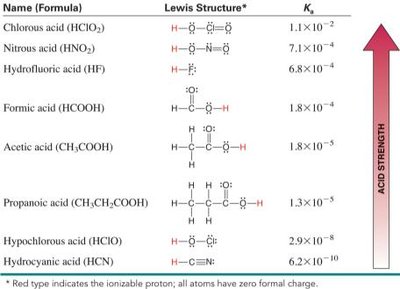
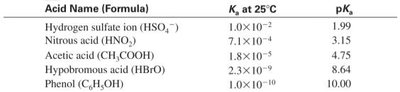
Ka measures the strength of an acid in water:
Larger Ka means stronger acid; smaller Ka means weaker acid.
Base Dissociation Constant (Kb)
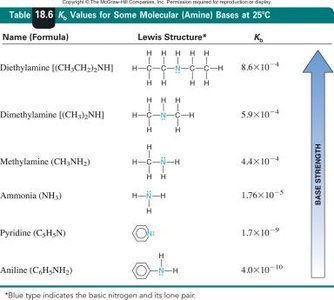
Kb measures the strength of a base in water:
Stronger bases have larger Kb values.
Acid-Base Equilibria and Calculations
Solving Acid-Base Equilibria
To solve for concentrations in acid-base equilibria:
Write a balanced equation.
Write the Ka or Kb expression.
Define x as the change in concentration.
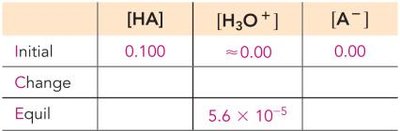
Construct a reaction table (ICE table).
Make simplifying assumptions if justified.
Substitute values and solve for x.
Check assumptions (5% rule).
Polyprotic Acids
Definition and Successive Dissociation
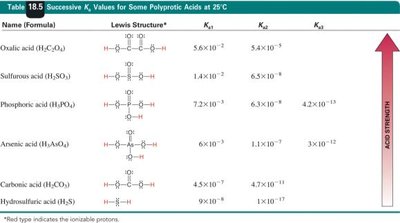
Polyprotic acids have more than one acidic proton and dissociate in steps, each with its own Ka value. The first dissociation is usually the strongest.
Examples: H2SO4, H3PO4, H2CO3
Successive Ka values decrease:
Weak Bases and Conjugate Acid-Base Pairs
Weak Bases
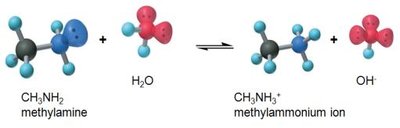
Weak bases accept protons from water, forming their conjugate acids and OH- ions.
Common weak bases: amines, anions of weak acids.
Example: CH3NH2 + H2O ⇌ CH3NH3+ + OH-
Relationship Between Ka, Kb, and Kw
For any conjugate acid-base pair:
This relationship allows calculation of base strength from acid strength and vice versa.
Salts and Their Effect on pH
Salt Solutions
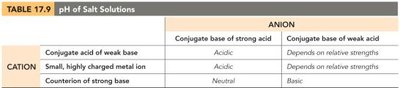
The pH of a salt solution depends on the nature of its cation and anion:
Salts from strong acid and strong base: neutral
Salts from strong acid and weak base: acidic
Salts from weak acid and strong base: basic
Lewis Acids and Bases: Applications
Electron-Deficient Species
Boron and aluminum compounds often act as Lewis acids due to their vacant orbitals.
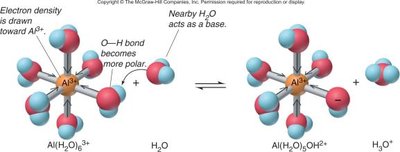
Hydrated Metal Ions
Metal cations in water can act as Lewis acids, forming hydrated ions and sometimes releasing H+ to make the solution acidic.
Summary Table: Learning Objectives
Define and classify acids and bases (Arrhenius, Brønsted-Lowry, Lewis)
Identify conjugate acids and bases
Calculate pH of strong and weak acid/base solutions
Relate pH, pOH, [H+], and [OH-]
Relate Ka and Kb to acid/base strength
Predict pH of salt solutions
Apply Lewis acid-base theory to electron-deficient species and metal ions
