 Back
BackAcids and Bases: Properties, Definitions, and Reactions
Study Guide - Smart Notes
 Tailored notes based on your materials, expanded with key definitions, examples, and context.
Acids and Bases
Introduction to Acids and Bases
Acids and bases are fundamental classes of compounds in chemistry, each with distinct properties and behaviors. Their study is essential for understanding chemical reactions, biological systems, and industrial processes.
Properties of Acids
Sour Taste: Acids typically taste sour. For example, the sour taste of candies like Sour Patch Kids is due to citric and tartaric acids, which release H+ ions that interact with taste receptors.
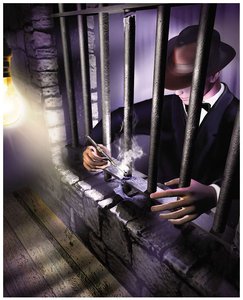
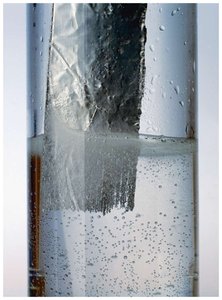
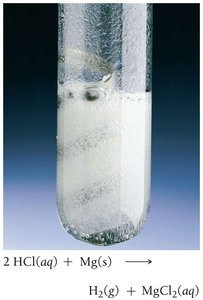
Reaction with Metals: Acids can dissolve many metals, producing hydrogen gas and a salt. However, some metals like gold are resistant to acid attack.
Litmus Test: Acids turn blue litmus paper red.
Examples of Common Acids
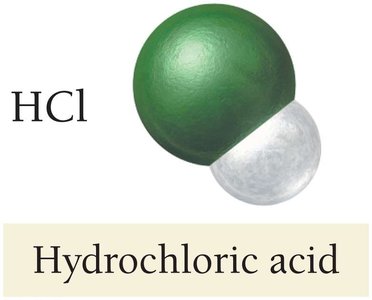
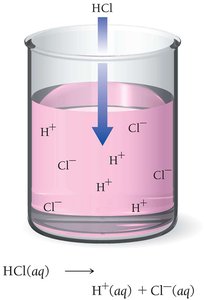
Hydrochloric Acid (HCl): Found in laboratories and stomach acid; used for cleaning metals and processing foods.
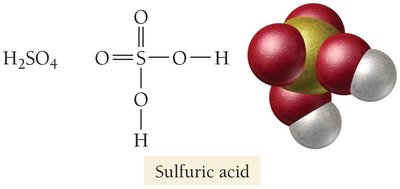
Sulfuric Acid (H2SO4): Widely used in industry, especially in fertilizers and batteries.
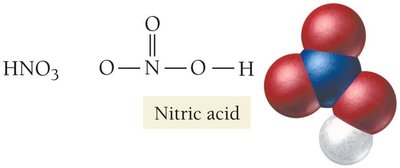
Nitric Acid (HNO3): Used in manufacturing fertilizers, explosives, and dyes.
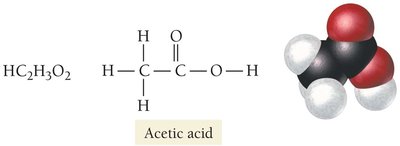
Acetic Acid (HC2H3O2): Main component of vinegar; a carboxylic acid.
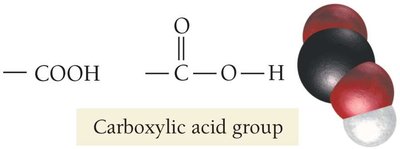
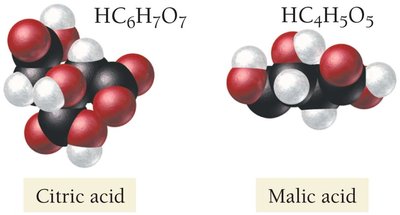
Carboxylic Acids: Organic acids containing the –COOH group, found in many biological substances (e.g., citric acid in lemons, malic acid in apples).
Properties of Bases
Bitter Taste: Bases taste bitter and are less common in foods due to their potential toxicity (e.g., alkaloids like coniine).
Slippery Feel: Bases feel slippery because they react with oils on the skin to form soap-like substances.
Litmus Test: Bases turn red litmus paper blue.
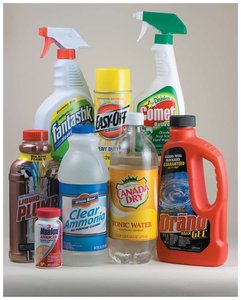
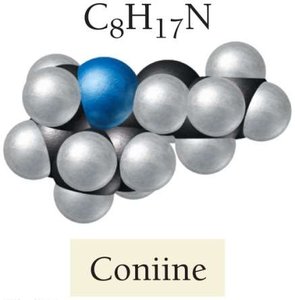
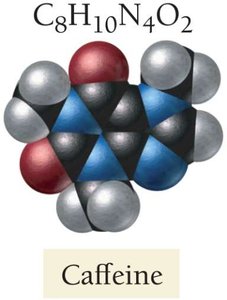
Examples of Common Bases
Sodium Hydroxide (NaOH): Used in soap making and drain cleaners.
Potassium Hydroxide (KOH): Used in manufacturing and as a laboratory reagent.
Sodium Bicarbonate (NaHCO3): Baking soda; used as an antacid.
Definitions of Acids and Bases
Arrhenius Definition
Acid: Produces H+ ions in aqueous solution.
Base: Produces OH− ions in aqueous solution.

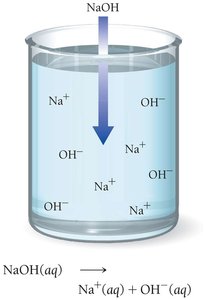
Brønsted–Lowry Definition
Acid: Proton (H+) donor.
Base: Proton (H+) acceptor.
This definition applies to a wider range of reactions, including those not in water.
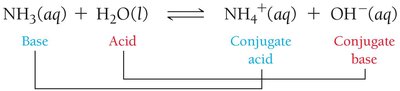


Conjugate Acid–Base Pairs
Any two substances related by the gain or loss of a proton are called a conjugate acid–base pair. For example, NH3 and NH4+ or H2O and OH−.
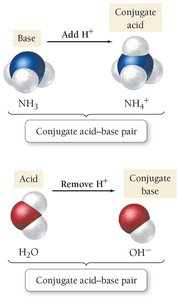
Reactions of Acids and Bases
Neutralization Reactions
When an acid reacts with a base, the H+ from the acid combines with the OH− from the base to form water. The other ions form a salt.
General Equation: $\mathrm{H^+ (aq) + OH^- (aq) \rightarrow H_2O (l)}$
Acid–base reactions with carbonates or bicarbonates produce water, carbon dioxide, and a salt.
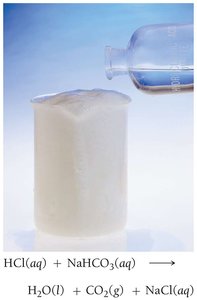
Acids Reacting with Metals
Acids react with many metals to produce hydrogen gas and a dissolved salt containing the metal ion.



Acids Reacting with Metal Oxides
Acids react with metal oxides to produce water and a dissolved salt.
Bases Reacting with Aluminum
Some metals, such as aluminum, can dissolve in strong bases like NaOH, producing hydrogen gas and a soluble aluminate ion.
Acid–Base Titration
Quantifying Acid or Base in Solution
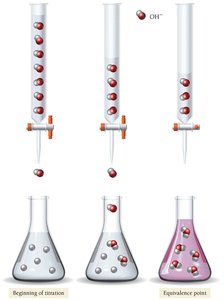
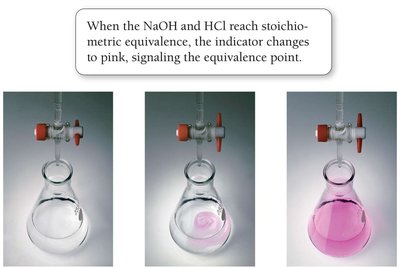
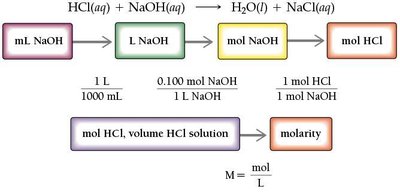
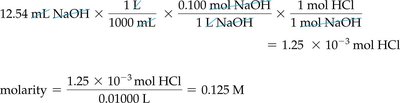
Titration is a laboratory technique used to determine the concentration of an unknown acid or base by reacting it with a solution of known concentration. The equivalence point is reached when stoichiometric amounts of acid and base have reacted.

Strong and Weak Acids and Bases
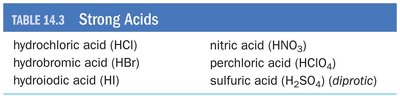
Strong Acids
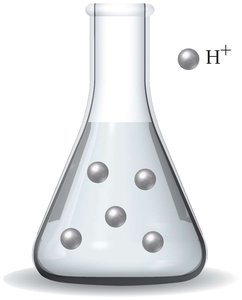
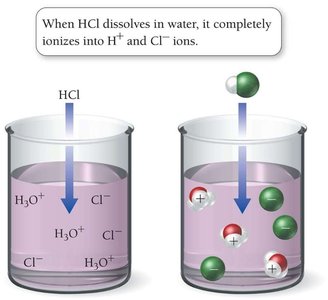
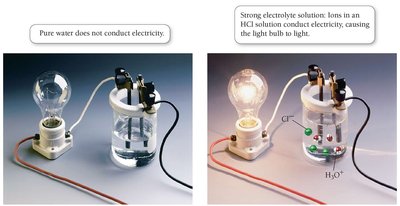
Completely ionize in solution, producing a high concentration of H+ (or H3O+).
Examples: HCl, HBr, HI, HNO3, HClO4, H2SO4 (first proton only).
Weak Acids
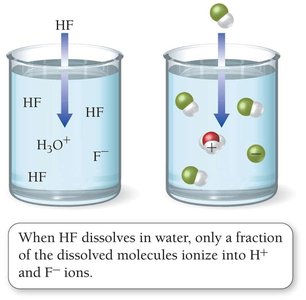
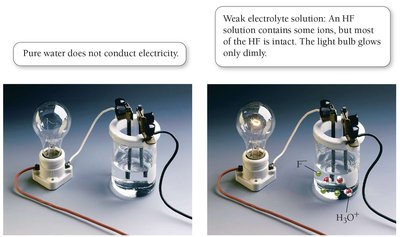
Only partially ionize in solution; most molecules remain intact.
Examples: HF, acetic acid, formic acid, carbonic acid, phosphoric acid.

Strong Bases
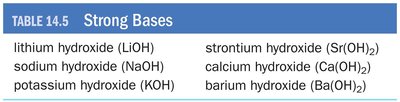
Completely dissociate in solution to produce OH− ions.
Examples: NaOH, KOH, Ba(OH)2, Sr(OH)2.
Weak Bases
Partially react with water to produce OH− ions; most molecules remain unreacted.
Examples: Ammonia (NH3), organic amines.
Water: Acid and Base in One (Amphoteric Behavior)
Water can act as both an acid and a base (amphoteric). In pure water, a small amount undergoes self-ionization:
$\mathrm{2H_2O(l) \rightleftharpoons H_3O^+(aq) + OH^-(aq)}$
At 25°C: $[\mathrm{H_3O^+}] = [\mathrm{OH^-}] = 1.0 \times 10^{-7}$ M
The ion product constant for water: $K_w = [\mathrm{H_3O^+}][\mathrm{OH^-}] = 1.0 \times 10^{-14}$
The pH and pOH Scales
pH: $\mathrm{pH = -\log [H_3O^+]}$
pOH: $\mathrm{pOH = -\log [OH^-]}$
At 25°C: pH + pOH = 14
pH < 7: acidic; pH > 7: basic; pH = 7: neutral
Buffers
Buffers are solutions that resist changes in pH when small amounts of acid or base are added. They contain significant amounts of both a weak acid and its conjugate base. Buffers are crucial in biological systems, such as blood, to maintain a stable pH.
Applications and Environmental Impact
Antifreeze Poisoning: Ethylene glycol is metabolized to glycolic acid, which can overwhelm the body's buffer system, leading to dangerously low blood pH.
Acid Rain: Caused by sulfur and nitrogen oxides reacting with water to form acids, which can damage buildings and ecosystems.
