 Back
Acids and Bases: Properties, Definitions, Strength, and Calculations
Study Guide - Smart Notes
 Tailored notes based on your materials, expanded with key definitions, examples, and context.
Acids and Bases
The Nature of Acids and Bases
Acids and bases are fundamental chemical species with distinct properties and behaviors in aqueous solutions. Understanding their nature is essential for predicting chemical reactions and solution characteristics.
Acids typically have a sour taste, react with active metals (e.g., Al, Zn, Fe), are corrosive, and turn blue litmus paper red. They react with carbonates to produce CO2 and with bases to form salts (neutralization).
Bases (alkalis) taste bitter, feel slippery, turn red litmus paper blue, and react with acids to form salts. Many bases are alkaloids, which are often poisonous plant products.
Arrhenius Definition of Acids and Bases
The Arrhenius theory defines acids and bases based on their behavior in water.
Acid: Produces H+ ions in aqueous solution.
Base: Produces OH- ions in aqueous solution.
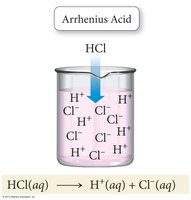
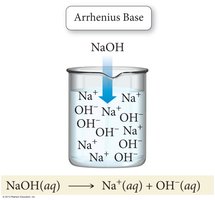
Limitations: The Arrhenius theory does not explain basicity of substances like NH3 or Na2CO3 that do not contain OH-, nor does it account for acid-base reactions outside aqueous solutions.
Brønsted–Lowry Definition
The Brønsted–Lowry theory expands the concept of acids and bases:
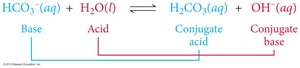
Acid: Donates a proton (H+).
Base: Accepts a proton (H+).
This definition explains reactions involving substances that do not contain OH- or H+ directly.
Conjugate Acid-Base Pairs
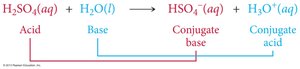
When an acid donates a proton, it forms its conjugate base; when a base accepts a proton, it forms its conjugate acid. These pairs are related by the transfer of a single proton.

Acid and Base Strength
Acids and bases are classified as strong or weak based on their degree of dissociation in water.
Strong acids/bases: Completely dissociate in water (strong electrolytes).
Weak acids/bases: Partially dissociate in water (weak electrolytes).
Ka (acid ionization constant): Ka > 1 indicates strong acid; Ka < 1 indicates weak acid.
Kb (base ionization constant): Kb > 1 indicates strong base; Kb < 1 indicates weak base.
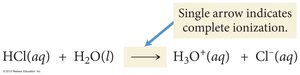
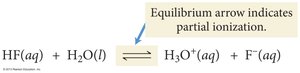
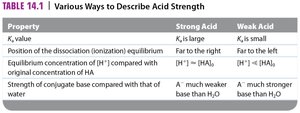
Property | Strong Acid | Weak Acid |
|---|---|---|
Ka value | Ka is large | Ka is small |
Position of equilibrium | Far to the right | Far to the left |
[H+] compared to [HA] | [H+] ≈ [HA] | [H+] << [HA] |
Strength of conjugate base | A- much weaker than H2O | A- much stronger than H2O |
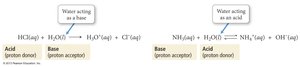
Water as an Acid and a Base (Amphoteric Behavior)
Water can act as both an acid and a base, depending on its environment. This amphoteric nature is demonstrated in reactions with strong acids and bases.
Autoionization of Water
Water undergoes autoionization, producing hydronium and hydroxide ions:
at 25°C
The pH Scale
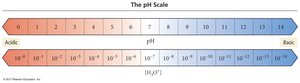
The pH scale is a logarithmic measure of acidity, ranging typically from 0 (very acidic) to 14 (very basic). pH is defined as:
pOH and Relationship to pH
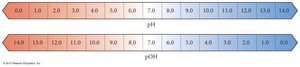
pOH is a similar logarithmic scale for hydroxide ion concentration:
(at 25°C)
Acid and Base Calculations
Calculating pH of Strong Acids
For strong acids, the concentration of acid equals the concentration of hydronium ion:
Calculating pH of Weak Acids
Weak acids require equilibrium calculations using ICE tables and the acid dissociation constant (Ka):
Set up the equilibrium:
Use the ICE table to solve for [H3O+]
Calculating pH of Strong Bases
For strong bases, the concentration of base equals the concentration of hydroxide ion:
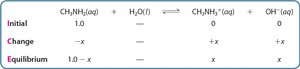
Calculating pH of Weak Bases
Weak bases require equilibrium calculations using ICE tables and the base dissociation constant (Kb):
Percent Dissociation (Ionization)
Percent dissociation is the fraction of acid molecules that ionize in solution, increasing as the initial concentration decreases.
Polyprotic Acids
Polyprotic acids can donate more than one proton, dissociating stepwise with decreasing Ka values for each subsequent proton.
Acid-Base Properties of Salts
The pH of a salt solution depends on the origins of its cation and anion:
Neutral: Cation from strong base, anion from strong acid (e.g., NaCl)
Basic: Cation from strong base, anion from weak acid (e.g., NaF)
Acidic: Cation from weak base, anion from strong acid (e.g., NH4Cl)
Effect of Structure on Acid-Base Properties
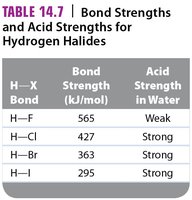
Acid strength is influenced by bond strength and bond polarity. For binary acids, strength increases across a period and down a group as bond strength decreases and bond polarity increases.
H–X Bond | Bond Strength (kJ/mol) | Acid Strength in Water |
|---|---|---|
H–F | 565 | Weak |
H–Cl | 427 | Strong |
H–Br | 363 | Strong |
H–I | 295 | Strong |
Oxyacids and Electronegativity
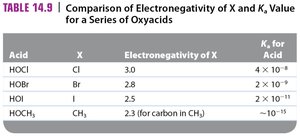
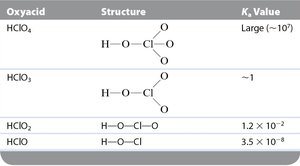
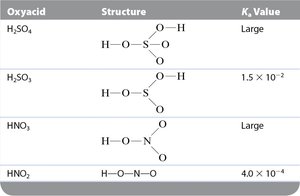
For oxyacids, acid strength increases with the electronegativity of the central atom and the number of oxygen atoms attached.
Acid | X | Electronegativity of X | Ka for Acid |
|---|---|---|---|
HOCl | Cl | 3.0 | 4 × 10⁻⁸ |
HOBr | Br | 2.8 | 2 × 10⁻⁹ |
HOI | I | 2.5 | 2 × 10–11 |
HOCH3 | CH3 | 2.3 | ~10–15 |
Oxyacid | Structure | Ka Value |
|---|---|---|
HClO4 | H–O–ClO3 | Large (~107) |
HClO3 | H–O–ClO2 | ~1 |
HClO2 | H–O–ClO | 1.2 × 10⁻² |
HClO | H–O–Cl | 3.5 × 10⁻⁸ |
Oxyacid | Structure | Ka Value |
|---|---|---|
H2SO4 | H–O–SO3 | Large |
H2SO3 | H–O–SO2 | 1.5 × 10⁻² |
HNO3 | H–O–NO2 | Large |
HNO2 | H–O–NO | 4.0 × 10⁻⁴ |
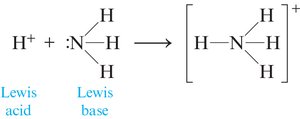
Lewis Acid-Base Theory
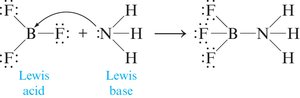
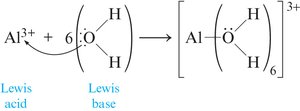
The Lewis theory defines acids as electron pair acceptors and bases as electron pair donors. This model explains reactions not covered by Brønsted–Lowry theory, such as the formation of coordinate covalent bonds.
Summary Table: Acid Strength and Structure
Acid strength increases with bond polarity and decreases with bond strength.
Oxyacid strength increases with electronegativity and number of oxygens.
Lewis acids and bases are defined by electron pair transfer, not proton transfer.
Practice Problems and Applications
Identify conjugate acid-base pairs in reactions.
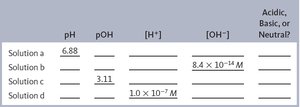
Calculate pH, pOH, [H+], and [OH-] for various solutions.
Predict the pH of salt solutions based on their cation and anion origins.
Additional info:
ICE tables are used for equilibrium calculations in weak acid/base solutions.
Polyprotic acids dissociate stepwise, with only the first dissociation significantly contributing to [H+].
Percent ionization increases as acid concentration decreases.
