 Back
BackAcids and Bases: Properties, Nomenclature, and Theories
Study Guide - Smart Notes
 Tailored notes based on your materials, expanded with key definitions, examples, and context.
Chapter 14: Acids and Bases
Section 1: Properties of Acids and Bases
Acids and bases are two fundamental categories of compounds in chemistry, each with distinct properties and behaviors in aqueous solutions.
Properties of Acids
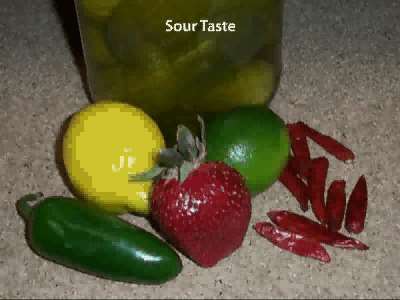
Sour taste: Many acids, such as citric acid in lemons, have a characteristic sour taste.
Indicator color change: Acids change the color of acid-base indicators (e.g., litmus turns red).
Reaction with metals: Acids react with active metals to release hydrogen gas, H2. For example:
Neutralization: Acids react with bases to produce salts and water.
Electrical conductivity: Acids conduct electric current in solution due to ionization.
Properties of Bases
Bitter taste: Bases typically taste bitter.
Indicator color change: Bases change the color of acid-base indicators (e.g., litmus turns blue).
Slippery feel: Dilute solutions of bases feel slippery to the touch.
Neutralization: Bases react with acids to produce salts and water.
Electrical conductivity: Bases conduct electric current in solution due to dissociation into ions.
Acid Nomenclature
Acids are named based on their composition and the anion they contain. There are two main types: binary acids and oxyacids.
Binary Acids
Contain hydrogen and one other, more electronegative element.
Naming rules:
Prefix "hydro-"
Root of the second element's name
Suffix "-ic"
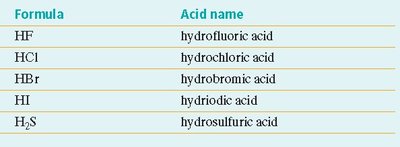
Formula | Acid name |
|---|---|
HF | hydrofluoric acid |
HCl | hydrochloric acid |
HBr | hydrobromic acid |
HI | hydroiodic acid |
H2S | hydrosulfuric acid |
Oxyacids
Contain hydrogen, oxygen, and a third element (usually a nonmetal).
The name is based on the polyatomic anion present.
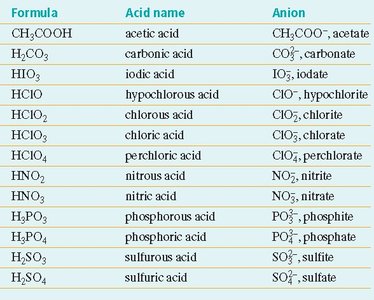
Formula | Acid name | Anion |
|---|---|---|
CH3COOH | acetic acid | CH3COO−, acetate |
H2CO3 | carbonic acid | CO32−, carbonate |
HNO3 | nitric acid | NO3−, nitrate |
H2SO4 | sulfuric acid | SO42−, sulfate |
Common Industrial Acids
Sulfuric acid (H2SO4): Most produced industrial chemical.
Nitric acid (HNO3): Used in fertilizers and explosives.
Phosphoric acid (H3PO4): Used in soft drinks and detergents.
Hydrochloric acid (HCl): Also known as muriatic acid, used in cleaning and processing steel.
Acetic acid (CH3COOH): Pure form is called glacial acetic acid, used in vinegar.
Arrhenius Acids and Bases
The Arrhenius definition is one of the earliest and simplest ways to classify acids and bases based on their behavior in water.
Arrhenius acid: Increases the concentration of hydrogen ions (H+) or hydronium ions (H3O+) in aqueous solution.
Arrhenius base: Increases the concentration of hydroxide ions (OH−) in aqueous solution.
Strength of Acids and Bases
The strength of an acid or base depends on its degree of ionization or dissociation in water.
Strong and Weak Acids
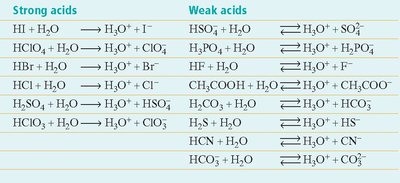
Strong acids: Ionize completely in aqueous solution (e.g., HCl, HNO3, HClO4).
Weak acids: Ionize only partially, producing fewer hydrogen ions (e.g., CH3COOH, HCN).
Strong acids | Weak acids | |
|---|---|---|
HI + H2O → H3O+ + I− | HSO4− + H2O ⇌ H3O+ + SO42− |
Strong and Weak Bases
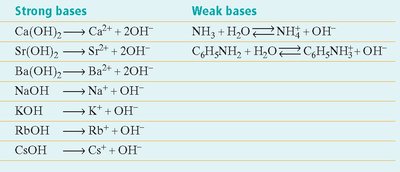
Strong bases: Dissociate completely in water (e.g., NaOH, KOH, Ba(OH)2).
Weak bases: Only partially react with water to produce hydroxide ions (e.g., NH3).
Strong bases | Weak bases | |
|---|---|---|
Ca(OH)2 → Ca2+ + 2OH− | NH3 + H2O ⇌ NH4+ + OH− |
Relationship of [H3O+] to [OH−]
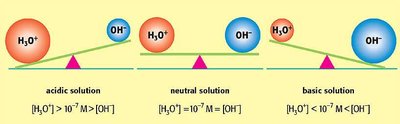
The concentrations of hydronium and hydroxide ions determine whether a solution is acidic, neutral, or basic.
Acidic solution: [H3O+] > [OH−]
Neutral solution: [H3O+] = [OH−] = M
Basic solution: [H3O+] < [OH−]
Section 2: Acid-Base Theories
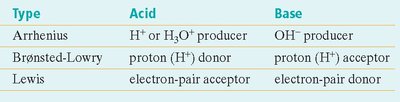
There are three main theories for defining acids and bases: Arrhenius, Brønsted-Lowry, and Lewis.
Type | Acid | Base |
|---|---|---|
Arrhenius | H+ or H3O+ producer | OH− producer |
Brønsted-Lowry | proton (H+) donor | proton (H+) acceptor |
Lewis | electron-pair acceptor | electron-pair donor |
Brønsted-Lowry Acids and Bases
Acid: Proton (H+) donor
Base: Proton (H+) acceptor
Example:
Lewis Acids and Bases
Lewis acid: Electron-pair acceptor (may not contain hydrogen)
Lewis base: Electron-pair donor
Example:
Monoprotic and Polyprotic Acids
Acids are classified by the number of protons (hydrogen ions) they can donate per molecule.
Monoprotic acid: Donates one proton (e.g., HCl, HNO3).
Diprotic acid: Donates two protons (e.g., H2SO4).
Triprotic acid: Donates three protons (e.g., H3PO4).
Section 3: Acid-Base Reactions
Conjugate Acids and Bases
In Brønsted-Lowry theory, acids and bases exist in conjugate pairs. When an acid donates a proton, it forms its conjugate base; when a base accepts a proton, it forms its conjugate acid.
Conjugate acid: The species formed when a base gains a proton.
Conjugate base: The species formed when an acid loses a proton.
Example:
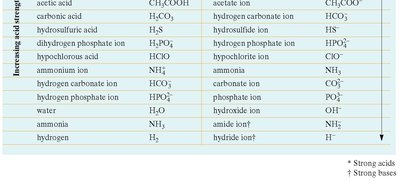
Strength of Conjugate Acids and Bases
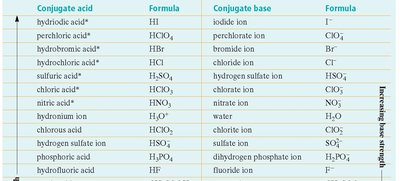
The stronger an acid, the weaker its conjugate base, and vice versa.
Proton transfer reactions favor the formation of the weaker acid and base.
Conjugate acid | Formula | Conjugate base | Formula |
|---|---|---|---|
Hydriodic acid | HI | Iodide ion | I− |
Perchloric acid | HClO4 | Perchlorate ion | ClO4− |
Amphoteric Compounds
Amphoteric substances can act as either acids or bases depending on the reaction. Water is a classic example.
Hydroxyl group (–OH): The presence and bonding of –OH groups influence whether a compound is acidic, basic, or amphoteric.
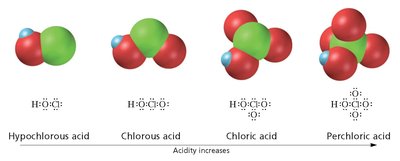
Oxyacids of Chlorine
Oxyacids of chlorine demonstrate how increasing the number of oxygen atoms increases acidity.
Neutralization Reactions
Neutralization is the reaction between hydronium ions (from acids) and hydroxide ions (from bases) to form water. The other product is a salt, an ionic compound composed of a cation from the base and an anion from the acid.
General equation:
