 Back
BackAcids and Bases: Strength, Structure, and Applications
Study Guide - Smart Notes
 Tailored notes based on your materials, expanded with key definitions, examples, and context.
Chapter 16: Acids and Bases
Introduction
This chapter explores the nature of acids and bases, focusing on why some acids are strong and others are weak, how molecular structure influences acidity, and the relevance of acid-base properties in drug molecules. Key concepts include the Arrhenius and Brønsted-Lowry definitions, conjugate acid-base pairs, and the relationship between structure and acid strength.
Arrhenius and Brønsted-Lowry Definitions
Arrhenius Acids and Bases
Arrhenius Acid: A compound that produces hydrogen ions (H+) or hydronium ions (H3O+) when dissolved in water.
Arrhenius Base: A compound that produces hydroxide ions (OH-) in water.
Strong acids completely ionize in water, producing only ions in solution. The six strong acids to memorize are: HCl, HBr, HI, HNO3, HClO4, and H2SO4. Weak acids only partially ionize, resulting in a mixture of molecules and ions. Example: acetic acid (CH3COOH).
Strong bases (e.g., NaOH, KOH) completely dissociate in water, while weak bases (e.g., NH3) only partially ionize.
Brønsted-Lowry Acids and Bases
Brønsted-Lowry Acid: Proton (H+) donor.
Brønsted-Lowry Base: Proton (H+) acceptor (must have a lone pair).
Amphoteric substances: Can act as either acid or base (e.g., water).
Conjugate acid-base pairs: Two species that differ by one proton.
Example: NH3 is the base, H2O is the acid; NH4+ is the conjugate acid, OH- is the conjugate base.
Conjugate Acid-Base Pairs
Definition and Examples
A conjugate acid-base pair consists of two species that differ by a single proton.
Example: HCN and CN-; H2O and H3O+.
Strong acids have weak conjugate bases; weak acids have relatively stronger conjugate bases.
Structure and Acid Strength
Binary Acids (H–X)
Binary acids consist of hydrogen and one other element (X). Their acidity is influenced by bond strength and electronegativity.
Across a period: Acidity increases with increasing electronegativity.
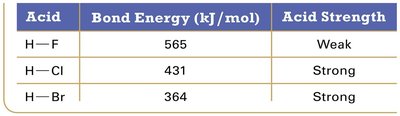
Down a group: Acidity increases as bond strength decreases (larger atoms form weaker H–X bonds).
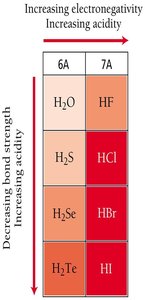
Example: HF (strong H–F bond, weak acid) vs. HI (weak H–I bond, strong acid).
Oxyacids (H–O–Y)
Oxyacids have the general formula H–O–Y, where Y is a central atom bonded to oxygen.
More oxygen atoms: Stronger acid (e.g., HClO4 > HClO3 > HClO2 > HClO).
More electronegative central atom (Y): Stronger acid if the number of oxygens is the same.
Example ranking: HClO3 > HBrO3 > HClO2 > HClO > HOBr.
Carboxylic Acids (R–COOH)
All carboxylic acids are weak acids. Their strength depends on the substituents attached to the carbon next to the –COOH group.
Electron-withdrawing groups (e.g., Cl, F) increase acidity by stabilizing the conjugate base.
Example ranking: CF3COOH > CCl3COOH > CBr3COOH > CI3COOH > CH3COOH.
More electronegative substituents lead to a stronger acid due to the inductive effect.
Acid and Base Strength in Drug Molecules
Functional Groups and Biological Relevance
Acidic groups: –COOH, –SO3H, phenol (aromatic –OH).
Basic groups: Amines (–NH2, –NHR, –NR2), nitrogen in heterocycles.
Acidic drugs may be negatively charged; basic drugs may be positively charged.
Charge affects solubility, absorption, and membrane crossing in biological systems.
Quantifying Acid Strength: The Acid Dissociation Constant (Ka)
Strong vs. Weak Acids
Strong acid: Large Ka, nearly 100% ionized, [H3O+] equals initial acid concentration.
Weak acid: Small Ka, partial ionization, equilibrium mixture of molecules and ions.
For a weak acid, the equilibrium expression is:
Example: For acetic acid (CH3COOH), .
Calculating [H3O+] for Weak Acids
Write the equilibrium reaction.
Set up an ICE table (Initial, Change, Equilibrium).
Let x = amount ionized.
Substitute into the Ka expression and solve for x.
Example: For 0.10 M CH3COOH, [H3O+] = M, percent ionization = 1.3%.
Percent Ionization
Definition and Examples
Strong acids: 100% ionization in water.
Weak acids: Low percent ionization (e.g., 1.3% for 0.10 M acetic acid).
Percent ionization decreases as acid concentration increases.
Percent ionization formula:
Comparative Examples and Applications
Ranking Acid Solutions
Given three 0.10 M solutions: HCl (strong acid), HF (weak acid, ), CH3COOH (weak acid, ):
(a) Highest % ionization and [H3O+]: HCl > HF > CH3COOH
(b) Most undissociated acid: CH3COOH > HF > HCl
Upon dilution, weak acids show increased percent ionization; strong acids do not.
