 Back
BackAcids, Bases, and Aqueous Ionic Equilibria: Study Notes for General Chemistry
Study Guide - Smart Notes
 Tailored notes based on your materials, expanded with key definitions, examples, and context.
Chapter 16: Acids and Bases
Brønsted-Lowry Theory of Acids and Bases
The Brønsted-Lowry theory defines acids and bases based on their ability to donate or accept protons (H+). This model expands upon the Arrhenius definition and is widely used in chemistry.
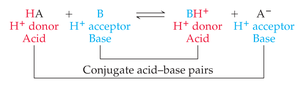
Brønsted-Lowry Acid: A substance that donates a proton (H+) to another substance. Typically, the proton is bonded to an electronegative atom.
Brønsted-Lowry Base: A substance that accepts a proton, usually possessing a lone pair of electrons to form a new bond with H+.
Conjugate Acid: The species formed when a base gains a proton.
Conjugate Base: The species formed when an acid loses a proton.
Conjugate Acid-Base Pair: Two species that differ by one proton.
Strong and Weak Acids and Bases
Acids and bases are classified as strong or weak based on their degree of ionization in water.
Strong Acid: Completely dissociates in water to produce H3O+ ions. Examples: HCl, HBr, HI, HNO3, HClO4, H2SO4 (first ionization).
Strong Base: Completely dissociates in water to produce OH− ions. Examples: LiOH, NaOH, KOH, RbOH, CsOH, Ca(OH)2, Sr(OH)2, Ba(OH)2.
Weak Acid: Partially dissociates in water. Examples: HF, CH3COOH, H3PO4, HNO2, HCN.
Weak Base: Partially dissociates in water. Examples: NH3, CH3NH2.
Key Points:
For strong acids, [H3O+] = initial acid concentration.
For strong bases, [OH−] = initial base concentration (adjust for polyhydroxide bases).
For weak acids and bases, equilibrium calculations are required to determine ion concentrations.
Acid and Base Strength Trends
The strength of acids and bases is influenced by molecular structure and periodic trends.
Acid Strength: The stronger the acid, the weaker its conjugate base. Acid strength increases with higher Ka and lower pKa values.
Base Strength: The stronger the base, the weaker its conjugate acid. Base strength increases with higher Kb and lower pKb values.
Bond Strength (Binary Acids): For acids with H–A bonds, acid strength increases as bond strength decreases (down a group: HF << HCl < HBr < HI).
Electronegativity (Binary Acids): For acids in the same period, acid strength increases with the electronegativity of A (CH4 < NH3 < H2O < HF).
Oxoacids: For acids with the same number of O atoms, acid strength increases with the electronegativity of the central atom. For acids with the same central atom, acid strength increases with the number of O atoms (HClO < HClO2 < HClO3 < HClO4).
Acid and Base Dissociation Constants
The extent of ionization for weak acids and bases is quantified by their dissociation constants.
Acid Dissociation Constant (Ka):
pKa:
Base Dissociation Constant (Kb):
pKb:
Relationship: and at 25°C.
pH, pOH, and Ion Product of Water
The pH scale quantifies the acidity or basicity of a solution. The ion product of water (Kw) is fundamental to these calculations.
at 25°C
at 25°C
Solution Classification:
pH < 7: Acidic
pH = 7: Neutral
pH > 7: Basic
Percent Ionization
Percent ionization measures the fraction of acid molecules that ionize in solution.
Percent Ionization =
Polyprotic Acids
Polyprotic acids can donate more than one proton, with each ionization step having its own Ka value.
Each successive proton is harder to remove:
The conjugate base of the first step acts as the acid in the next step.
Acid-Base Properties of Salts
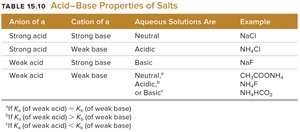
Salts can produce acidic, basic, or neutral solutions depending on the strengths of the parent acid and base.
Anion of a | Cation of a | Aqueous Solutions Are | Example |
|---|---|---|---|
Strong acid | Strong base | Neutral | NaCl |
Strong acid | Weak base | Acidic | NH4Cl |
Weak acid | Strong base | Basic | NaF |
Weak acid | Weak base | Neutral*, Acidic*, or Basic* | CH3COONH4, NH4F, NH4HCO3 |
*If Ka (of weak acid) = Kb (of weak base): Neutral If Ka (of weak acid) > Kb (of weak base): Acidic If Ka (of weak acid) < Kb (of weak base): Basic
Chapter 17: Aqueous Ionic Equilibria (Sections 17.2 – 17.4)
Common Ion Effect
The common ion effect describes the shift in equilibrium that occurs when a solution already contains one of the ions involved in the equilibrium. This suppresses the ionization of weak acids or bases.
Example: In acetic acid solution, adding sodium acetate (which provides acetate ions) decreases the ionization of acetic acid, lowering [H3O+] and increasing pH.
Buffer Solutions
Buffer solutions consist of a weak acid and its conjugate base (or a weak base and its conjugate acid). They resist drastic changes in pH upon addition of small amounts of acid or base.
The weak acid neutralizes added base; the conjugate base neutralizes added acid.
The best buffer has a pH close to the pKa of the weak acid.
Henderson-Hasselbalch Equation
The Henderson-Hasselbalch equation is used to calculate the pH of buffer solutions:
Given pH and pKa, the ratio of [base]/[acid] can be determined.
Titration and Titration Curves
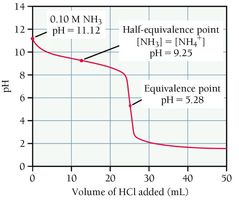
Titration is a technique for determining the concentration of a solution by reacting it with a solution of known concentration. The titration curve plots pH versus volume of titrant added.
Equivalence Point: The point at which stoichiometrically equivalent quantities of acid and base have reacted.
The shape of the titration curve depends on the strengths of the acid and base involved.
Strong Acid with Strong Base
Sharp rise in pH at equivalence point; equivalence point at pH = 7.
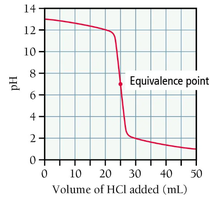
Strong Base with Strong Acid
Sharp drop in pH at equivalence point; equivalence point at pH = 7.
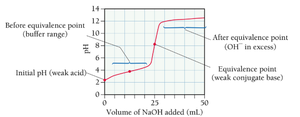
Weak Acid with Strong Base
Initial pH is higher than for a strong acid; equivalence point pH > 7 due to formation of a weak conjugate base.
Buffer region before equivalence point.
Weak Base with Strong Acid
Initial pH is high; equivalence point pH < 7 due to formation of a weak conjugate acid.
Buffer region before equivalence point.
Key Skills and Calculations
Calculate pH from [H+] or [OH−], and vice versa.
Calculate pH of strong acid/base solutions given concentration.
Determine Ka or Kb from pH and concentration for weak acids/bases.
Use ICE tables to solve equilibrium problems for weak acids and bases.
Calculate buffer pH using the Henderson-Hasselbalch equation.
Calculate pH changes upon addition of strong acid or base to a buffer.
Interpret titration curves and identify equivalence points.
