 Back
Acids, Bases, and Buffer Systems: Study Notes for General Chemistry
Study Guide - Smart Notes
 Tailored notes based on your materials, expanded with key definitions, examples, and context.
Acids and Bases: Definitions and Concepts
Arrhenius and Brønsted-Lowry Definitions
The concept of acids and bases is fundamental in chemistry, with several definitions used to describe their behavior in aqueous solutions.
Arrhenius Acid: Produces H+ ions in water.
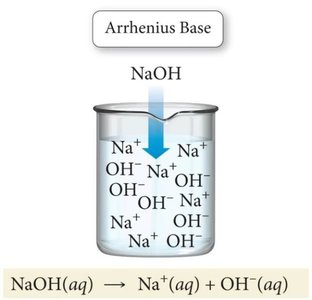
Arrhenius Base: Produces OH- ions in water.
Brønsted-Lowry Acid: Donates a proton (H+).
Brønsted-Lowry Base: Accepts a proton (H+).
Amphoteric: A substance that can act as both an acid and a base (e.g., water).
Conjugate Acid-Base Pairs: When an acid donates a proton, it forms its conjugate base; when a base accepts a proton, it forms its conjugate acid.
Acid and Base Strength
Strong vs. Weak Acids and Bases
Acids and bases are classified as strong or weak based on their degree of ionization in water.
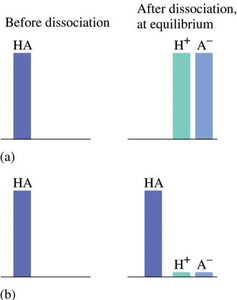
Strong Acids: Completely ionize in water; reaction goes to completion. Examples include HCl, HBr, HI, HNO3, HClO4, and H2SO4.
Weak Acids: Partially ionize in water; characterized by an equilibrium constant, Ka.
Strong Bases: Hydroxides of Group 1 and 2 metals (except Mg); completely dissociate in water.
Weak Bases: Partially ionize in water; characterized by an equilibrium constant, Kb.
The relationship between acid and base strength is inverse: the stronger the acid, the weaker its conjugate base, and vice versa.
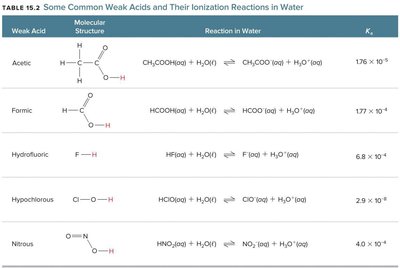
Examples of Weak Acids and Their Ionization
Weak acids have characteristic ionization reactions and equilibrium constants (Ka).
Weak Acid | Molecular Structure | Reaction in Water | Ka |
|---|---|---|---|
Acetic | CH3COOH | CH3COOH(aq) + H2O(l) → CH3COO-(aq) + H3O+(aq) | 1.76 × 10⁻⁵ |
Formic | HCOOH | HCOOH(aq) + H2O(l) → HCOO-(aq) + H3O+(aq) | 1.77 × 10⁻⁴ |
Hydrofluoric | HF | HF(aq) + H2O(l) → F-(aq) + H3O+(aq) | 6.8 × 10⁻⁴ |
Hypochlorous | HClO | HClO(aq) + H2O(l) → ClO-(aq) + H3O+(aq) | 2.9 × 10⁻⁸ |
Nitrous | HNO2 | HNO2(aq) + H2O(l) → NO2-(aq) + H3O+(aq) | 4.0 × 10⁻⁴ |
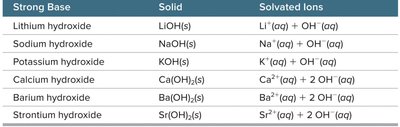
Strong Bases and Their Dissociation
Strong bases dissociate completely in water, producing hydroxide ions.
Strong Base | Solid | Solvated Ions |
|---|---|---|
Lithium hydroxide | LiOH(s) | Li+(aq) + OH-(aq) |
Sodium hydroxide | NaOH(s) | Na+(aq) + OH-(aq) |
Potassium hydroxide | KOH(s) | K+(aq) + OH-(aq) |
Calcium hydroxide | Ca(OH)2(s) | Ca2+(aq) + 2 OH-(aq) |
Barium hydroxide | Ba(OH)2(s) | Ba2+(aq) + 2 OH-(aq) |
Strontium hydroxide | Sr(OH)2(s) | Sr2+(aq) + 2 OH-(aq) |
Ionization of Water and the pH Scale
Autoionization of Water
Water can ionize itself, producing hydronium and hydroxide ions. This equilibrium is characterized by the ion product constant, Kw.
Equation:
Ion Product Constant:
At 25°C,
Neutral solution:

pH and pOH Calculations
The pH scale is used to quantify the acidity or basicity of a solution.
pH: or
pOH:
Relationship: at 25°C
pH < 7: acidic; pH > 7: basic; pH = 7: neutral (at 25°C)
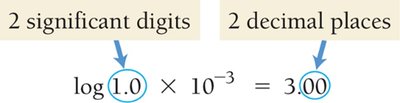
Significant Figures in pH: The number of decimal places in the pH value equals the number of significant digits in the concentration.
Buffer Solutions
Buffer Composition and Function
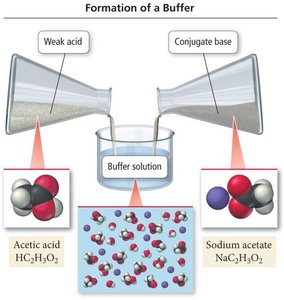
A buffer solution consists of a weak acid and its conjugate base, or a weak base and its conjugate acid. Buffers resist changes in pH when small amounts of acid or base are added.
Common Buffer Systems: Acetic acid/acetate, carbonic acid/hydrogen carbonate, ammonia/ammonium.
Buffer Equation (Henderson-Hasselbalch):
Effective buffer range: pKa ± 1
Buffer capacity: Amount of acid/base a buffer can absorb without significant pH change.
Buffer Action in Blood
The carbonic acid/bicarbonate system is a key buffer in blood, maintaining pH near 7.4. The equilibrium shifts in response to changes in CO2 concentration.
Equation:
Excess CO2: pH decreases (acidosis)
Loss of CO2: pH increases (alkalosis)
Buffer Practice: A buffer is most effective when [base]/[acid] = 1, and the effective pH range is pKa ± 1.
Summary Table: Key Equations and Relationships
