 Back
BackAcids, Bases, and pKa: Comparing Acid Strengths Using Molecular Diagrams
Study Guide - Smart Notes
 Tailored notes based on your materials, expanded with key definitions, examples, and context.
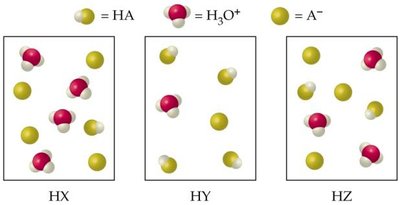
Q7. The figure below shows three acids HX, HY, and HZ (water molecules are omitted for clarity). Which acid has the largest pKa?
Background
Topic: Acid Strength and pKa
This question tests your understanding of how acid strength relates to pKa and how molecular diagrams can be used to compare the extent of ionization of different acids in water.
Key Terms and Formulas
pKa: The negative logarithm of the acid dissociation constant (). Lower pKa means stronger acid.
Acid Dissociation:
Ka:
pKa:
Step-by-Step Guidance
Examine the diagrams for HX, HY, and HZ. Count the number of undissociated acid molecules (HA), hydronium ions (), and conjugate base ions () in each box.
Recall that a strong acid will dissociate more, producing more and , while a weak acid will have more undissociated HA.
Compare the relative amounts of HA, , and in each diagram. The acid with the most undissociated HA and the least $H_3O^+$/$A^-$ is the weakest acid.
Remember: The weakest acid has the smallest and therefore the largest .
Try solving on your own before revealing the answer!
Final Answer: HY
HY has the largest pKa because it shows the least ionization (most HA, fewest and ), indicating it is the weakest acid.
We compared the diagrams and used the relationship between acid strength, , and to determine which acid is weakest.
