 Back
BackAcids, Bases, and Solution Chemistry – Step-by-Step Guidance
Study Guide - Smart Notes
 Tailored notes based on your materials, expanded with key definitions, examples, and context.
Q1. What is the conjugate base of HPO42−?
Background
Topic: Acid-Base Chemistry (Conjugate Pairs)
This question tests your understanding of conjugate acids and bases, specifically how to identify the conjugate base of a given species.
Key Terms:
Conjugate base: The species formed when an acid loses a proton (H+).
HPO42−: Hydrogen phosphate ion.
Step-by-Step Guidance
Recall that a conjugate base is formed by removing one H+ from the acid.
Write the equation for the loss of a proton from HPO42−:
Compare the answer choices to see which matches the formula for the conjugate base.
Try solving on your own before revealing the answer!
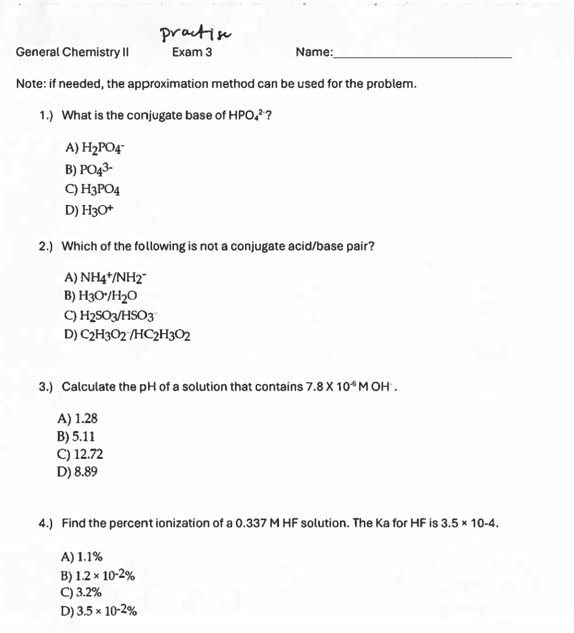
Q2. Which of the following is NOT a conjugate acid/base pair?
Background
Topic: Acid-Base Chemistry (Conjugate Pairs)
This question tests your ability to recognize conjugate acid/base pairs, which differ by one proton (H+).
Key Terms:
Conjugate acid/base pair: Two species that differ by a single proton.
Examples: NH4+/NH3, H2O/H+
Step-by-Step Guidance
For each pair, check if one species can be formed from the other by adding or removing an H+.
Write the chemical equations for each pair to see if they differ by a single proton.
Identify the pair that does NOT fit this definition.
Try solving on your own before revealing the answer!
Q3. Calculate the pH of a solution that contains M OH−.
Background
Topic: Solution Chemistry (pH and pOH Calculations)
This question tests your ability to calculate pH from the concentration of hydroxide ions (OH−).
Key Formulas:
(at 25°C)
Step-by-Step Guidance
Calculate the pOH using the formula:
Use the relationship between pH and pOH:
Set up the calculation for pH, but stop before plugging in the final value.
Try solving on your own before revealing the answer!
Q4. Find the percent ionization of a 0.337 M HF solution. The Ka for HF is .
Background
Topic: Weak Acid Equilibrium (Percent Ionization)
This question tests your ability to calculate the percent ionization of a weak acid using its concentration and acid dissociation constant (Ka).
Key Terms and Formulas:
Percent ionization:
Ka expression for HF:
Step-by-Step Guidance
Set up the equilibrium expression for HF dissociation:
Let be the amount of HF that ionizes. Write the Ka expression:
Assume is small compared to 0.337, so .
Solve for (concentration of H+), but stop before calculating the final value.
Try solving on your own before revealing the answer!
