Back
BackAcids, Bases, and Solution Equilibria – Guided Practice
Study Guide - Smart Notes
 Tailored notes based on your materials, expanded with key definitions, examples, and context.
Q1. Which one of the following will form an acidic solution in water?
Background
Topic: Acid-Base Properties of Salts
This question tests your understanding of how salts affect the pH of aqueous solutions, specifically which ions hydrolyze to produce acidic or basic solutions.
Key Terms and Concepts:
Acidic solution: A solution with pH < 7, containing excess H3O+.
Salt hydrolysis: The reaction of salt ions with water to produce H3O+ or OH-.
Conjugate acid/base: The species formed when an acid donates or a base accepts a proton.
Step-by-Step Guidance
Identify the ions produced when each salt dissolves in water (e.g., NH4Cl → NH4+ + Cl-).
Determine whether each ion is the conjugate acid or base of a strong or weak acid/base.
Recall that the conjugate acid of a weak base will hydrolyze to produce H3O+ (acidic solution).
Analyze each option to see which salt contains an ion that will make the solution acidic.
Try solving on your own before revealing the answer!
Q2. The acid-dissociation constant of hydrocyanic acid (HCN) at 25.0°C is 4.9 × 10⁻¹⁰. What is the pH of an aqueous solution of 0.080 M sodium cyanide (NaCN)?
Background
Topic: Weak Base Equilibria and Salt Solutions
This question tests your ability to calculate the pH of a solution containing the salt of a weak acid (NaCN), using the relationship between Ka and Kb.
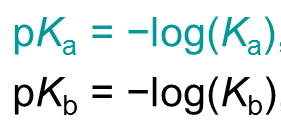
Key Terms and Formulas:
Acid dissociation constant (): $K_a$ for HCN is given.
Base dissociation constant (): $K_b$ for CN- can be found using .
pH and pOH: at 25°C.
Step-by-Step Guidance
Write the hydrolysis equation for CN-: .
Calculate for CN- using ( at 25°C).
Set up an ICE table for the hydrolysis reaction, using the initial concentration of CN- (0.080 M).
Write the expression for and solve for at equilibrium.
Calculate pOH from , then use to find the pH.
Try solving on your own before revealing the answer!
Q3. Determine the ammonia concentration of an aqueous solution that has a pH of 11.00. The equation for the dissociation of NH3 (Kb = 1.8 × 10⁻⁵) is:
NH3(aq) + H2O(l) ⇌ NH4+(aq) + OH-(aq)
Background
Topic: Weak Base Equilibria
This question tests your ability to relate pH, pOH, and base concentration using equilibrium concepts for weak bases.
Key Terms and Formulas:
(base dissociation constant):
pH and pOH:
ICE table for equilibrium calculations
Step-by-Step Guidance
Calculate pOH using .
Find using .
Set up an ICE table for the dissociation of NH3 and express all concentrations in terms of (change in ).
Write the expression and substitute the equilibrium values.
Try solving on your own before revealing the answer!
Q4. What is the pH of a 0.100 M NH3 solution that has Kb = 1.8 × 10⁻⁵?
NH3(aq) + H2O(l) ⇌ NH4+(aq) + OH-(aq)
Background
Topic: Weak Base Equilibria
This question tests your ability to calculate the pH of a weak base solution using equilibrium concepts and .
Key Terms and Formulas:
(base dissociation constant):
ICE table for equilibrium calculations
pOH and pH relationship:
Step-by-Step Guidance
Set up an ICE table for the dissociation of NH3 with an initial concentration of 0.100 M.
Write the expression and substitute the equilibrium values.
Solve for at equilibrium.
Calculate pOH from , then use to find the pH.
Try solving on your own before revealing the answer!
Q5. Calculate the pOH of a nitrous acid solution that contains 3.9 × 10⁻⁸ M H3O+ at 25°C.
Background
Topic: pH and pOH Calculations
This question tests your ability to relate hydronium ion concentration to pOH using the properties of water at 25°C.
Key Terms and Formulas:
(hydronium ion concentration)
at 25°C
Step-by-Step Guidance
Calculate pH using .
Use to solve for pOH.
Try solving on your own before revealing the answer!
Q6. Identify the strongest acid.
Background
Topic: Oxoacid Strength Trends
This question tests your understanding of periodic trends and structure in determining acid strength, especially for oxoacids of the same central atom.
Key Terms and Concepts:
Oxoacid: An acid with hydrogen, oxygen, and another element (the central atom).
Acid strength increases with more oxygen atoms attached to the central atom.
Step-by-Step Guidance
List the formulas for each acid and count the number of oxygen atoms.
Recall that for oxoacids with the same central atom, acid strength increases with more oxygens.
Identify which acid has the most oxygen atoms.
Try solving on your own before revealing the answer!