 Back
Advanced Chemical Bonding: Valence Bond Theory, Hybridization, and Molecular Orbital Theory
Study Guide - Smart Notes
 Tailored notes based on your materials, expanded with key definitions, examples, and context.
Chemical Bonding: Magnetic Properties and Theoretical Models
Magnetic Properties of Molecules
Chemical substances can exhibit different magnetic behaviors based on their electron configurations. These properties are important for understanding molecular structure and reactivity.
Diamagnetic: Substances with all electrons paired; not attracted to a magnetic field.
Paramagnetic: Substances with unpaired electrons; attracted to a magnetic field.
Example: Oxygen (O2) is paramagnetic, even though Lewis theory predicts it should be diamagnetic.



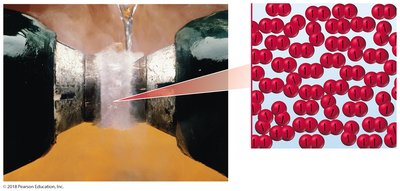
Additional info: Paramagnetism arises from the presence of unpaired electrons, which align with external magnetic fields, while diamagnetic substances are repelled due to paired electrons.
Limitations of Lewis Theory
Problems with Lewis Theory
Lewis theory is foundational for understanding chemical bonding, but it has several limitations:
Does not provide accurate numerical predictions for bond angles, bond strengths, or bond lengths.
Cannot always represent molecules with resonance correctly.
Fails to predict magnetic properties accurately (e.g., O2).
Valence Bond Theory and Orbital Overlap
Orbital Overlap and Chemical Bonding
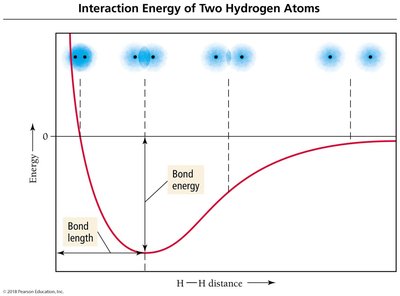
Valence Bond Theory explains chemical bonding as the overlap of atomic orbitals, resulting in the pairing of valence electrons. The geometry of these overlapping orbitals determines the molecular shape.
Bonding can occur between half-filled orbitals (spin-pairing) or between a filled and an empty orbital.
Valence electrons may occupy pure atomic orbitals (s, p, d, f) or hybrid orbitals.
Hybridization of Atomic Orbitals
Concept of Hybridization
Hybridization is the process of mixing different types of atomic orbitals in the valence shell to form new, degenerate orbitals. This explains observed molecular geometries that differ from simple predictions.
Types: sp, sp2, sp3, sp3d, sp3d2
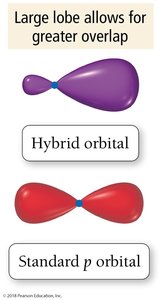
Hybrid orbitals have larger lobes, allowing greater overlap and stronger bonds.
Formation of sp3 Hybrid Orbitals
sp3 hybridization occurs when one s and three p orbitals mix, forming four equivalent orbitals. This is seen in molecules like methane (CH4).
Tetrahedral geometry with bond angles of 109.5°.
All single bonds and lone pairs use hybrid orbitals.
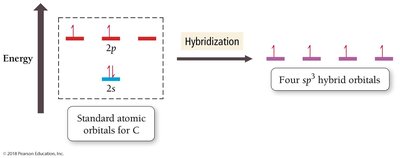
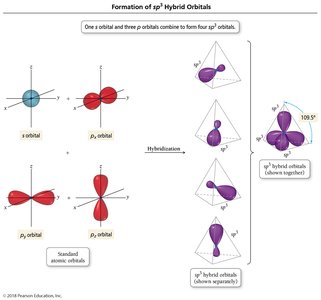
Example: Methane (CH4) has four sp3 hybrid orbitals arranged tetrahedrally.
Formation of sp2 and sp Hybrid Orbitals
Hybridization can also involve fewer p orbitals:
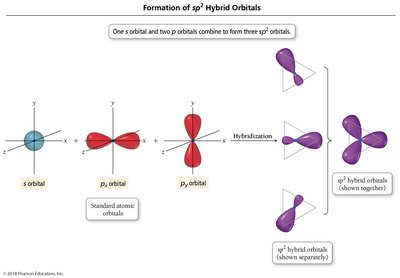
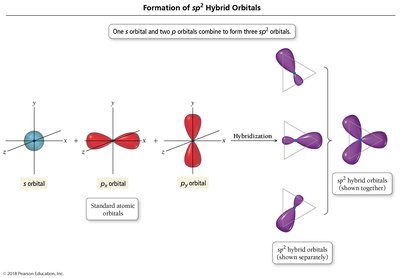
sp2: One s and two p orbitals mix, forming three sp2 orbitals (trigonal planar, 120° angles).
sp: One s and one p orbital mix, forming two sp orbitals (linear, 180° angles).
Example: Ethyne (C2H2) uses sp hybrid orbitals for its triple bond.
Types of Chemical Bonds: Sigma and Pi Bonds
Sigma (σ) and Pi (π) Bonds
Chemical bonds are classified based on the orientation and overlap of atomic orbitals:
Sigma (σ) bond: Formed by direct overlap along the axis connecting two nuclei; stronger than π bonds.
Pi (π) bond: Formed by parallel overlap of unhybridized p orbitals, perpendicular to the bond axis.
σ bonds and lone pairs are considered electron groups; π bonds are not.
Example: In a double bond, one is a σ bond and one is a π bond; in a triple bond, one is σ and two are π.
Molecular Orbital (MO) Theory
Electron Delocalization and MO Formation
Molecular Orbital Theory applies quantum mechanics to molecules, treating electrons as delocalized over the entire molecule. Molecular orbitals are formed by the linear combination of atomic orbitals (LCAO).
The number of molecular orbitals equals the number of atomic orbitals combined.
Orbitals can combine constructively (bonding MO) or destructively (antibonding MO).
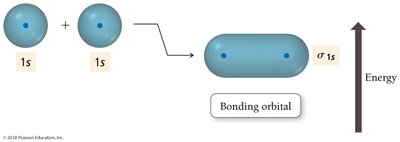
Bonding and Antibonding Molecular Orbitals
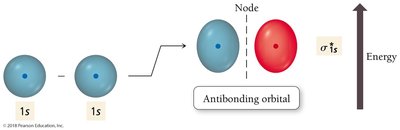
Bonding molecular orbitals have lower energy and greater electron density between nuclei, stabilizing the molecule. Antibonding orbitals have higher energy and electron density outside the internuclear axis, destabilizing the molecule.
Bonding orbitals: σ, π
Antibonding orbitals: σ*, π*
Nodes are regions of zero electron density between nuclei in antibonding orbitals.
Bond Order and Molecular Stability
Bond order is a measure of bond strength and stability, calculated from the number of electrons in bonding and antibonding molecular orbitals:
Bond order formula:
Higher bond order means stronger, shorter bonds.
If bond order = 0, the molecule is unstable and does not exist.
Example: For H2: ; for He2:
Magnetic Properties in MO Theory
MO diagrams can predict magnetic properties:
Paramagnetic: MO diagram has unpaired electrons.
Diamagnetic: All electrons are paired in the MO diagram.
Summary Table: Comparison of Bond Order, Bond Length, Bond Strength, Stability, and Magnetic Properties
Molecule | Bond Order | Bond Length | Bond Strength | Stability | Magnetic Property |
|---|---|---|---|---|---|
C2 | 2 | Short | Strong | Stable | Diamagnetic |
C22+ | 1 | Longer | Weaker | Less stable | Diamagnetic |
O2 | 2 | Short | Strong | Stable | Paramagnetic |
O2- | 1.5 | Longer | Weaker | Less stable | Paramagnetic |
Additional info: Bond order correlates with bond length and strength: higher bond order means shorter and stronger bonds. Magnetic properties depend on electron pairing in molecular orbitals.
