 Back
BackLesson 1.1: Alkanes: Structure, Properties, and Nomenclature
Study Guide - Smart Notes
 Tailored notes based on your materials, expanded with key definitions, examples, and context.
Organic Compounds and Hydrocarbons
Definition and Importance
Organic chemistry is the study of carbon compounds. An organic compound is defined as a molecular compound containing carbon, with the exception of carbon monoxide (CO), carbon dioxide (CO2), and hydrogen cyanide (HCN). Carbon atoms, with four valence electrons, typically form four covalent bonds, often bonding with other carbon atoms to create chains that serve as the backbone for a wide variety of molecules. These carbon-based molecules are essential for life on Earth.
Hydrocarbons are compounds composed only of carbon and hydrogen atoms.
Most fuels, such as natural gas, gasoline, and diesel, are hydrocarbons.
Burning hydrocarbons releases carbon dioxide, contributing to global warming and other environmental issues.

Additional info: The image above shows a racing car being refueled, highlighting the use of hydrocarbons as fuels in transportation.
Alkanes: Saturated Hydrocarbons
Structure and General Formula
An alkane is a saturated hydrocarbon, meaning all bonds between carbon atoms are single covalent bonds. The simplest alkane is methane (CH4), which has a tetrahedral structure. Alkanes can be represented by structural formulas, ball-and-stick models, or space-filling models to illustrate their three-dimensional arrangements.
The general formula for an alkane is .
Alkanes with carbon atoms in a straight chain are called straight-chain alkanes.
Empirical evidence shows that the bond angle between carbon atoms in a chain is 109.5°, resulting in a zigzag configuration.
Cyclic alkanes (cycloalkanes) are hydrocarbons where carbon atoms form a closed ring, with the general formula .
Table: The First Ten Alkanes
Number of C atoms | Name | Molecular formula | Condensed formula |
|---|---|---|---|
1 | methane | CH4 | CH4 |
2 | ethane | C2H6 | CH3CH3 |
3 | propane | C3H8 | CH3CH2CH3 |
4 | butane | C4H10 | CH3(CH2)2CH3 |
5 | pentane | C5H12 | CH3(CH2)3CH3 |
6 | hexane | C6H14 | CH3(CH2)4CH3 |
7 | heptane | C7H16 | CH3(CH2)5CH3 |
8 | octane | C8H18 | CH3(CH2)6CH3 |
9 | nonane | C9H20 | CH3(CH2)7CH3 |
10 | decane | C10H22 | CH3(CH2)8CH3 |
Structural Isomerism and Alkyl Groups
Isomerism and Branching
Alkanes with four or more carbon atoms can form structural isomers, which are compounds with the same molecular formula but different structures. Branches off the main chain are called alkyl groups, named by the number of carbons and the suffix -yl (e.g., methyl, ethyl). A substituent group is any atom or group that replaces a hydrogen atom in an organic compound.
Isomers have different physical and chemical properties, such as boiling points.
Example: Butane (C4H10) and methylpropane are structural isomers.
Naming Alkanes (IUPAC System)
Systematic Nomenclature
The International Union of Pure and Applied Chemistry (IUPAC) provides rules for naming alkanes:
Identify the longest continuous carbon chain (parent chain).
Identify and name all substituent groups attached to the parent chain.
Number the parent chain from the end nearest a substituent to give the lowest possible numbers.
Use prefixes (di-, tri-, tetra-) if the same substituent appears more than once, and indicate each location with a number.
List substituents in alphabetical order, ignoring prefixes, and separate numbers by commas and words by hyphens.
For cyclic alkanes, add the prefix cyclo- to the root name.
Properties and Uses of Alkanes
Physical and Chemical Properties
Alkanes are generally unreactive at room temperature, making them useful as lubricants and structural materials. Their main use is as fuels, where they undergo complete combustion to produce carbon dioxide, water, and energy:
Alkanes are non-polar due to similar electronegativities of carbon and hydrogen, resulting in weak van der Waals forces.
They have low boiling and melting points, which increase with chain length.
Fractional distillation is used to separate alkanes in crude oil based on their boiling points.
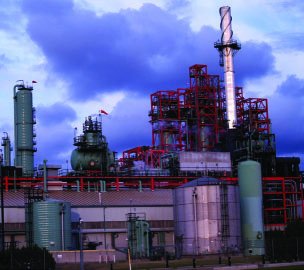
Additional info: The image above shows a fractionation tower, which is used in oil refineries to separate crude oil into its component alkanes by boiling point.
Table: Selected Properties of the First Ten Straight-Chain Alkanes
Name | Formula | Molar mass (g/mol) | Melting point (°C) | Boiling point (°C) | Number of structural isomers |
|---|---|---|---|---|---|
methane | CH4 | 16 | -182 | -162 | 1 |
ethane | C2H6 | 30 | -183 | -89 | 1 |
propane | C3H8 | 44 | -187 | -42 | 1 |
butane | C4H10 | 58 | -138 | 0 | 2 |
pentane | C5H12 | 72 | -130 | 36 | 3 |
hexane | C6H14 | 86 | -95 | 68 | 5 |
heptane | C7H16 | 100 | -91 | 98 | 9 |
octane | C8H18 | 114 | -57 | 126 | 18 |
nonane | C9H20 | 128 | -54 | 151 | 35 |
decane | C10H22 | 142 | -30 | 174 | 75 |
Table: Selected Uses of Alkanes
Length of carbon chain | Uses |
|---|---|
1–4 | Fuels such as natural gas, propane for heating and torches, butane for lighters |
5–12 | Gasoline |
12–18 | Jet fuel |
18–20 | Home heating oil |
20–30 | Lubricating oils |
30–40 | Fuel oils for ships |
40–50 | Waxes and thick oils |
More than 50 | Tars for road surfacing |
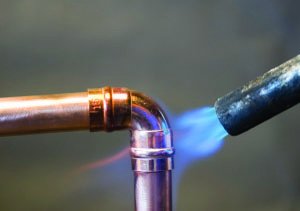
Additional info: The image above shows a propane torch, illustrating the use of alkanes as fuels for tools such as soldering torches.
Alkyl Halides
Definition and Properties
An alkyl halide is an alkane in which one or more hydrogen atoms have been replaced by halogen atoms (e.g., chlorine, fluorine). Alkyl halides are formed by substitution reactions, such as:
Halogen atoms are more electronegative than carbon and hydrogen, making alkyl halides polar and increasing their boiling and melting points compared to the corresponding alkanes. Some alkyl halides, such as chlorofluorocarbons (CFCs), have been used as refrigerants but are being phased out due to environmental concerns.
Summary
Hydrocarbons are compounds of hydrogen and carbon; alkanes are saturated hydrocarbons with only single bonds.
Structural isomers have the same molecular formula but different structures.
Alkanes can be straight-chain, branched, or cyclic.
Alkyl halides are alkanes with halogen substituents, which increase polarity and boiling points.
