 Back
BackAP Chemistry Review: Atomic Structure, Periodic Trends, and Lab Analysis
Study Guide - Smart Notes
 Tailored notes based on your materials, expanded with key definitions, examples, and context.
Atomic Structure and Electron Configuration
Transition Metal Electron Configuration
Transition metals have unique electron configurations due to the relative energies of their s and d orbitals. When forming cations, transition metals lose electrons from the highest principal energy level first, which is typically the s orbital.
Key Point: For Iron (Fe), the ground-state configuration is . To form Fe2+, remove the two 4s electrons, resulting in .
Example: Fe2+ has the configuration .
Additional info: The Aufbau Principle states that electrons fill the lowest energy orbitals first, but when ions are formed, electrons are removed from the highest principal quantum number.
Isoelectronic Series and Atomic Radius
Comparing Atomic Radii in Isoelectronic Series
An isoelectronic series consists of ions or atoms with the same number of electrons. The atomic radius in such a series is determined by the number of protons: more protons mean a stronger pull on electrons, resulting in a smaller radius.
Key Point: In the series (, , , ), all have 18 electrons. Sulfur () has the fewest protons, so its electron cloud is largest.
Example: is larger than , , and .
Additional info: The effective nuclear charge () increases with more protons, shrinking the radius.
Lab Techniques and Error Analysis
Hydrate Analysis and Lab Errors
Hydrate analysis involves heating a sample to remove water and determining the formula based on mass changes. Accurate heating is crucial for correct results.
Key Point: If the sample is not heated to constant mass, water remains, making the calculated value of x (in ) too low.
Key Point: If salt spatters out, the final mass is too low, making the calculated water loss too high.
Example: For , incomplete heating results in underestimated water content.
Additional info: Always heat to constant mass and avoid spattering for accurate hydrate analysis.
Coulomb's Law and Lattice Energy
Lattice Energy in Ionic Compounds
Lattice energy is the energy required to separate an ionic solid into its ions. It is governed by Coulomb's Law: , where and are ion charges and is the distance between ions.
Key Point: Higher charges and smaller ions result in higher lattice energy.
Example: () has higher lattice energy than () due to greater charge and smaller ion size.
Additional info: Lattice energy explains the stability and melting points of ionic compounds.
Stoichiometry and Decomposition Reactions
Calculating Mass Percent from Decomposition
When a solid decomposes and releases a gas, the mass lost corresponds to the gas produced. Use molar ratios from the balanced equation to determine the original amount of solid.
Key Point: The mass lost during heating equals the mass of gas released.
Example: decomposes to and . If of is released, calculate moles and use stoichiometry to find the mass percent of .
Additional info: Always use molar masses and balanced equations for accurate stoichiometric calculations.
Photoelectron Spectroscopy (PES) and Periodic Trends
PES and Binding Energy
Photoelectron Spectroscopy (PES) measures the binding energy of electrons in atoms. Peaks correspond to electron shells; their height shows electron count, and their position shows binding energy.
Key Point: When an atom loses electrons to form a cation, the remaining peaks shift to higher binding energy because the nucleus pulls more strongly on fewer electrons.
Example: lacks the peak, and its remaining peaks shift left compared to .
Additional info: Isoelectronic ions with more protons have higher binding energy for the same electron configuration.
Periodic Properties of the Elements
Trends in Atomic Radius, Ionization Energy, and Electron Affinity
Periodic trends describe how properties change across periods and groups in the periodic table. These include atomic radius, ionization energy, and electron affinity.
Atomic Radius: Increases down a group (more shells), decreases across a period (higher ).
Ionization Energy: Increases across a period (higher ), decreases down a group (more shielding).
Electron Affinity: Increases across a period, decreases down a group.
Metallic Character: Increases down a group and to the left; Nonmetallic Character increases up and to the right.
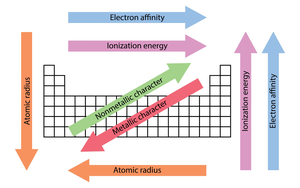
Example: Sodium has a larger atomic radius than chlorine, but chlorine has higher ionization energy and electron affinity.
Additional info: These trends are fundamental for predicting chemical reactivity and bonding.
Moles, Molar Mass, and Mass Spectroscopy
Counting Atoms and Isotopes
The mole () is a counting unit for atoms and molecules. Mass spectroscopy reveals the relative abundance of isotopes, allowing calculation of average atomic mass.
Key Point: Average atomic mass is a weighted average, closer to the most abundant isotope.
Example: Chlorine's average atomic mass is closer to due to its higher abundance.
Additional info: Use mass spectra to determine elemental composition and empirical formulas.
Elemental Composition and Hydrate Formulas
Empirical and Hydrate Formulas
Empirical formulas show the simplest ratio of atoms in a compound. Hydrate analysis determines the number of water molecules in a hydrate by measuring mass loss upon heating.
Key Point: Calculate in by finding moles of water lost and moles of salt.
Example: loses mol water; if , the formula is .
Additional info: Accurate measurements and error analysis are essential for correct empirical and hydrate formulas.
